
How to Get a 5 in AP English: The Real Logic Isn’t Language — It’s Thinking Structure
Many parents hold a common misconception about AP English (both AP Language & Composition and AP Literature):
- ❌ “AP English = vocabulary + writing practice”
- ❌ “Students with strong English will get a 5 easily”
- ❌ “Just read more books and you’ll score high”
But in reality:
AP English = thinking structure + analytical capability.
That’s why: many native English speakers don’t get a 5, while some ESL students do — because what’s being tested isn’t English itself, but the capability to do academic analysis in English.
Start here:
📌 Students & parents → Find an AP English tutor 📌 Tutors → Join Tutriva and support AP English students
1. The Scoring Rubric (Core)
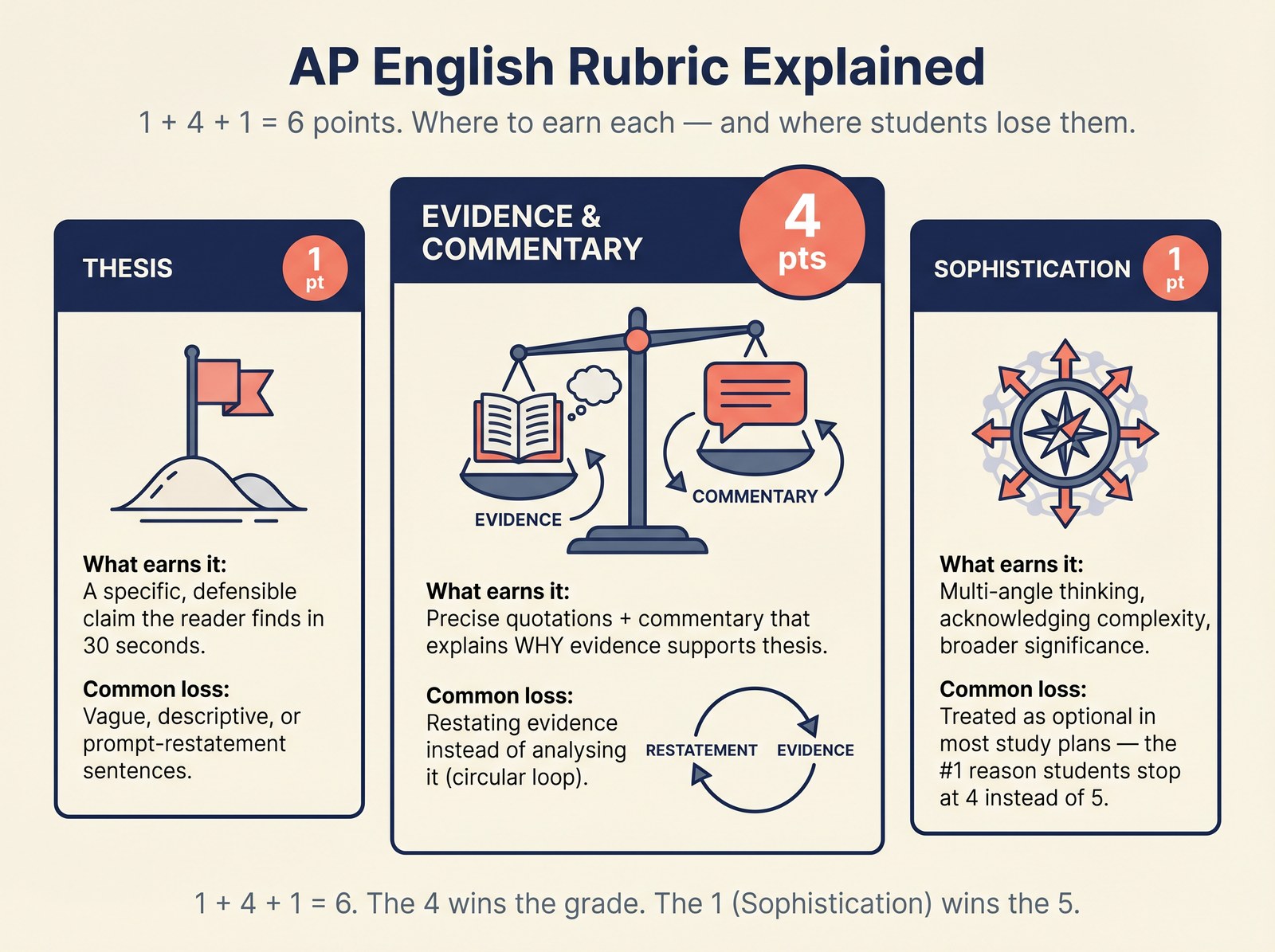
From the College Board AP English rubric (applies to both Lang and Lit):
1.1 Thesis (1 point)
Is the viewpoint clear?
- ✔ One specific, defensible claim
- ❌ Vague, descriptive, or prompt-restatement sentences
Scoring reality: The AP reader must be able to find your thesis in 30 seconds — and that thesis must be defensible (not a filler sentence like “the author uses imagery”).
1.2 Evidence & Commentary (4 points)
Is the analysis real?
- Evidence — precise quotations from the text
- Commentary — the explanation of the evidence (not restatement of it)
This is the biggest point-loss source in AP English. Average student pattern:
“The author uses the word ‘dark.’ This word shows the mood is dark. The mood is dark because the word ‘dark’ is used.”
👉 Circular restatement ≠ commentary.
5-score student pattern:
“The word ‘dark’ echoes the earlier reference to her father’s absence, transforming what initially seemed a literal setting into a psychological projection — the external world taking on the internal state.”
👉 Commentary’s essence = explaining “why this evidence supports your thesis.”
1.3 Sophistication (1 point)
Is there depth?
This is the hardest point. To earn it:
- Multi-angle thinking (seeing both sides)
- Acknowledge complexity (not binary framing)
- Deep meaning / broader significance
5-score sophistication doesn’t come from technique — it comes from real thinking depth.
2. The Core Difference: 5-Score Students vs Average Students
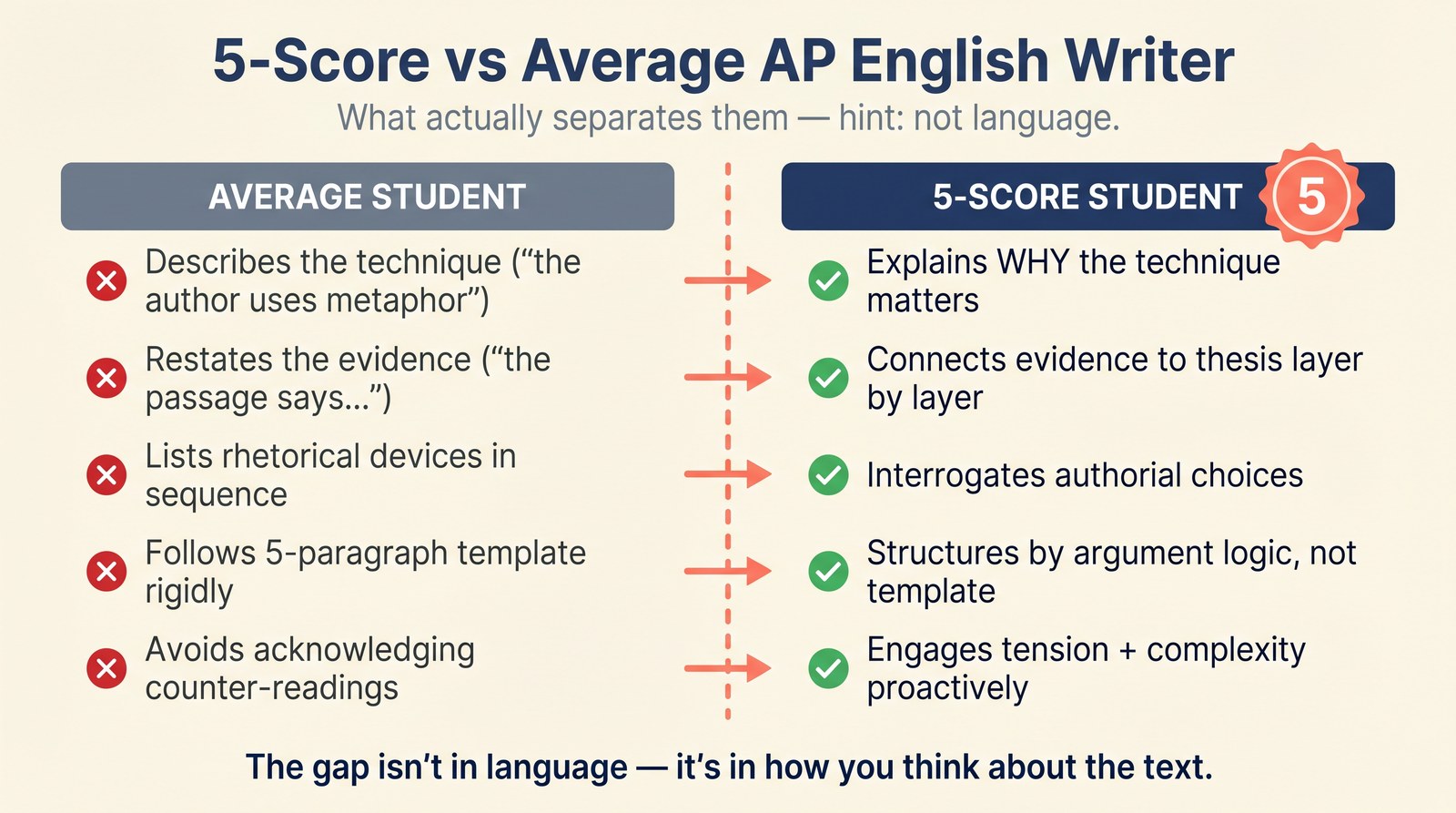
Average student traits:
- ✔ Describe (the author uses metaphor)
- ✔ Restate (the author says that…)
- ✔ List techniques (imagery, alliteration, personification)
5-score student traits:
- ✔ Clear viewpoint (a defensible, specific claim)
- ✔ Deep analysis (connecting evidence to thesis layer by layer)
- ✔ Acknowledge complexity (engaging counter-readings, nuance)
- ✔ Build connections (connecting the text to broader human experience)
👉 The gap isn’t in language — it’s in how the student thinks.
3. The Three Capabilities That Actually Create the Gap
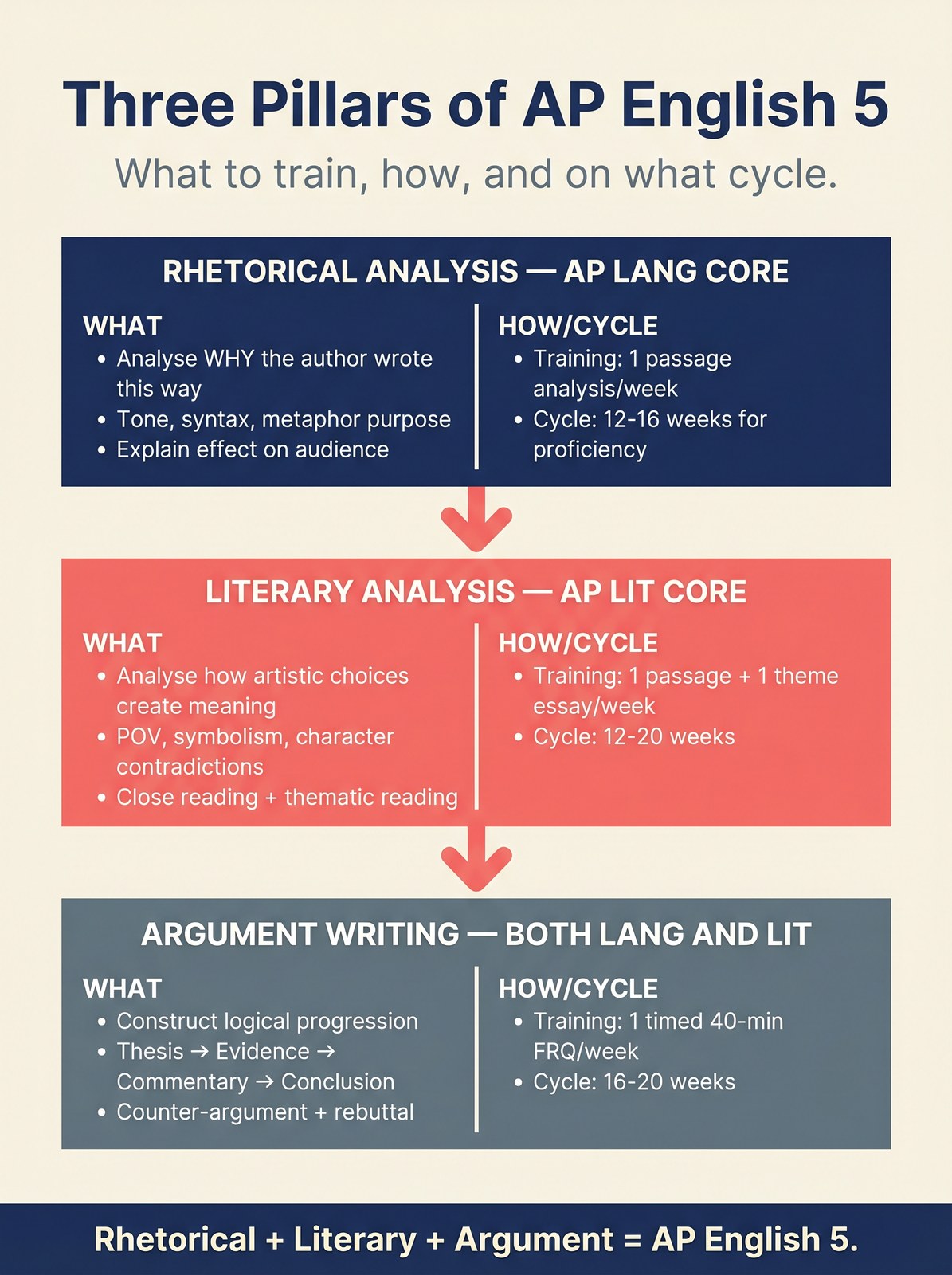
3.1 Rhetorical Analysis (core of AP Lang)
Analysing rhetoric — why did the author write this way?
- Why does tone shift from neutral to ironic?
- Why does syntax suddenly shorten?
- Why did the author choose this particular metaphor?
Training focus: Not identifying rhetoric (“this is a metaphor”), but explaining the effect and purpose (“this metaphor positions the reader as complicit”).
3.2 Literary Analysis (core of AP Lit)
Analysing text — how do the author’s artistic choices create meaning?
- How does POV choice shape reader judgment?
- How do layered symbols build theme?
- How do character contradictions refract thematic tension?
Training focus: Close reading + thematic reading together — see details, but see how details aggregate into theme.
3.3 Argument Writing (both Lang and Lit)
Constructing logic — your essay is a structured argument, not a 5-paragraph essay template.
- Introduction: context + thesis
- Body 1-3: evidence + commentary + transition
- Conclusion: re-assert thesis + broader significance
Training focus: Ensure logical progression between paragraphs (not just “second point,” “third point”).
Mid-article CTA:
📌 Students & parents → Browse AP English / essay writing tutors 📌 Tutors → Join Tutriva and support AP English students
4. The Hardest Layer: Sophistication
This is the final gate most students fail to pass.
Sophistication includes:
4.1 Multi-angle Thinking
Seeing tension and ambiguity — instead of forcing a simple conclusion.
Example: Analysing The Great Gatsby, an average student might write “Gatsby is a tragic hero.” A 5-score student writes “Gatsby is simultaneously tragic and complicit — his ‘dream’ critiques the very system he serves.”
4.2 Acknowledging Complexity
Acknowledge counter-readings. Don’t be afraid of your thesis being challenged — raise counter-arguments proactively in the essay, then respond to them.
4.3 Deep Meaning
Connect the text to broader human experience / historical context / philosophical question.
Not “this book tells a woman’s story,” but “this text interrogates the inevitability of late-19th-century women’s social roles.”
5. Why Many Students Don’t Get a 5
❌ Reason 1: Strong language ≠ strong analysis
Native English speakers often land at 3-4 because “grammar is fine + sentences are pretty” — but they miss the 5 because they lack structured analysis training.
❌ Reason 2: Template-driven writing loses points
The 5-paragraph template (intro thesis + 3 supporting + conclusion) can get you to a 3, but not a 5. 5-score essays are not written by template — they’re written by argument logic.
❌ Reason 3: No close-reading ability
Average students remember “what happened” after finishing the passage. 5-score students remember “what specific choice the author made in this specific sentence.” This is trained, not innate.
❌ Reason 4: No Sophistication practice
Many AP review courses only cover thesis + evidence, and skip Sophistication — because Sophistication is hard to teach. But that 1-point gap is the difference between 5 and 4.
6. The Right Training Pathway
6.1 Deep Reading (long-term)
- Close-read 6-8 classics (AP Lit: Beloved, Hamlet, Invisible Man, The Kite Runner; AP Lang: Into the Wild, In Cold Blood, Between the World and Me)
- Close reading training: pick 3-5 passages per book for sentence-level analysis
- Theme tracking: summarise each book’s theme in one paragraph after finishing
6.2 Analysis Training
- Analyse 1 FRQ sample essay per week (College Board publicly releases 2020-2025 FRQs + sample responses)
- Decompose 5-score sample essays: Which sentence is the thesis? Where is commentary? Where is Sophistication?
6.3 Writing Structure
- Write 1 × 40-minute FRQ per week (match exam pacing)
- Have the tutor mark paragraph-by-paragraph (focus on thesis clarity + commentary depth + Sophistication)
- Review errors: Which sentence is evidence restatement? Which is commentary?
7. What AP English Really Signals
An AP English 5 doesn’t represent “good English” — it represents:
7.1 Academic Voice
You can argue in academic register — not casual “I think” phrasing, but evidence-grounded measured claims.
7.2 Thinking Maturity
You can build a rigorous argument in 40 minutes — this is university-level thinking training.
7.3 University Capability
AP English 5 = directly maps to first-year university English standards. Top 20 universities read an AP English 5 as a hard signal of academic writing capability.
8. Platform Perspective (Tutriva)
On Tutriva, look for:
- ✔ AP English Tutor (AP Lang or AP Lit specialisation, with FRQ grading experience)
- ✔ Essay Writing Tutor (teaches thesis / commentary / Sophistication structure)
- ✔ Critical Reading Tutor (runs close reading training)
Preferred backgrounds:
- Former AP English teacher or College Board reader
- Top-school English / Writing background (UBC / McGill / Harvard / Columbia English Literature)
- Verifiable track record of students scoring AP 5
Avoid:
- ❌ Template-only tutors
- ❌ Tutors who skip Sophistication training
- ❌ Tutors doing only SAT / basic English (that’s a different skill tier)
FAQ
Should I take AP Lang or AP Lit? Typical sequence: AP Lang (Grade 11) → AP Lit (Grade 12). Lang tests nonfiction rhetorical analysis; Lit tests fiction + poetry. If you can only pick one, Lang has broader application (business / STEM applicants also use rhetorical-analysis skills).
How early should we start? Ideal: start close-reading training in the summer before G11. Realistic: starting in early G11 (September), 1-2 sessions per week, through the May exam.
Are templates really unusable? 3-4 level students can use templates — they ensure thesis clarity and structural completeness. But for a 5, you must move beyond templates, adjusting argumentation strategy per each prompt’s uniqueness.
What does it cost? Specialist AP English tutors typically charge $60-$150 per hour. Former AP readers or Ivy-League English backgrounds may charge more. Tutriva takes zero commission — 100% goes to the tutor.
Do Chinese-speaking families need a bilingual AP English tutor? Not recommended. AP English’s core training is English thinking + analysis — bilingual instruction slows this down. Students new to AP English can use bilingual delivery for the first 3-4 sessions as transition, then must switch to full English.
Can online tutors do close reading? Yes, with an advantage. Screen-share PDF + real-time annotation + recorded replay is clearer than an in-person whiteboard. Most AP English tutors on Tutriva support online delivery.
Final CTA:
On Tutriva, filter for AP English tutor — find someone who teaches Thesis + Commentary + Sophistication, not templates.
AP English tutors are in very high demand.
📌 Students & parents → Find an AP English tutor 📌 Tutors → AP English tutors are in very high demand on Tutriva — if you specialise in Rhetorical / Literary Analysis or Essay Writing, join Tutriva.