How to Find Strong SAT Math and AP Science Tutors in Vancouver (2026 Guide)
A good SAT Math or AP Science tutor does something that isn’t obvious on paper. They don’t just “know the content” — they know the test, they know how your child learns, and they know which of the two things currently matters more. In a year when the Digital SAT has fully replaced paper testing, when the College Board is tightening AP exam rigour in Physics 1, Chemistry, and Calculus BC, and when admissions offices are reading Grade 12 transcripts with renewed skepticism, that difference decides outcomes.
This guide is written for Vancouver, Richmond, North Shore, West Vancouver, and Lower Mainland parents of Grade 10–12 students. It is not a ranking of tutoring companies. Tutriva is a marketplace — we introduce families directly to independent tutors, take zero commission on sessions, and charge one flat monthly membership instead. Our interest is that you find the right tutor, not that you book the most hours.
Below: the four non-obvious signals that separate a high-score-producing tutor from an average one, the six technical questions to ask in the first 20 minutes of any intro call, a concise map of the 2024–2026 Digital SAT changes, and subject-specific notes on AP Physics, AP Chemistry, AP Biology, AP Calculus, and IB HL Mathematics.
The Four Non-Obvious Signals of a Strong Test-Prep Tutor
Most families interview tutors on the obvious axes: credentials (UBC / SFU / Ivy), past scores (98+ on SAT Math, 5 on AP Physics 1), and availability. Those matter. But they don’t distinguish the top 10% of tutors from the top 40%. Here are the four signals that do.
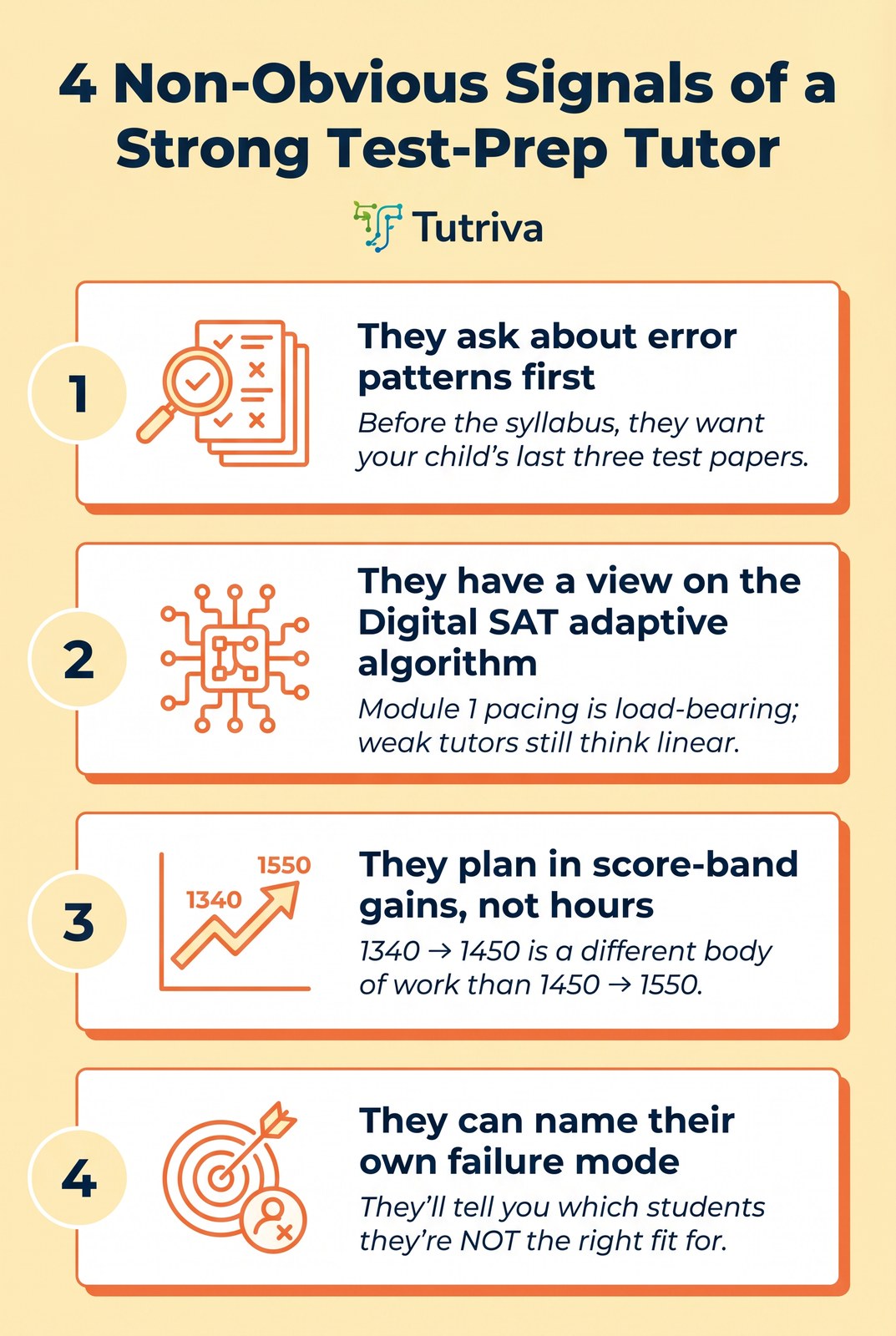
1. They talk about the student’s error patterns before they talk about the syllabus.
A strong tutor’s very first conversation isn’t “here’s my plan.” It’s “can you send me your child’s last three test papers?” They want to see which questions the student lost points on and why. An average tutor follows a fixed curriculum. A strong one builds the curriculum around the error pattern, because the SAT Math score improvement from 680 to 760 is almost entirely about pattern recognition, not new content.
Concrete test during an intro call: ask the tutor “Given an 680 SAT Math student, where do most of the missing 80 points come from?” A strong tutor answers specifically (algebraic manipulation under time pressure, word-problem translation, quadratic structure). A weak one answers generically (“we’ll practice more questions”).
2. They have a point of view on the Digital SAT’s adaptive algorithm.
Since March 2024, the SAT has been fully digital in international markets and from August 2024 across the US and Canada. The Digital SAT is adaptive across modules: the difficulty of the second Math module depends on performance in the first. This changes strategy materially — a student who rushes Module 1 to “save time” may land themselves in the easier Module 2 and cap their maximum score.
A strong tutor will explain, unprompted, how the adaptive structure affects pacing and mistake tolerance in Module 1. A weaker tutor still talks about the SAT as if it were a linear paper test.
3. They plan in score-band gains, not just hours.
“40 hours of tutoring” is a service, not an outcome. A strong tutor says something like: “From your child’s baseline of 1340 composite, the realistic 12-week target is 1450–1480, and here’s what we prioritize to get there.” They understand that 1340 → 1450 is a different body of work than 1450 → 1550, and that the latter is mostly about the last 10 hardest questions across two modules.
If a tutor quotes you a flat package (“$2,400 for 20 hours”) without a band target attached, that’s not necessarily a deal-breaker, but you should ask: “Given my child’s starting point, what score band do you typically move students into, and in how many weeks?”
4. They have a clear subject-specific failure mode.
The strongest AP Physics tutors will tell you — before you ask — which type of student struggles with them. (“I’m great for students who already have algebra fluency but need the physics intuition. I’m less effective for students still shaky on solving two-variable systems; they need to build that first.”) The strongest IB HL Math tutors similarly specify their sweet spot (Analysis & Approaches vs. Applications & Interpretation; Paper 3 investigations vs. Papers 1–2 technical depth).
This level of self-knowledge indicates the tutor has taught enough students to see the pattern, and is honest enough to recommend against themselves when the fit isn’t right. In Tutriva’s experience introducing families to tutors, this is the single best predictor of long-term student progress.
Six Technical Questions to Ask in the First Intro Call
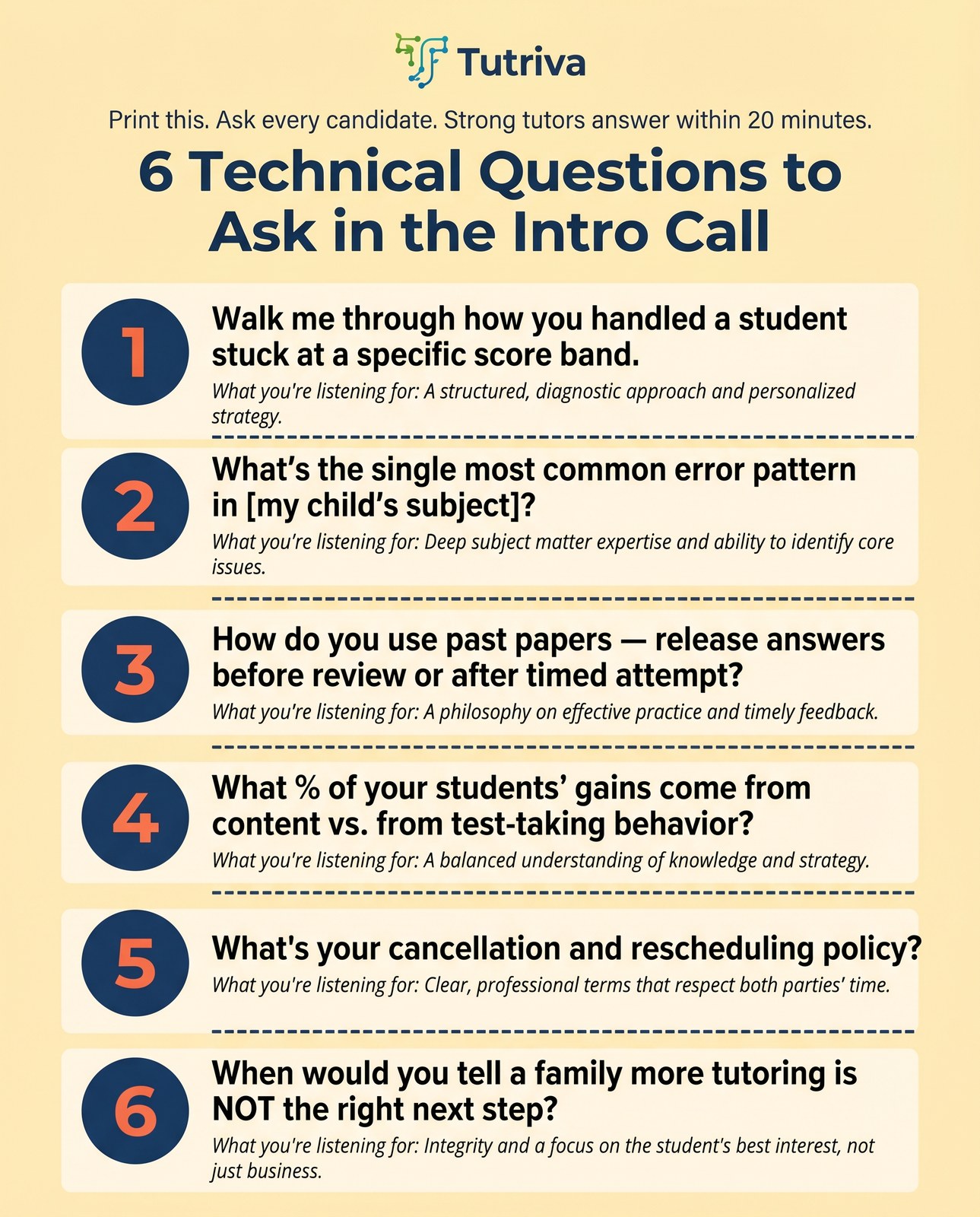
Tutriva intro calls are 15 minutes and free. Use them well. In a single call you can compress a tutor’s credentials, teaching philosophy, and subject depth if you steer with specific questions. Here are six to ask — in this order:
Q1. “Walk me through how you handled a student who was stuck at a specific score band.” Listen for a specific number and a specific intervention. Generic answers (“I helped her improve her fundamentals”) are a flag.
Q2. “What’s the single most common error pattern in [my child’s subject] at [my child’s level]?” For Grade 11 SAT Math, strong tutors often point to misreading of units, sign errors in algebraic rearrangement, or misapplication of quadratic vs. exponential growth. For AP Physics 1, it’s often free-body-diagram completeness or Newton’s third-law pair confusion. Specificity matters.
Q3. “How do you use past papers — do you release answers before review, or after the student attempts timed?” The correct answer is almost always “after timed attempt.” If the tutor gives students solutions during the attempt, they’re removing the diagnostic value of the practice.
Q4. “What percentage of your students’ score gains come from content versus from test-taking behaviour?” A strong tutor gives you a ratio and explains it. Above the 1400 SAT band, 60–70% of gains typically come from behaviour (pacing, question-selection strategy, mental stamina). Below 1200, it’s usually the opposite. A tutor who doesn’t know this distinction is guessing.
Q5. “What’s your cancellation and rescheduling policy?” Not glamorous, but operationally crucial for Grade 12 students juggling mock exams, extracurriculars, and college application deadlines. Tutriva tutors set their own policies — you negotiate directly.
Q6. “When would you tell a family that more tutoring is not the right next step?” This is the trust question. A strong tutor has a clear answer: when the student is ready to self-practice, when a burnout signal is showing, or when the bottleneck has shifted from content to sleep/stress. A tutor who can’t imagine ever saying “you don’t need more sessions” is not optimizing for your child.
The Digital SAT 2024–2026 at a Glance
If the last time you looked at SAT structure was for an older sibling pre-2024, a short update:
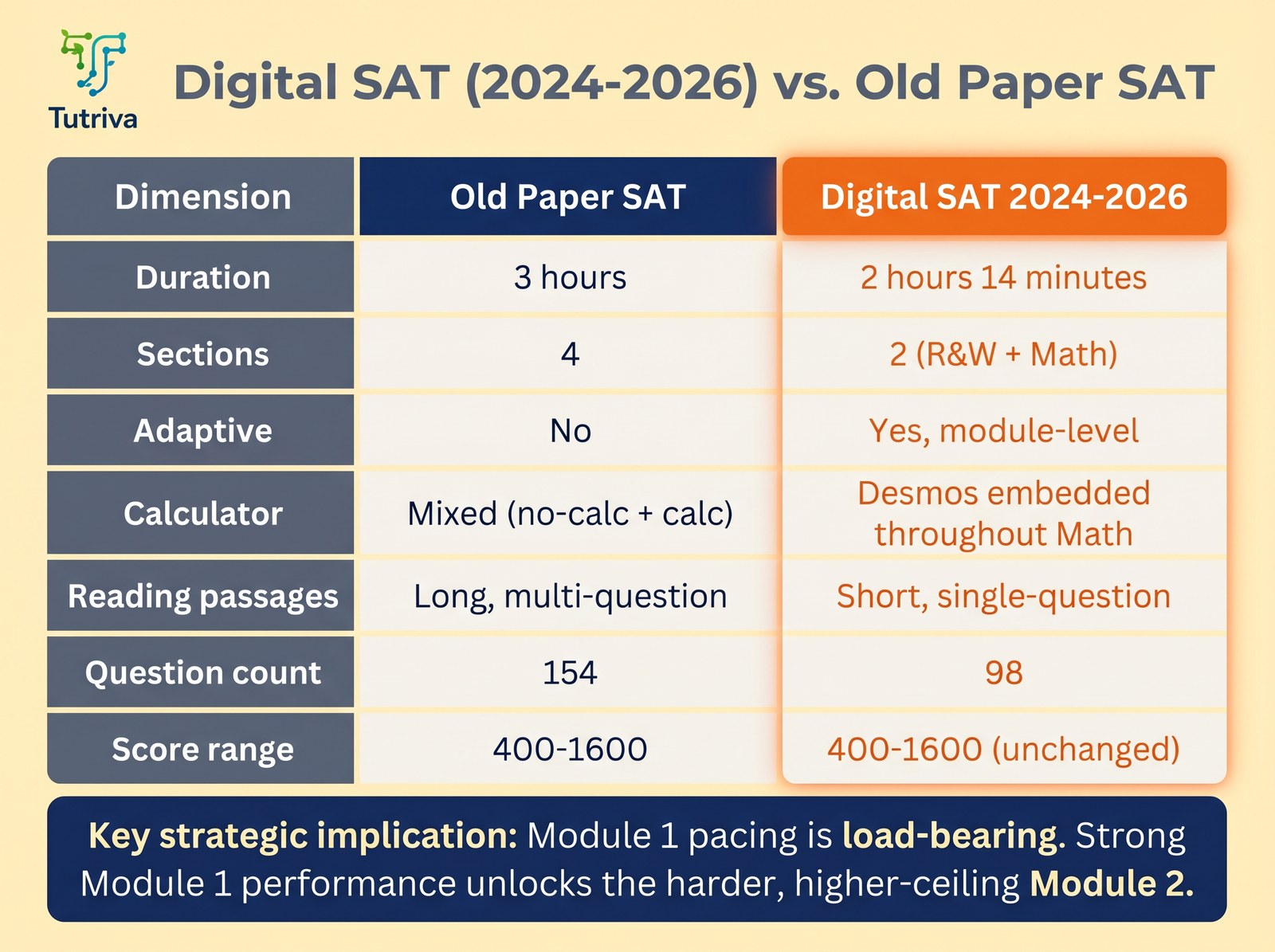
| Dimension | Old paper SAT | Digital SAT (2024–2026) |
|---|---|---|
| Duration | 3 hours | 2 hours 14 minutes |
| Sections | 4 | 2 (Reading & Writing, Math) |
| Adaptive | No | Yes, at module level |
| Calculator | Math no-calc + calc sections | Calculator allowed throughout Math; Desmos embedded |
| Reading passages | Long, multi-question | Short, single-question |
| Question count | 154 | 98 |
| Score range | 400–1600 | 400–1600 (unchanged) |
Key strategic implications for Grade 11–12 students in 2026:
- Desmos in Math is not optional — it’s a skill. Students who practise with Desmos (graphing, table, regression) gain 30–80 points on Math. Tutors should know this tool inside out.
- Module 1 pacing is load-bearing. Strong Module 1 performance unlocks the harder (higher-ceiling) Module 2. This is the single most common strategy miss Tutriva sees in Vancouver families.
- Reading & Writing rewards density, not stamina. Short passages mean every sentence matters. Speed-reading techniques from the paper-SAT era are counterproductive.
- The question bank is tighter. 98 questions, fewer “throw-away” problems. Every question has weight.
AP Science and Math: Subject-by-Subject Notes for Vancouver Families
BC’s high school calendar doesn’t line up with the US AP calendar perfectly. In Vancouver, students typically take AP courses through private schools (Mulgrave, Stratford Hall, WPGA, SMUS, Crofton House), as enrichment outside public school, or as self-study candidates. Here’s what parents need to know in 2026:
AP Physics 1 & 2
The 2024 AP Physics 1 redesign added a stronger emphasis on experimental design and representation translation (from graphs to equations to diagrams and back). Strong tutors for Physics 1 and 2 will explicitly practice “translate a verbal scenario into a free-body diagram in under 30 seconds.” If a tutor only drills equation manipulation, they’re preparing your child for a 4, not a 5.
For Mandarin-speaking families in Richmond and West Vancouver, bilingual AP Physics tutors are increasingly in demand — the instinct for physical intuition often develops faster in a student’s primary thinking language, even if the exam is in English.
AP Chemistry
The 5-rate (top-score) path in AP Chem runs through equilibrium, thermodynamics, and reaction-mechanism reasoning. A strong Vancouver tutor will have a specific approach to the free-response section’s lab-design questions, which is where most 4 → 5 gains come from.
AP Biology
The content volume is enormous. A strong Bio tutor’s value is in prioritization — which topics repeat in the exam, which are tested lightly, how to use the formula sheet. Rote memorization is the wrong goal; conceptual connection across cells, genetics, evolution, and ecosystems is the right one.
AP Calculus AB / BC
Calc BC’s Series unit is the traditional 5-score gatekeeper. A strong tutor will pre-assess your child’s algebraic fluency before touching Calculus topics — because students who struggle with Calculus almost always struggle with the underlying algebra/trigonometry, not the new Calc concepts.
IB HL Mathematics
For IB families at Mulgrave, Stratford Hall, and Pearson, HL Math (Analysis & Approaches in particular) requires a tutor comfortable with Paper 3 Investigation questions. These are open-ended, multi-part problems weighted heavily on method, not just final answer. A strong IB HL tutor will show you graded sample Paper 3 responses in the intro call.
Edexcel IGCSE / GCSE Math 1MA1 Higher (for UK-track families)
A subset of Vancouver families — those at Collingwood’s international stream, those planning UK university pathways (Oxford, Cambridge, LSE, Imperial), and some returning-international families — prepare for the Edexcel Level 1/Level 2 GCSE (9–1) in Mathematics 1MA1 Higher Tier rather than the BC provincial pathway.
1MA1 Higher is three papers of 80 marks and 1 hour 30 minutes each. Paper 1 is non-calculator (number fluency, algebraic manipulation, graph interpretation); Papers 2 and 3 allow calculators (trigonometry, statistics, probability, functions, coordinate geometry). 2025 high-leverage topics included prime factorisation with HCF/LCM, standard form, quadratic solving with graph sketching, the sine and cosine rules applied to non-right triangles, circle theorems, cumulative frequency and histograms, conditional probability via tree and Venn diagrams, and function notation f(x) with inverse and intersection finding.
2026 predictions for 1MA1 Higher: function transformations combined with graph interpretation; mixed geometry blending ratio and trigonometry; comparative multi-dataset interpretation; multi-stage probability in real-world context; piecewise-function introductions. Edexcel’s marking scheme rewards Procedural Fluency (show-your-working), Mathematical Reasoning (condition → relation → solve → interpret), and Communication of Reasoning — a tutor who drills answers only, without the expressed reasoning chain, costs the student method marks.
On Tutriva, filter by “Edexcel GCSE Math” or “IGCSE Math” + “Higher Tier” to find tutors who have guided 2025-cycle students. Ask specifically about Paper 3 experience — it is the most open-ended of the three.
The 2025 Evidence: What Strong Tutors See in Real Papers
The observations in this section come from Tutriva-adjacent tutors who guided students through the 2025 exam cycle and debriefed against the official 2025 papers — SAT, AP Calculus BC, AP Statistics, and Edexcel GCSE Mathematics 1MA1 Higher. These are the patterns that separate a grade 4 from a 5, a 1450 from a 1550, and a grade 8 from a grade 9. Parents using this article as an interview brief should feel free to reference these specifics by name.
SAT Math — how a 540 → 750+ jump actually works
One well-documented 2025-cycle path: a Grade 11 student scoring roughly 540 on a diagnostic full-length, reaching 730–750+ within four months. The trajectory was not “more questions.” It was structural.
SAT Math is not a list of topics. Experienced tutors treat it as a 5-board system with roughly 40–45 teaching units:
- Algebra & Linear Models — reading word problems, translating semantics into variable relationships, distinguishing initial value from rate of change.
- Quadratics & Functions — completing the square, vertex form, graph-table integration, function transformations.
- Exponents & Nonlinear Models — spotting multiplicative growth versus additive; never writing an exponential as a linear increment.
- Geometry — angle relationships decided by rule (vertical, alternate-interior, supplementary) rather than by looking at the diagram.
- Data Analysis & Probability — scatter plots and best-fit trends judged on the whole distribution, not a single outlier; sample-space denominators chosen carefully.
Each of the 40–45 units should run a full training loop: concept → standard-level drill → hard/variant drill → trap drill. A student who “has done that topic” but has not done the trap-drill is unlikely to hold the gain under exam pressure.
Where 540-band students most often lose points in the 2025 cycle:
- Misreading linear-model word problems (treating the initial value as the rate of change)
- Comparing two linear models only by numeric output without interpreting slope as rate
- Writing an exponential model as linear (additive increments instead of multiplicative factors)
- Angle questions decided by visual intuition instead of a named rule
- Letting a single outlier dictate the scatter-plot trend
- Probability questions with the wrong denominator (ignoring the “randomly chosen” premise)
The 540 → 750 progression runs in three phases across four months: structure-build (months 1–2, cover all five boards with a model-recognition focus), cross-module integration (month 3, mixed-type problems where the student has to identify which model to invoke), and stabilisation (month 4, full-length timed mocks treated as diagnosis, not verdict).
What to ask your SAT tutor: “If my child is at 540, which of the five boards do you cover first — and why?” A strong tutor has a specific sequencing opinion. A weaker one defers to “we’ll see.”
AP Calculus BC — where Vancouver students lose points on 2025 FRQs
The 2025 AP Calculus BC Free-Response papers tested three layers simultaneously: Conceptual Understanding, Procedural Fluency, and Reasoning & Interpretation. The 2025 spine was Integral Calculus + Modeling + Representation.
Stable point-earners — strong tutors insist on no losses here:
- Accumulation & Average Value — definite integrals set up correctly with units labelled, the initial value retained, and interval-length division applied for averages.
- Basic derivative interpretation via the signs of f′ and f″, including the Mean Value Theorem with explicit continuity + differentiability verification.
- Linearisation — L(t) written explicitly, with the sign of f″ used to justify over- or underestimate direction.
High-loss modules — the real 4 vs. 5 decider:
- Piecewise accumulation. The integral itself is easy; identifying the correct intervals, splicing the function, and confirming continuity via limits is where points disappear.
- Polar area. A = ½ ∫ r² dθ. Students forget the ½, forget to square r, or mis-set the interval.
- Accumulation from a velocity graph. Position = integral of velocity plus the initial position. Confusing displacement with total distance is the classic trap.
- Power series and approximation. The BC-specific differentiator. Reporting the radius of convergence without the full interval (endpoint checks missed); misstating alternating-series error bounds as the next term’s signed value instead of its absolute value.
The 2026 prediction: series remain central and are increasingly combined with approximation + error bounds in applied context. A strong AP Calc BC tutor drills these specific high-loss modules as named units — not as “end-of-textbook material.”
What to ask your AP Calc BC tutor: “On a 2025 FRQ, where do your students most often lose the last two points?” Expect: series endpoints, polar area half-coefficient, piecewise continuity. Generic answers are a signal.
AP Statistics — the MCQ-vs-FRQ scoring math
AP Statistics is weighted 50/50 between Multiple-Choice (MCQ) and Free-Response (FRQ), but the scoring math is asymmetric in practice:
- MCQ holds the floor. Read-computer-output fluency, sampling-vs.-assignment distinctions, and confidence-interval interpretation are the repeat offenders. Target 35+ out of 40. No partial credit, so accuracy and speed dominate.
- FRQ decides 4 vs. 5. The scoring rubrics are literal — the scoring points are the language: state, calculate, justify, in context, conditions. Students who treat FRQs as computation problems underperform; students who treat them as structured writing tasks earn full credit.
The 2025 six-FRQ layout, which will largely recur in 2026:
- FRQ 1 — distribution comparison (boxplot / histogram). Must compare center, spread, shape, outliers in statistical language. “Country A is bigger than Country B” without “median / IQR” does not earn credit.
- FRQ 2 — sampling design and bias. Must name the bias source and the direction of error in context.
- FRQ 3 — Binomial / Geometric modelling + expected value. Must write X ~ Binomial(n, p) explicitly, not just the numeric answer. Common trap: “with replacement” mis-read as “without replacement.”
- FRQ 4 — one-sample inference (usually a z-test for a proportion). Most-missed point across students: failing to verify all three conditions (random, 10% independence, large counts).
- FRQ 5 — multi-focus: discrete distribution + t-test + Type I error + CI / hypothesis-test correspondence. “A 97% CI corresponds to α = 0.03 for a two-sided test” is a mechanical drill — students who have not done it lose points.
- FRQ 6 — Investigative Task. Two-sample inference with scope-of-inference reasoning. The 2025 paper explicitly tested nondefinitive language (“evidence suggests,” not “proves”) and the random assignment (causal) vs. random sampling (generalisation) distinction.
What to ask your AP Stats tutor: “Give me a student who lost three points on FRQ 4 in 2025 — what did they miss?” The answer should be specific: “They computed the statistic correctly but didn’t state H₀ / Hₐ in context,” or “They skipped the 10% independence check.” Generic answers (“they didn’t study enough”) are a flag.
The shared 16-week, 4-phase training model
A pattern shared by Tutriva-adjacent tutors across SAT, AP Calc BC, AP Statistics, and Edexcel GCSE coaching is a 16-week, 4-phase training structure. It is not a slogan; it is how the best tutors sequence a preparation cycle.
Phase 1 (weeks 1–4) — Foundation Accuracy. Daily micro-drills on the mechanics: arithmetic fluency, algebraic manipulation, standard-form notation, derivative / integral technique, rubric language — depending on the exam. Accuracy first, speed later. No full-length mocks yet.
Phase 2 (weeks 5–8) — Integration & Application. Multi-step contextual problems that chain Phase 1 skills together. Two to three medium-length mock sections per week. Parents should start seeing model-recognition improve, not just raw score.
Phase 3 (weeks 9–12) — Higher Reasoning. The differentiator phase. For SAT, pacing strategy and the last 10 hardest questions. For AP Calc BC, polar area, piecewise accumulation, and series convergence intervals. For AP Statistics, Investigative Task writing and scope of inference. For GCSE, Paper 3 functional reasoning and comparative data interpretation.
Phase 4 (weeks 13–16) — Full Timed Simulation. One complete mock per week. Every wrong answer classified into one of four buckets: concept, procedure, expression, calculation — because the remediation for each is different. This classification is what most self-taught students skip, and why their plateau starts at the exact point where structured coaching would compound.
When interviewing a Tutriva tutor, ask how they would allocate the 16 weeks for your child specifically. A tutor who can sketch a four-phase plan with named focus areas per phase is operating at the level of the best 2025-cycle teachers. A tutor who hand-waves (“we’ll go week by week”) is running ad-hoc sessions.
Where Tutriva Helps: The Marketplace Fit for Premium Test Prep
Tutriva is not a test-prep franchise. We don’t have a curriculum, a pacing book, or an institutional brand voice telling students to “trust the process.” Instead, Tutriva is the infrastructure that makes high-quality independent tutors findable and bookable without the per-session markup that traditional agencies add.
For SAT and AP families, this plays out in four ways:
- Zero commission on tutor pay. If your tutor charges $110/hour, you pay $110/hour. Tutriva takes $0 of that. Our revenue comes from the flat monthly family membership, not from a percentage of session cost. Top Vancouver test-prep tutors typically price in the $85–$180/hour range; on per-session commission platforms, families effectively pay 15–25% on top.
- Direct tutor–student connection. After intro, you have the tutor’s phone and email. Reschedule around mock exams and college deadlines in real time — no ticketing queue.
- Multilingual talent pool. Mandarin- and Cantonese-speaking SAT Math specialists are searchable as a filter, not as an afterthought. For Richmond, West Van, Burnaby, and Coquitlam families where the at-home thinking language is Chinese, this matters for the specific kinds of physics and math intuition that develop best in a first language.
- Same account, every subject. The tutor introduction fee is zero, and the family membership covers unlimited introductions. If your child needs SAT Math in April, AP Chemistry in May, and IB HL Math in August, all three run under a single Tutriva account — with three different tutors if that’s the right fit.
Five-Step Process for Choosing Your Grade 11–12 Test-Prep Tutor
Step 1: Diagnose the starting point. Collect your child’s most recent practice-test scores (full-length and timed) and the last three class assessments. If you don’t have these, commission a diagnostic test first — Tutriva tutors can administer one in a 1.5-hour session.
Step 2: Define the target and the timeline. Be specific. “1480 composite by September 2026” is usable. “Good SAT score” is not. Work backward from college application deadlines (most Canadian and US selective schools are November 1 Early Action or January 1 Regular).
Step 3: Shortlist 3–5 tutors on Tutriva. Filter by subject, city, language, and rate range. Read the tutor’s answers to the Tutriva profile questions, not just the credentials.
Step 4: Interview with the six-question list. Use the call for signal, not small talk. At the end of the call, have the tutor draft a one-paragraph “starting plan” based on what they heard.
Step 5: Book in 4-week blocks with a built-in checkpoint. At the end of each 4-week block, run a full-length timed practice test. Compare score band progression against the tutor’s stated target. If the band isn’t moving, change tutors — and because Tutriva doesn’t take per-session commission, you pay no switching penalty.
Founding-Period Policy for Senior-Year Families (Class of 2027 and 2028)
Families with a Grade 11 or Grade 12 student joining Tutriva before July 31, 2026 qualify for the founding-rate family membership, locked in through the 2026–2027 academic year. Because senior-year workload spikes between September and December, the stability of the same membership price across summer SAT prep, fall AP review, and winter IB mocks is designed to be predictable for families planning a heavy schedule.
The zero-commission structure never sunsets — that’s a platform principle, not a promotional discount.
Frequently Asked Questions
Is SAT tutoring still worth it given test-optional admissions? For Canadian universities, test-optional rarely applies. For US schools, the market has quietly shifted back toward test-informed reading of applications in 2025–2026. If your target list includes any US school, SAT score is load-bearing. Even where optional, a submitted score above the published 75th percentile is still a measurable admissions advantage.
How many hours of tutoring does a typical SAT score jump require? Industry norms: 1340 → 1450 takes roughly 30–40 hours of guided prep plus equivalent self-study. 1450 → 1550 takes 40–60. 1550+ is diminishing returns and often better served by extensive self-practice than paid hours.
Can a single tutor teach both SAT Math and AP Calculus? Sometimes. But the two tests are different enough that many top tutors specialize in one. Ask specifically in the intro: “Which of the two do you spend more of your teaching hours on?”
What is Mandarin-speaking AP tutoring actually like? The session is conducted primarily in the student’s strongest thinking language, with English content (vocabulary, equations, exam-standard phrasing) woven in. The goal is to build physics or chemistry intuition faster by reducing translation overhead, then transition to English-only rehearsal 4–6 weeks before the exam. Not every student needs this, but for recent immigrants and international students at private schools, it reliably accelerates progress.
Can my child prep for Digital SAT using paper materials? Only partially. The Math sections require Desmos fluency, which can’t be drilled on paper. Tutriva tutors specializing in Digital SAT use Bluebook (the official College Board app) plus Khan Academy’s Official Digital SAT Practice.
How do I tell if my tutor is actually working on the right weaknesses? Ask for a weekly one-paragraph summary: “What did we work on, what improved, what’s the next focus.” Any strong tutor provides this without prompting. If you have to request it, the tutor’s own teaching self-reflection may not be where you need it.
What if my child has anxiety about the test itself? Content tutoring alone won’t fix test anxiety. Look for tutors who explicitly mention exam-simulation practice in their profile, or combine tutoring with short sessions focused on pacing and breathing under timed conditions. Tutriva has a growing roster of tutors whose background overlaps education and sport psychology.
Does Tutriva vet tutors’ actual SAT/AP scores? Tutriva verifies identity and education credentials. Score claims are the tutor’s own disclosure on their profile. We recommend asking for a screenshot of an official score report during the intro call — any serious test-prep tutor is ready to provide this.
Is online tutoring as effective as in-person for SAT Math and AP Physics? For Digital SAT prep, online is often more effective (same platform as the exam). For AP Physics and Chemistry lab-design questions, in-person can be marginally better for diagramming, but a well-equipped tutor with a document camera bridges the gap.
What if we need both IB HL Math and SAT prep simultaneously? Common for IB families targeting US schools. Tutriva lets you book two tutors under one family membership. Many parents schedule IB Math on weekday evenings and SAT Math on weekends.
Is SAT Math or AP Calculus BC harder for a BC student? Different skill sets. SAT Math tests broad speed across a five-board system of 40–45 units — pattern recognition under a clock. AP Calculus BC tests conceptual depth plus procedural stamina — especially in series convergence, polar area, and piecewise accumulation, where 2025 FRQs dispensed most of the 4-vs-5 delta. If your child is strong on sustained technical reasoning but slower at mixed-topic speed, BC can actually feel more manageable than SAT; if the opposite, SAT is the friendlier exam.
My child is on the UK / Edexcel IGCSE or GCSE track, not the BC curriculum. Can Tutriva help? Yes. Filter tutors by “Edexcel GCSE Math” or “IGCSE Math” and choose Higher Tier. Ask about Paper 3 experience in the intro — Paper 3 is the most open-ended of the three and where strong tutors are separated from generalists. For families planning UK university applications (Oxford, Cambridge, LSE, Imperial, UCL), also ask whether the tutor is familiar with admissions tests like MAT, STEP, and TMUA, which are handled as separate tracks on Tutriva.
Start with a Free Intro Call
If you have a Grade 11 or 12 student targeting selective admissions in the 2026–2028 cycle, the first move is a free intro call with a SAT Math or AP Science specialist on Tutriva.
Start a Free Intro with a SAT Math Specialist →
Browse AP Science Tutors by Subject →
Related reading on the Tutriva Blog:
- What Can You Teach on Tutriva? From SAT Math to Summer Enrichment
- Math Tutor in Vancouver: Find the Right Match on Tutriva
- How to Join Tutriva as a Tutor in BC: Academic, Summer, and Flexible Opportunities
- Beyond Summer Camps: Flexible Learning and Enrichment Tutors for Vancouver Families