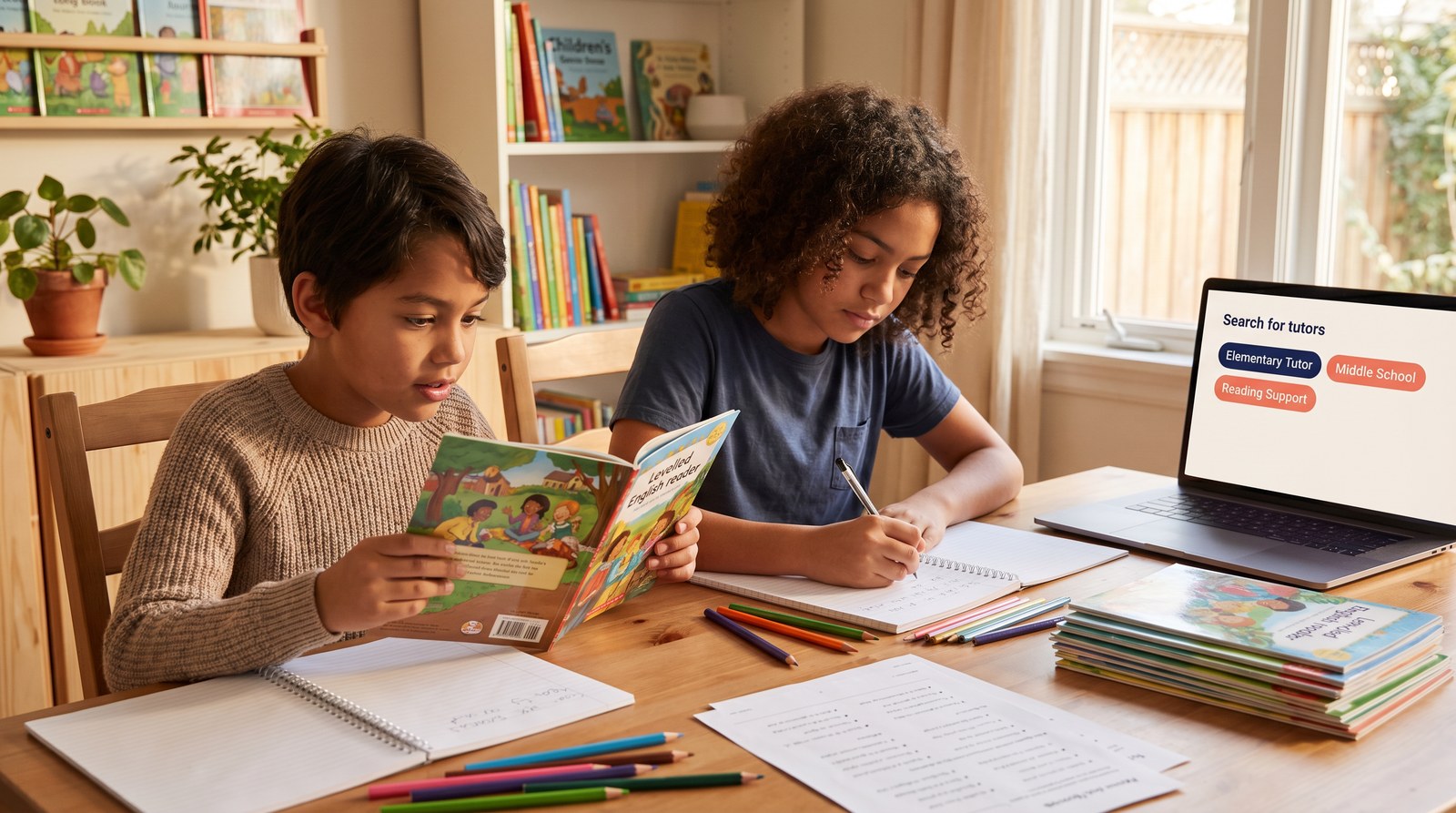
Why Grades 4-8 Are the Golden Window for Your Child’s Future Competitiveness
In North American academic pathways, many parents focus on:
- SSAT (Grade 7-8 entrance exam)
- Private school applications (Grade 7-9)
- AP / IB after Grade 9
But the real turning point is earlier:
Grades 4-8 (upper elementary + middle school).
This stage doesn’t determine grades — it determines the underlying structure of academic capability: reading, writing, thinking, and learning methods. Miss this window, and post-G9 remediation costs grow exponentially.
Start here:
📌 Students & parents → Find an elementary / middle school tutor 📌 Tutors → Join Tutriva and support G4-8 capability building
1. Why This Stage Matters Most
Because this is the:
Cognitive Structure Formation Phase.
From a developmental psychology standpoint, ages 9-14 are the critical period for abstract thinking. During this stage, children shift:
- From concrete thinking → abstract thinking
- From fact memorisation → logical reasoning
- From imitation learning → critical learning
These capabilities don’t “appear suddenly in Grade 9.” They accumulate gradually across G4-G8. Miss the window, and even with heavy investment after G9, catch-up velocity can’t match peers who built the foundation earlier.
2. Grades 4-6: The Starting Point (Foundation Phase)
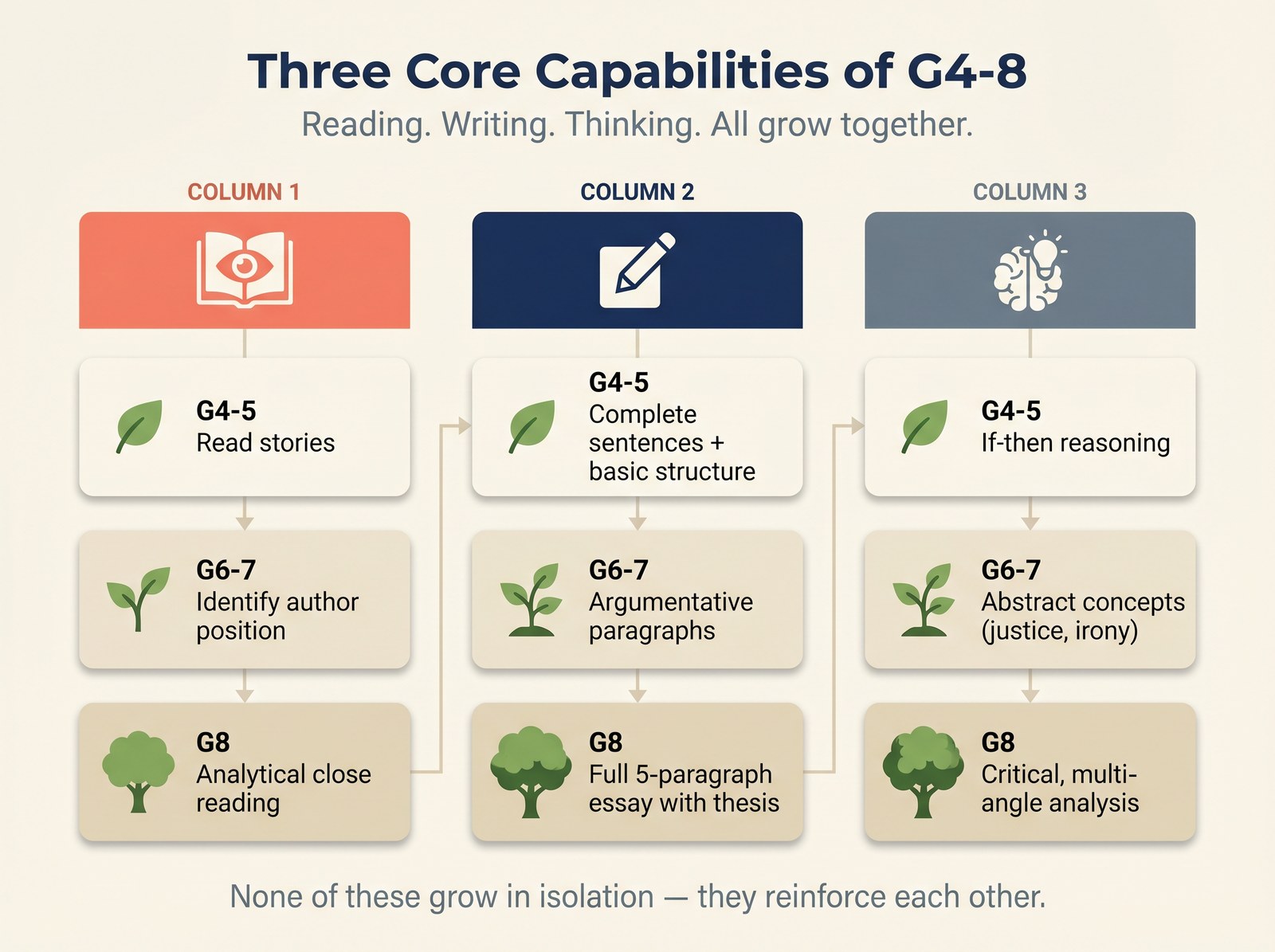
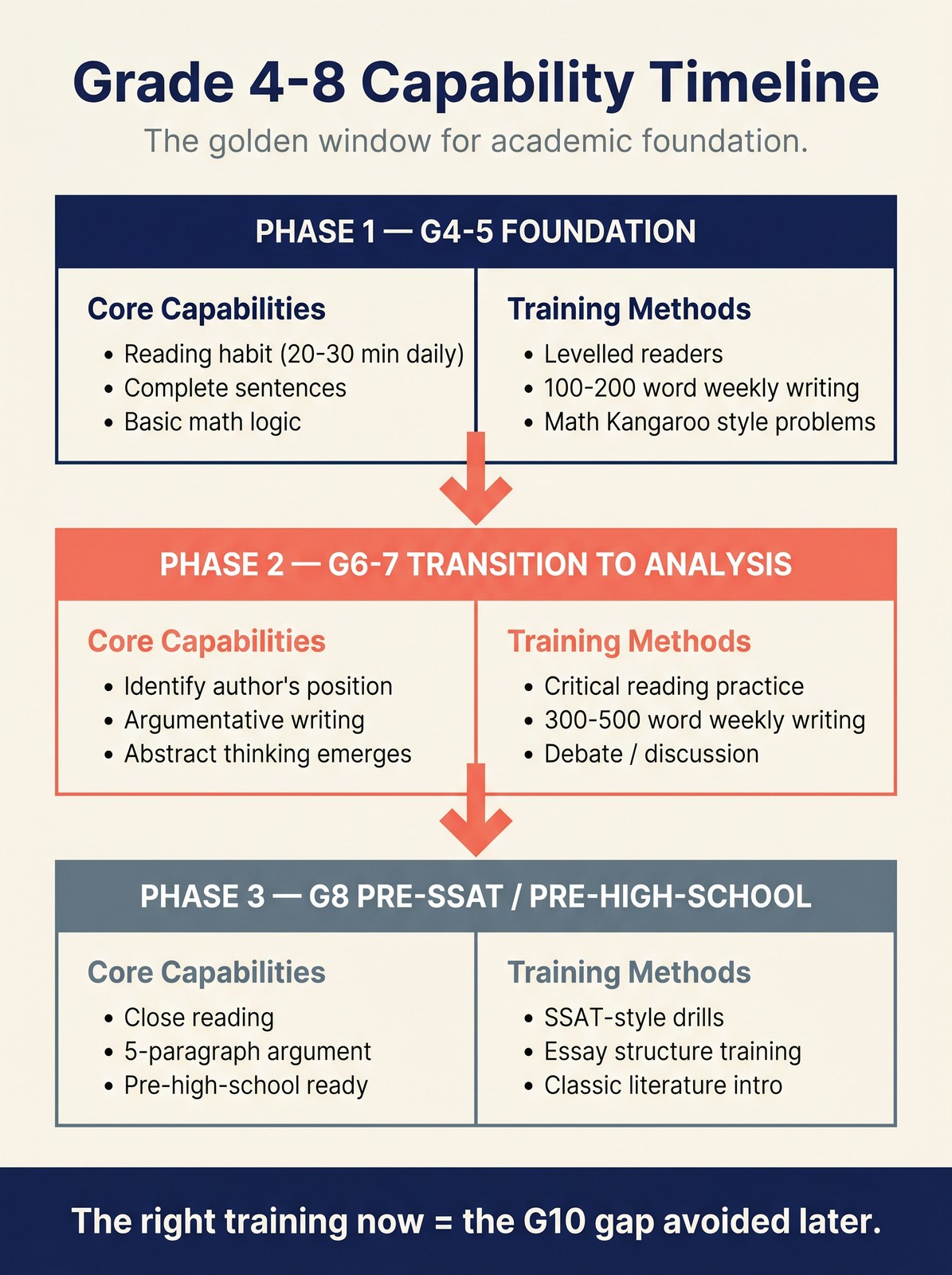
This stage focuses on building three core foundations.
2.1 Reading Foundation
Goals:
- Understand stories (can retell the main plot of 1-2 page short texts)
- Begin reasoning (can answer “if… then…” questions)
- Build a reading habit (20-30 minutes of independent reading daily)
Training methods:
- Levelled readers (Raz-Kids / Lexile / Reading A-Z series)
- One or two comprehension questions per book
- Family reading time (parent-child co-reading still has value)
2.2 Writing Foundation
Goals:
- Complete sentences (clear subject-verb-object, correct punctuation)
- Basic structure (5-paragraph pattern: intro + 3 supporting + conclusion)
- Basic description (3-5 sentences to tell one thing clearly)
Training methods:
- One or two 100-200 word pieces per week
- Writing prompts (“My favourite animal and why”)
- Parent / tutor feedback focused on structure, not spelling
2.3 Math Thinking
Goals:
- Basic logic (if-then reasoning, categorisation)
- Problem understanding (reads word problems accurately)
- Computational fluency (four operations + fractions + basic geometry)
Training methods:
- Entry-level Math Olympiad problems (Math Kangaroo Grade 3-4)
- Focused word-problem practice (5-10 per week)
- Avoid pure computation drilling
👉 If this stage isn’t solid, difficulty compounds exponentially later. G7-G8 English and Math courses assume “G4-G6 basics are done.” Without them, G7 becomes simultaneous new-learning + old-remediation — a painful combination.
3. Grades 6-8: The Watershed (Transition Phase)
This is the most critical stage!
G6-G8 isn’t a simple continuation of G4-G6 — it’s a capability jump.
3.1 Reading Upgrade
From: “Understanding” (literal comprehension) To: “Analysis” (analytical reading)
Students need to learn to:
- Identify the author’s position (what does this article support? oppose?)
- Judge evidence strength (is this paragraph fact or opinion?)
- Understand metaphor and symbol (poetry / fables / short fiction)
📌 Keywords: academic reading / critical reading / middle school reading tutor
3.2 Writing Upgrade
From: Description (descriptive writing) To: Argumentation (argumentative writing)
Students need to learn to:
- Present a viewpoint (thesis in embryonic form)
- Give reasons (supporting reasons in logical sequence)
- Anticipate counter-arguments (awareness of counter-argument)
This is exactly the preparatory training for G10 academic writing — strong G6-G8 here means the G10 transition cliff isn’t as steep.
3.3 Thinking Capability
Emerging:
- Abstract thinking (can grasp concepts like “justice,” “evolution,” “irony”)
- Logical reasoning (If A then B; if not B then not A — argument forms)
- Critical thinking (not just memorising answers — asking “why is this right”)
👉 This stage determines:
- ✔ Private school admissibility (SSAT tests exactly these capabilities)
- ✔ AP readiness (G11 AP English / History directly need these)
- ✔ Whether the student holds steady at the G10 academic transition
Mid-article CTA:
📌 Students & parents → Browse G4-8 capability-building tutors 📌 Tutors → Join Tutriva and build academic foundations for G4-8 students
4. The Hardest Truth
Many families:
- 👉 Start remediation in G9
- 👉 Only realise capability gaps in G10
- 👉 Begin systematic training in G11
By then:
- Writing structure is locked in (three years of narrative-style writing = deep grooves)
- Reading speed is hard to lift (reading speed accumulates over 3-5 years — not doublable in 3 months)
- Thinking patterns have formed (habituated to “receive + memorise” rather than “analyse + output”)
Starting large-scale capability training in G9-G11 is essentially racing against time — and usually losing.
G4-G8 is the highest-ROI investment window: one tutor session at this stage yields far more capability than the same session in G10.
5. The Right Pathway (Long-Term Plan)
5.1 Reading Training (Long-term, continuous)
- Fiction + Nonfiction in parallel (stories build empathy; science builds logic)
- 20-30 books per year in G4-5; 15-20 books in G6-8 (books get longer)
- Levelled → classic literature (G4 Magic Tree House → G8 To Kill a Mockingbird)
5.2 Writing Training
- Structure first (thesis → evidence → commentary)
- Argument training (not just “I think,” but “I believe X because Y, though some might argue Z, but…”)
- Weekly practice (G4-6: 150-300 words; G7-8: 300-500 words)
5.3 Expression Capability
- Discussion (classroom / family / peer)
- Interview / Presentation (one 5-minute oral report per semester)
- Debate (entry-level debate training can start in G7-8)
6. What This Stage Determines
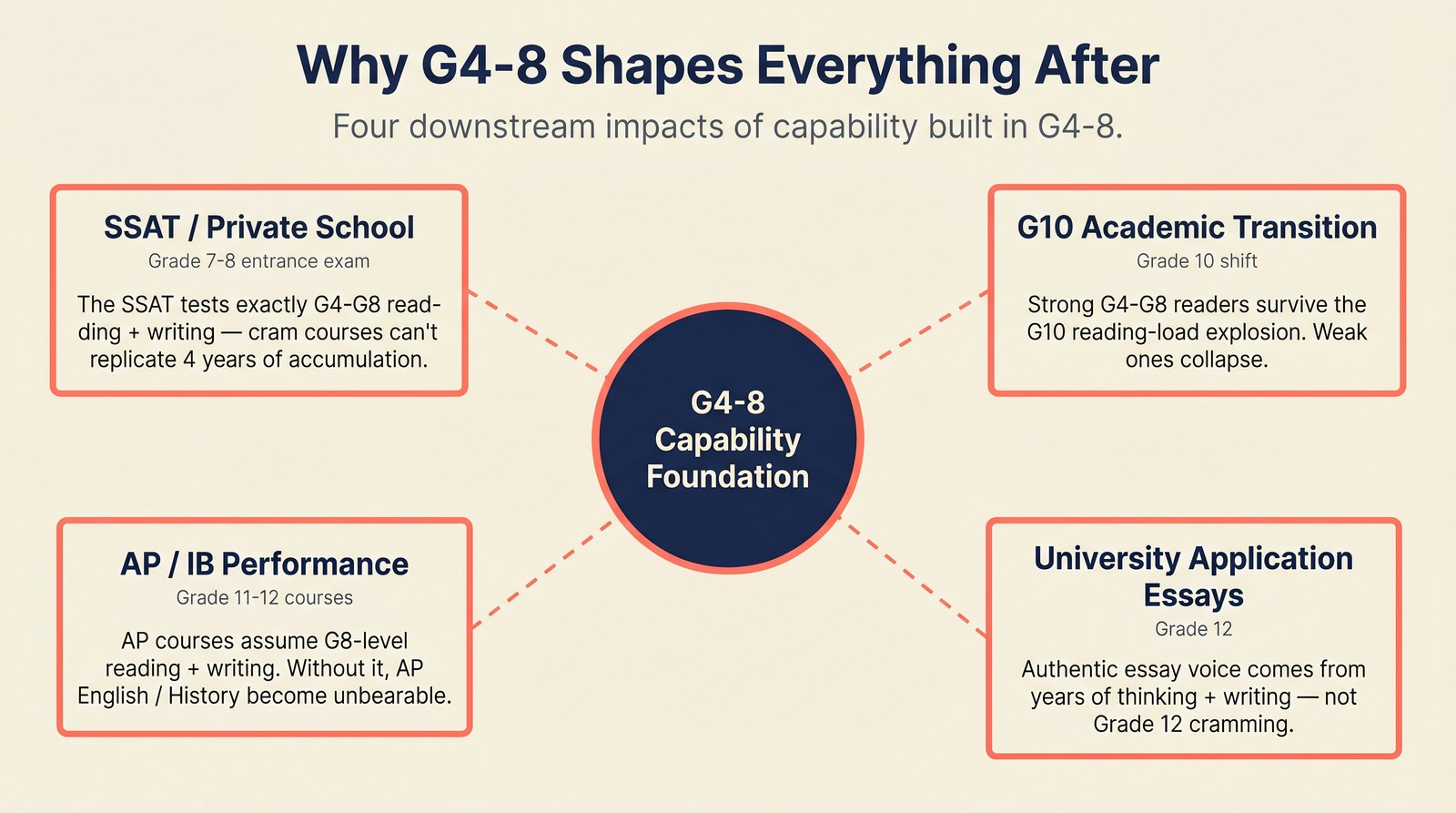
6.1 Private School Admissions
The SSAT tests G4-G8 accumulation. When students take the SSAT in Grade 7-8, cram courses can add 50-80 points, but the genuine 700+ scores come from long-term capability built across G4-G6. See Tutriva’s SSAT Reading & Vocabulary Guide + SSAT Math Strategy.
6.2 AP Performance
AP courses assume G8-level reading + writing capability. Students who didn’t build this in G4-G8 will struggle severely when choosing AP English / History in G11.
6.3 University Applications
US / Canadian top universities evaluate more than grades — essays, extracurriculars, depth of thought are all extensions of G4-G8 capability. A student strong in reading and writing from G4-G8 writes naturally authentic essays; a student starting training only in G11 produces essays that admission officers spot as formulaic at a glance.
7. Platform Solutions (Tutriva)
On Tutriva, filter by:
- Elementary Tutor (G4-6 upper-elementary specialisation, with childhood education experience)
- Middle School Tutor (G6-8 transition specialisation, familiar with SSAT / private school applications)
- Enrichment Tutor (reading companion / writing starter / expression training)
- Academic Writing Tutor (writing structure specialisation)
- Critical Reading Tutor (reading analysis specialisation)
FAQ
How many tutor hours per week for G4-8? Don’t overload. G4-5: 1-2 hours total reading + writing per week (can split into 2 × 30-45 min sessions). G6-7: 2-3 hours (1-1.5 reading + 1-1.5 writing). G8: 3-4 hours (adds SSAT prep and academic writing).
What if the child can’t sit still at this age? Choose a Companion-style tutor — they don’t just teach content, they guide the child into a “30 minutes of focused learning” rhythm. Attention-building is more valuable than content coverage at this age.
Is the SSAT required for all private schools? Most top private day schools / boarding schools require SSAT. Some schools accept alternatives like SSAT Standard, SSAT Elementary, or Character Skills Snapshot. Starting 2-3 years early (G5-G6) is the safest path.
What does G4-8 tutoring cost? Elementary + middle school tutors typically charge $30-$70 per hour — cheaper than specialist high school tutors. Zero commission — 100% goes to the tutor. This is why G4-G8 is the highest-ROI window: large capability gain per dollar invested.
How should bilingual Chinese families choose tutors? G4-5: bilingual use is fine (Mandarin support + English primary). G6-8: shift toward English primary (Mandarin only for abstract concept explanation). Post-G8: aim for English-only instruction.
Should my child read classic English literature? Reading classics (simplified or abridged) starting in G7-G8 helps — it gets them used to the literary analysis text style they’ll face in G10. Recommendations: Of Mice and Men, The Giver, Hatchet, Tuck Everlasting, To Kill a Mockingbird (all standard G8-G10 curriculum books in North America).
Final CTA:
If your child is in G4-G8:
This is the most important stage, right now.
Miss this golden window, and post-G9 catch-up costs grow exponentially.
📌 Students & parents → Find a G4-8 capability-building tutor 📌 Tutors → If you specialise in Enrichment / Writing / Reading / Middle School Prep, join Tutriva.