
Why Students Suddenly Struggle in Grade 10: The Most Underestimated Learning Gap in North American High School
In North American education, there’s a pattern that shows up repeatedly — but is rarely explained systematically:
👉 Students perform steadily, even excellently, in Grade 8 and Grade 9 👉 Then in Grade 10, they suddenly face:
- Grade volatility
- Sharp increase in study pressure
- Declining confidence
Parents’ first reactions are usually:
- ❌ “Is the student slacking off?”
- ❌ “Are they just not adapting?”
- ❌ “Is this adolescence?”
But the real cause is a structural Academic Transition Gap — not an attitude problem, and not just a difficulty jump. It’s that the way learning happens fundamentally changes in Grade 10, and most students have never been trained to handle the shift.
Start here:
📌 Students & parents → Find a high school English & academic writing tutor 📌 Tutors → Join Tutriva and support G9-G10 transition students
1. What Actually Happens in Grade 10 (The Underlying Shift)
Grade 10 is a pivot point. It marks:
The transition from “knowledge input” to “capability output.”
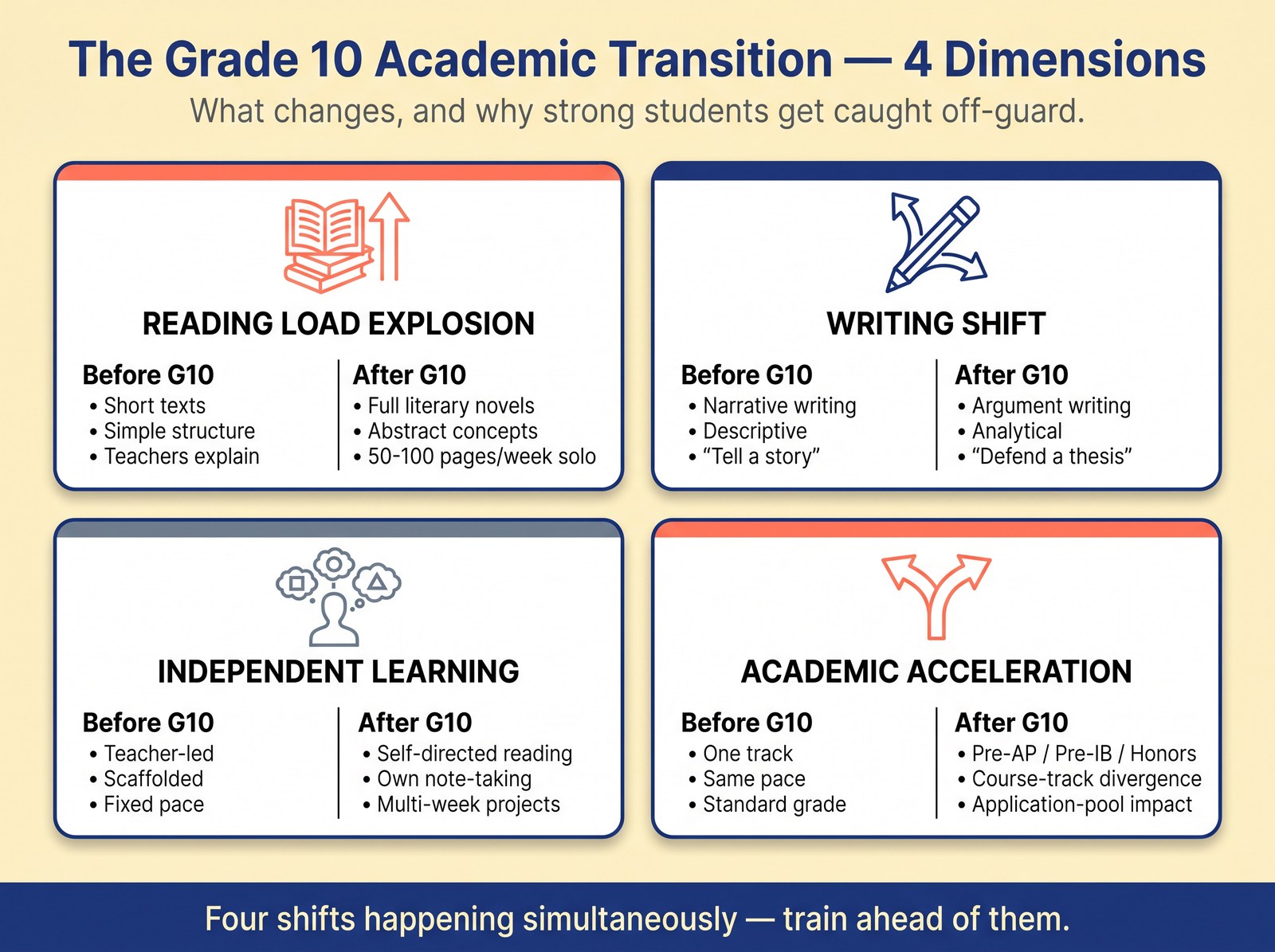
This shows up along four dimensions simultaneously:
1.1 Reading Load Explosion
Before Grade 10:
- Shorter texts (paragraph-level + short stories)
- Simpler structure (linear narratives)
- Teachers explain; students receive
In Grade 10:
- Longer texts (full-length literary works + nonfiction argumentation)
- Abstract concepts (evolutionary mechanism, cultural construct, systemic bias)
- Much higher volume (50-100 pages per week is normal)
👉 Students need to:
- Grab the main idea fast (one read, one-sentence summary)
- Read tone (is the author ironic? sympathetic? neutral?)
- Analyse structure (argument vs narrative vs exposition)
📌 Keywords: academic reading / high school reading skills / reading comprehension tutor
1.2 Writing Shift
From:
- Narrative writing (“Tell a story about…”)
- Descriptive writing (“Describe a place…”)
To:
- Argument writing
- Analytical writing
Students need to:
- Build a thesis (a clear, defensible claim)
- Use evidence (textual quotes, data, references)
- Write commentary (analysis of the evidence — not restatement)
- Develop logical structure (transitions, counter-argument, conclusion)
👉 For many students, this is the first encounter with real academic writing — and everything they practiced in Grade 7-9 (“My dream vacation,” “A memorable day”) suddenly doesn’t transfer.
1.3 Independent Learning
From Grade 10 onward, students must:
- Read on their own (teachers no longer explain every paragraph)
- Take their own notes (Cornell Notes / Outlining)
- Manage their own time (5-6 courses running in parallel)
- Complete multi-week projects (independent research)
👉 The essence: transition toward university-style learning — Grade 10 is no longer “teacher teaches, student memorises.” It’s “student self-studies, teacher guides.”
1.4 Academic Acceleration
Grade 10 typically opens up:
- Pre-AP / Pre-IB courses
- Honors courses
- Course-track divergence — regular / Honors / Pre-AP pathways split here
👉 The ability bar rises sharply. If a student can’t make Honors or Pre-AP, that’s effectively closing a door on G11-G12 AP / IB options — which in turn narrows the university application pool.
2. Why “Strong Students” Also Fall Behind
Because historically they relied on:
- ✔ Listening ability (if the teacher explains clearly, they understand)
- ✔ Memorisation (memorise it → ace the test)
- ✔ Assignment completion (follow the template → get the grade)
But Grade 10 tests:
- ❗ Analysis (given an unfamiliar text, can you dissect it?)
- ❗ Expression (can you write a 250-word persuasive argument?)
- ❗ Thinking structure (can you do setup-development-resolution across 3 paragraphs?)
These three capabilities are cumulative — they can’t be patched in one semester. They require long-term training.
That’s why many straight-A Grade 8 students start losing points in Grade 10 — not because they got weaker, but because their old learning mode hit its ceiling.
Mid-article CTA:
📌 Students & parents → Browse high school English / academic writing tutors 📌 Tutors → Join Tutriva and support G10 transition students
3. The Core Problem: Capability Built Too Late
The common student path:
- 👉 Starts patching writing in Grade 9
- 👉 Starts practising reading in Grade 9
- 👉 First realises “I need study methods” in Grade 9
Result:
- Reading speed can’t keep up (one read, still don’t understand)
- Writing structure is chaotic (no thesis, no evidence — just a flow of observations)
- Learning efficiency drops (3 hours to finish what peers do in 1 hour)
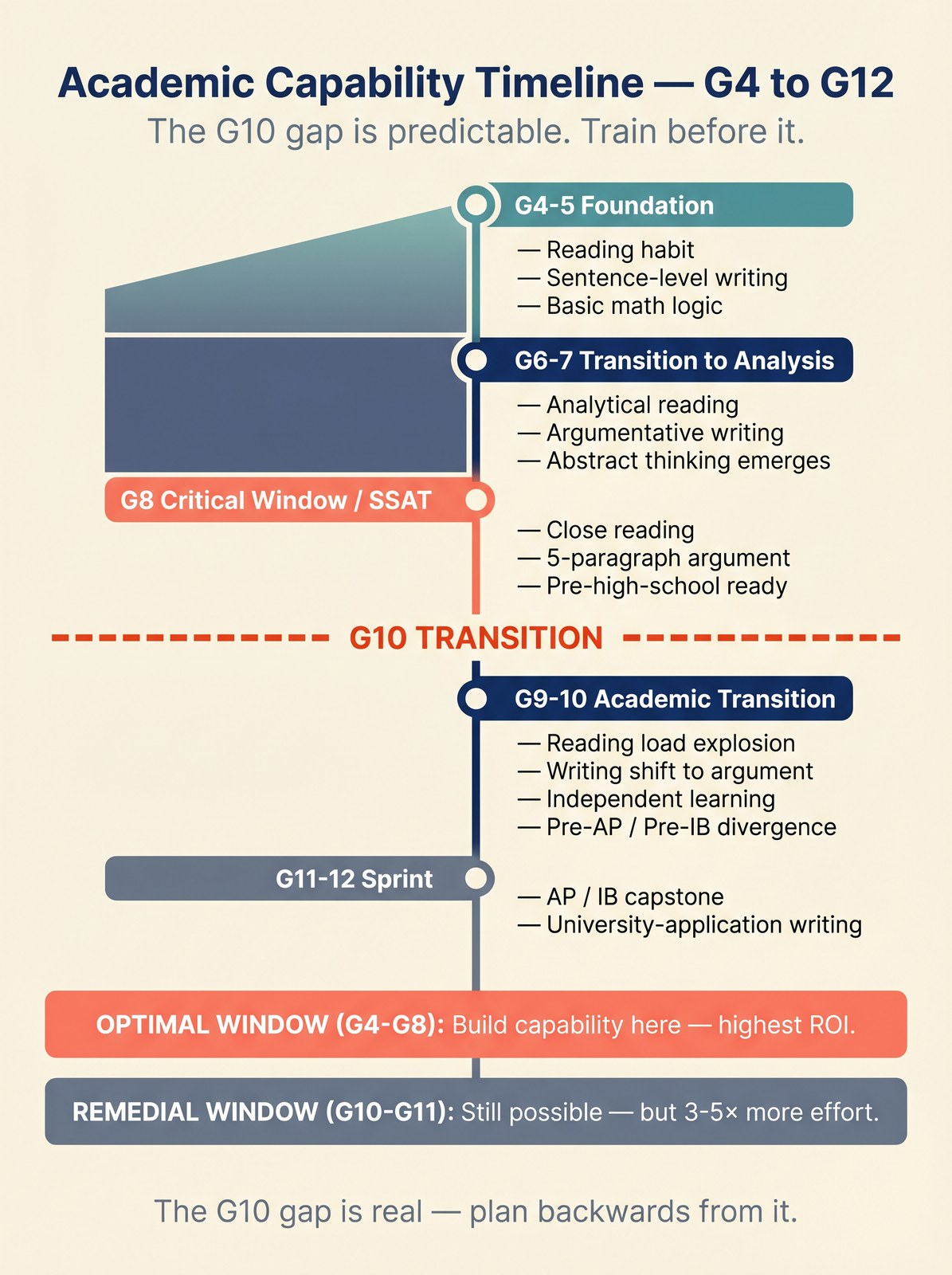
👉 The right window is Grade 6-8 — see Tutriva’s guide on Why Grades 4-8 Are the Most Important Years for Academic Success.
4. Typical G10 Gap Signals (Real Observation Checklist)
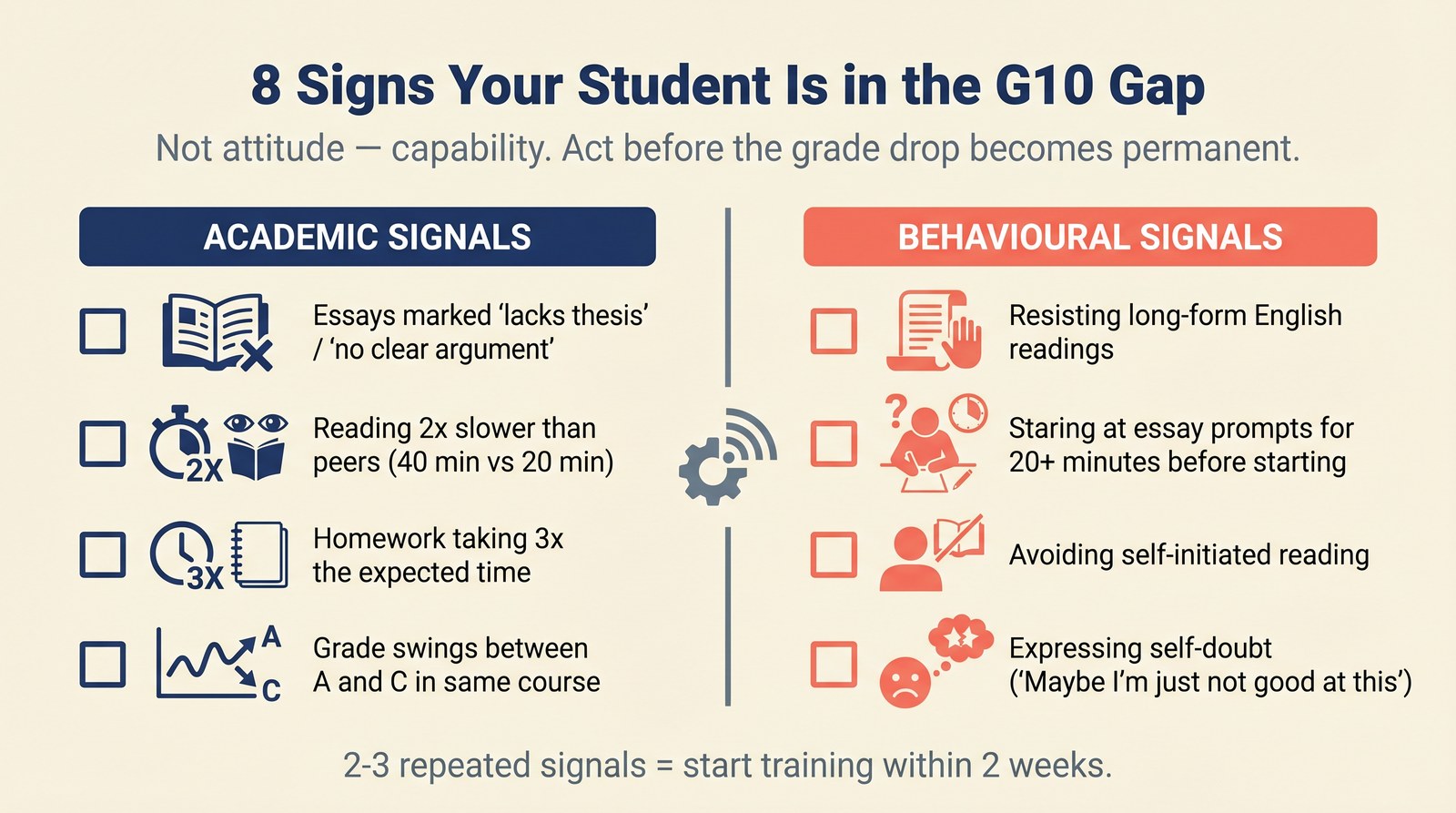
Parents can watch for these signs:
Academic signals:
- Writing without structure (teacher comments often: “lacks thesis” / “no clear argument”)
- Slow and error-prone reading (the same article that peers finish in 20 minutes takes 40+ minutes)
- Homework takes unusually long (1-hour assignments now take 3 hours)
- Grade volatility (same subject bouncing between A and C)
Behavioural signals:
- Starts resisting long English readings
- Takes ages to get the first sentence down on an essay
- Begins avoiding self-initiated reading
- Starts doubting ability (“Maybe I’m just not good at this”)
👉 This is not an attitude problem — it’s a capability problem. It requires systematic training to fix.
5. How to Solve It (What Actually Works)
❌ Wrong approaches
- Homework help only (having a tutor finish the assignment ≠ learning)
- Drill-and-kill (English isn’t math — reading volume requires method + quantity, not repeating the same question)
- Short-term cramming (3 sessions can’t fix 3 years of accumulated gaps)
✅ Right approach
5.1 Reading Capability Training
- Main-idea extraction (30-second 1-sentence summary per article)
- Structural analysis (is it narrative / argument / expository? What’s the function of each paragraph?)
- Tone recognition (supportive / opposing / neutral?)
Recommended cycle: 3-5 articles per week, 12-16 weeks.
5.2 Writing Structure Training
- Thesis construction (every essay’s core claim in one sentence)
- Paragraph structure (Topic Sentence + Evidence + Commentary + Link)
- Argument logic (Claim → Warrant → Counter-argument → Rebuttal)
Recommended cycle: 1 × 300-500-word essay per week, 16-20 weeks.
5.3 Study Method Building
- Note-taking (pick one: Cornell Notes / Mind Map / Outlining — and practise it until fluent)
- Time management (3 × 2-hour fixed study blocks daily)
- Active reading (annotate while reading, self-question after finishing)
6. Grade 10 Isn’t a Problem — It’s a “Filter Point”
From the education system’s perspective, the Grade 10 gap isn’t a bug — it’s a feature:
👉 Its function: to judge whether a student has
- High school academic competitiveness
- AP / IB course-handling capability
- University preparedness
Students who clear Grade 10 enter G11-12 AP / IB / Honors tracks. Those who don’t get pushed back to regular pathways — which directly affects university application pools (regular-course vs AP-heavy applications don’t sit at the same competitive tier).
So: the Grade 10 gap isn’t something to “just power through” — it needs early identification and deliberate training.
7. Platform Perspective: How to Find Actually Effective Tutors
On Tutriva, prioritise:
- ✔ High School English Tutor (specialised in high school English, knows G10-12 curriculum)
- ✔ Academic Writing Tutor (can teach thesis + evidence + commentary structure)
- ✔ Reading Tutor (teaches structure / tone / inference as methodology)
Avoid:
- ❌ Homework help only
- ❌ General English tutoring (doesn’t know academic writing framework)
- ❌ Test-technique only (doesn’t teach underlying capability)
FAQ
If my child has already fallen behind in G10, can they recover? Yes. If you catch it in G10 first semester and start systematic training immediately, 12-16 weeks usually restores footing. Starting in G10 second semester or G11 is considerably harder. Earlier is much better — if you see 2-3 consecutive C-grade essays, start addressing it.
What can we do proactively in G9? Three things: (1) Start reading literary analysis books (starter picks: Of Mice and Men, The Pearl); (2) Practice one 5-paragraph argumentative essay per week; (3) Learn Cornell Notes or Outlining. This dramatically softens the G10 impact.
How often should the tutor meet with the student? G10 English / academic writing: 1-2 sessions per week, 60-90 minutes each. Less than that loses continuity; more than that doesn’t leave digestion time.
What does it cost? High school English / academic writing tutors typically charge $50-$100 per hour. Tutors with AP English or IB Language-A experience may charge more. Tutriva takes zero commission — 100% goes to the tutor.
Do Chinese-speaking families need bilingual tutors? Starting G10, strongly prefer English-only tutoring — this is capability-building, and bilingual instruction slows English-thinking development. Newcomer families may use a bilingual tutor for the first 2-3 months as transition.
Online or in-person? Online works perfectly. Reading / Writing online has a natural advantage — screen-share text annotation is more efficient than in-person classroom settings. Most G10 English tutors on Tutriva support online delivery.
Final CTA:
If your student is in the G8-G10 transition:
Start building:
- ✔ Reading capability
- ✔ Writing capability
- ✔ Study structure
Tutriva matches you with the right tutor.
📌 Students & parents → Find a high school English / academic writing tutor 📌 Tutors → If you specialise in high school English / writing / learning strategy, join Tutriva.