
How to Prepare for SAT, AP, IB, IGCSE, and A-Level: A Strategy Guide for 2026
When preparing for standardized exams, many students instinctively focus on one thing: doing more practice questions.
But real progress doesn’t come from undifferentiated problem-solving. It comes from:
Clear pathway + right method + the right guidance.
For SAT, AP, IB, IGCSE, and A-Level, how you study matters far more than how long you study.
Start here:
📌 Students & families → Find a test-prep tutor 📌 Tutors → Join Tutriva and offer test-prep support
Effective prep is not just about effort
To prepare for standardized tests efficiently, a few key steps make a real difference:
1. Define your target
Be clear about your exam type, timeline, target score, and application need:
- SAT 1500+ is the competitive threshold for many Top 30 universities
- AP 5 is the credit-transfer threshold at Selective schools
- IB HL 6-7 is a common T20 international application ask
- IGCSE A*/A is the entry line for Commonwealth-track schools
- A-Level A*AA is the common Oxbridge / NUS requirement
Without a defined target, training fragments.
2. Find the real weak points
Different students have different problems:
- Some have weak foundational knowledge
- Some have shallow concept understanding
- Some have knowledge blind spots (get the topic wrong every time)
- Some have slow pacing
- Some have time-management issues
- Some lack test strategy / technique
- Some actually know the content, but don’t know how to build an exam strategy
A real diagnostic (mock exam + error analysis) is worth more than 3 months of blind practice.
3. Separate “foundations” from “score-push”
Some students need to go back to content basics. Others need question-type training, timing control, and exam technique.
Distinguishing these two modes is the first step of efficient prep. A student with SAT Math at 560 and a student with SAT Math at 720 pushing toward 780 need completely different training.
4. Build a targeted training plan
Phased, goal-specific training beats general study every time.
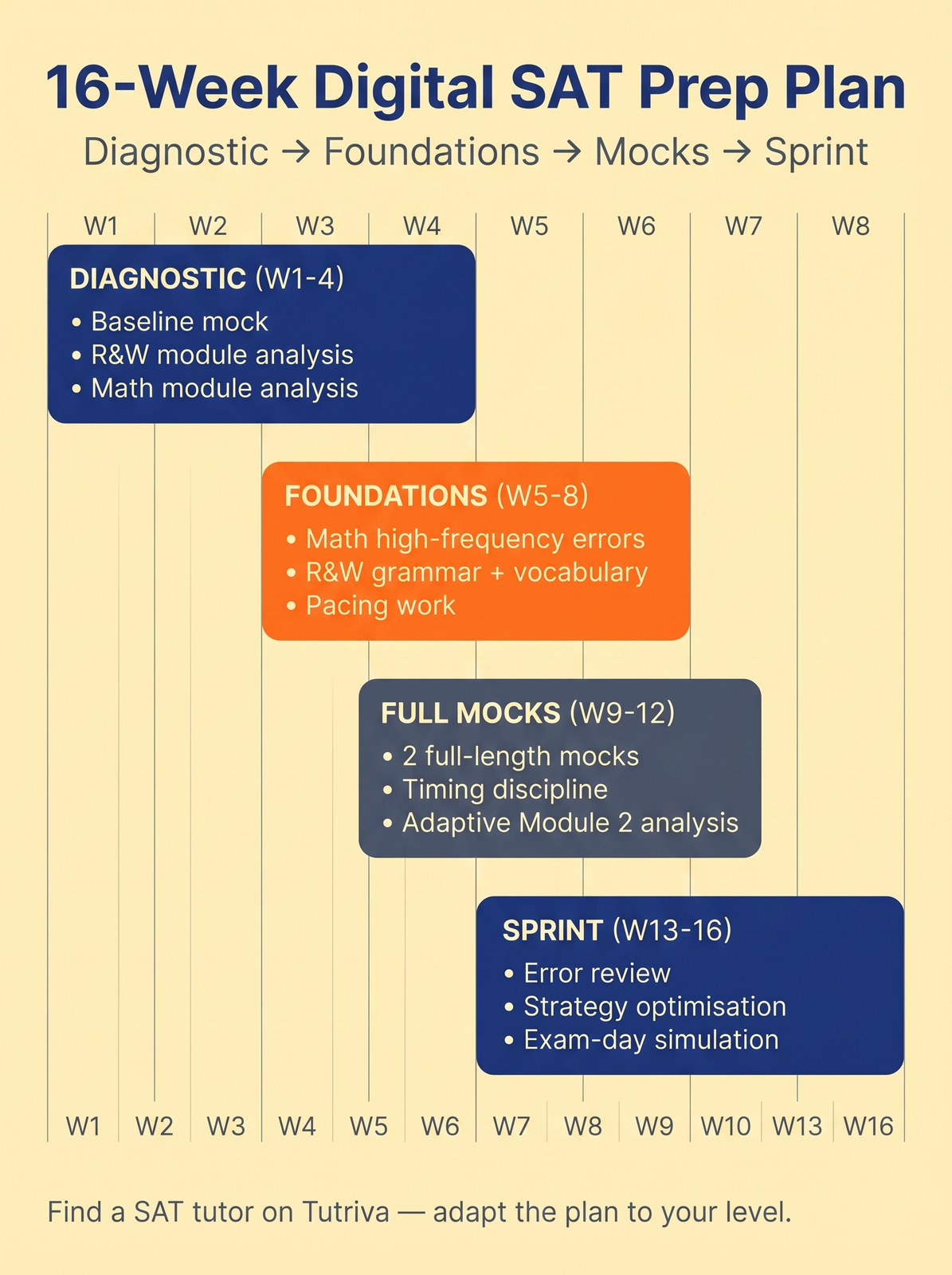
Example — Digital SAT 16-week sprint:
- Weeks 1-4: Diagnostic + Reading & Writing foundations
- Weeks 5-8: Math module focus + high-frequency error patterns
- Weeks 9-12: Full-length mocks + timing discipline
- Weeks 13-16: Error review + strategy optimisation + exam-day simulation
What parents really need isn’t “someone who teaches the subject”
For SAT / AP / IB / IGCSE / A-Level, the tutor families actually need usually has:
- Personal familiarity with the exam (took it, taught it, or tracks it long-term)
- Understanding of structure, curriculum, and scoring logic
- Tracks recent changes and update trends
- Can rapidly identify where the student’s problem sits
- Distinguishes foundation issues, concept issues, approach issues, and technique issues
- Can help the student find the most efficient improvement path within a limited time
The value of this kind of tutor isn’t “explaining problems.” It’s helping students diagnose faster and take fewer detours.
Mid-article CTA:
📌 Students → Find a SAT / AP / IB / IGCSE / A-Level tutor 📌 Tutors → Join Tutriva and help students build efficient learning paths
Why the right tutor matters
A real-fit test-prep tutor helps you:
- Plan a learning pathway
- Judge priorities
- Diagnose and stratify (foundations vs technique)
- Give phase-based feedback
- Track progress and exam-ready state
- Eliminate wasted effort
That’s why more and more families are choosing to find a tutor through a tutor platform, rather than relying on uniform group courses.
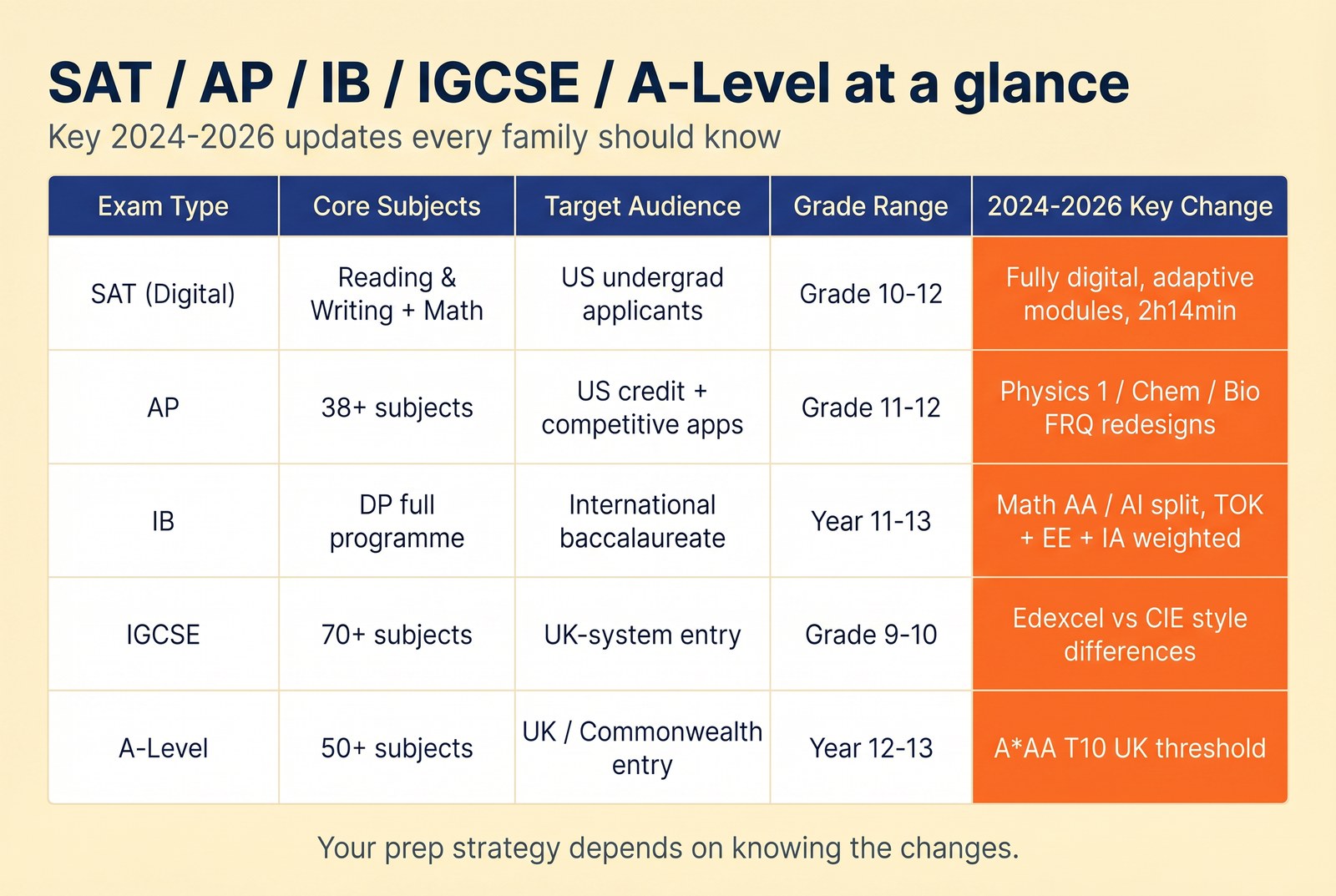
Key 2024-2026 exam changes
Digital SAT (fully digital from 2024)
- Total time cut to 2h 14min (from 3+ hours)
- Two Reading & Writing modules + two Math modules
- Adaptive mechanism: Module 2 difficulty depends on Module 1 performance
- Short passages replace long ones (Reading passages 25-150 words)
- Desmos calculator available throughout Math
Implication: Module 1 stability = the ceiling of your entire score. High-score training must start from Module 1.
AP 2024-2026 redesigns
- AP Physics 1: Fall 2024 redesign, Electric charge/force back in
- AP Chemistry: FRQ-type adjustments, more model-reasoning weight
- AP Biology: 2025 curriculum shifts emphasis to systems + evolution
- AP Calculus BC: question-structure refinements
- AP Statistics: Investigative Task weight up
Implication: Prepping from 2019 textbooks = wasted time. Find a tutor tracking 2024-2026 FRQs.
IB programme
- IB Math AA vs AI (AA = analysis-heavy, AI = applications)
- Extended Essay + TOK + IA — three independently scored components
- HL vs SL content depth differs significantly
IGCSE / A-Level
- Edexcel vs CIE — two exam boards, visibly different question styles
- A-Level A*AA is the T10 UK threshold
- Edexcel IAL vs CIE acceptance differs by jurisdiction (Singapore / Hong Kong / China channels)
What tutors you can find on Tutriva
On Tutriva, students can find:
- SAT tutor (Digital SAT specialists + Math / R&W split)
- AP tutor (covering 20+ subjects)
- IB tutor (HL / SL full subject set + EE / TOK / IA guidance)
- IGCSE tutor (Edexcel / CIE)
- A-Level tutor (Math / Further Math / Physics / Chemistry / Economics)
- Mathematics tutor
- Science tutor
- Writing / ESL tutor
- Competition tutor (AMC / Euclid / CCC)
For tutors, this is a clear opportunity direction: test prep is consistently in demand across Canadian and international education markets, and tutors who genuinely know the exam and keep their knowledge current are highly valued.
Beyond the score — the real value is the pathway
Many families eventually realise that the value of test prep isn’t only the score. It’s:
- Building a clearer knowledge structure
- Learning to plan and reflect
- Developing long-term learning capability
- Staying steady under pressure
- Forming more mature study habits
That’s why good test prep isn’t just a short-term sprint — it can become part of long-term academic growth.
FAQ
When should prep start? SAT: diagnostic + foundations in Grade 10 second semester, sprint in Grade 11. AP: 9-12 months per subject, aligned with course. IB: systematic training from Year 1. IGCSE: from Grade 9. A-Level: full Year 12 + sprint in Year 13.
1:1 vs group — which is better? Diagnostic + sprint phases are best 1:1; foundation-building works fine in groups. Most Tutriva tutors are 1:1, with some supporting small 2-4 person groups.
How much does it cost? Specialist SAT / AP / IB tutors typically charge $60-$120/hr; top-tier educators (former AP markers, IB examiners) may be higher. Zero commission — 100% goes to the tutor.
Can tutors help with IB Extended Essay or SAT application essays? Yes. Tutriva has tutors focused specifically on EE / TOK / IA and college application writing.
Can bilingual Chinese families find bilingual tutors? Yes. Filter by Mandarin or Cantonese tags — many test-prep tutors are fully bilingual.
Online or in-person? SAT / AP / IB prep mostly online (efficient + larger tutor pool + cross-time-zone availability). IGCSE / A-Level students at local British-system schools may choose in-person.
Final CTA:
📌 Students → Find the right test-prep tutor for you 📌 Tutors → Join Tutriva and expand your teaching opportunities