From Ontario EQAO to SSAT to SAT — Not Just Tests, But Watersheds of Academic Ability

**About Tutriva** — Tutriva is a tutor-parent matching platform. Tutors create their own profiles with the qualifications, experience, and rates they choose to share; parents post requests; both sides connect directly and decide on lesson terms together. Tutriva provides the marketplace and tools — what each user evaluates, trusts, and books is up to them.
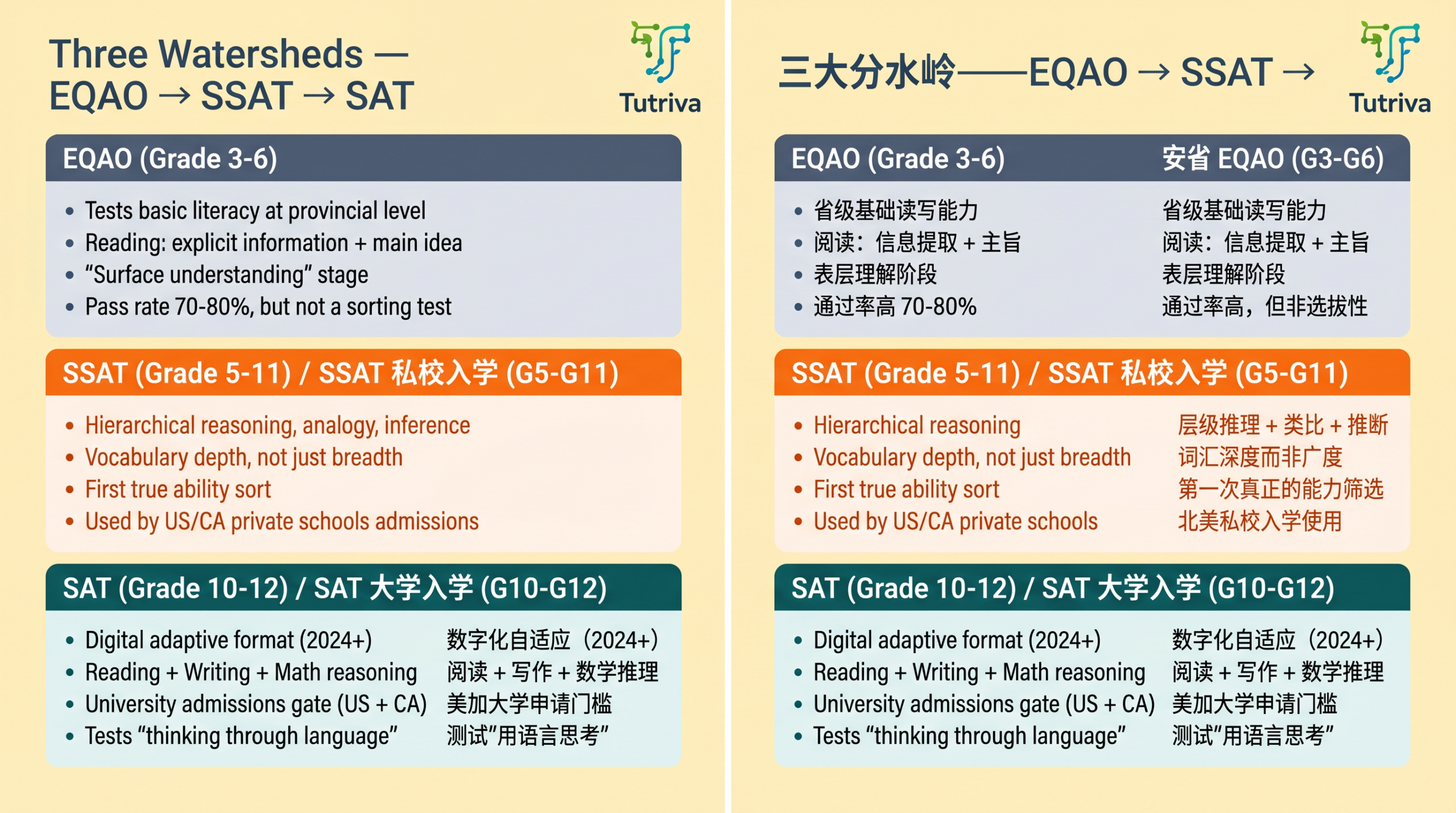
From EQAO to SSAT to SAT: Not Just Tests, but a Continuum of Academic Thinking
1. The Core Issue: It’s Not About Learning English — It’s About Entering an Academic Language System
In North American education, many students appear to be doing well in English for years:
They can understand what they read
Their vocabulary gradually improves
Their school grades remain stable
However, a clear shift often happens around Grades 7–9:
Students can “understand” a passage, but struggle with inference questions
Writing is grammatically correct, yet lacks structure and argument
Nonfiction texts become significantly more difficult
This is not a sudden decline.
It reflects a deeper issue:
Students have developed language recognition, but not academic processing ability.
In other words:
They use English as a tool for communication
But have not yet developed English as a system for thinking
2. What EQAO Really Measures — and What It Doesn’t
In Ontario, EQAO results are often used as a benchmark:
Grade 3 reading proficiency: ~70%+
Grade 6 reading proficiency: ~80%+
At first glance, performance appears stable and improving.
However, a closer look at EQAO reading tasks reveals a clear boundary.
Typical EQAO Reading Skills
EQAO primarily assesses:
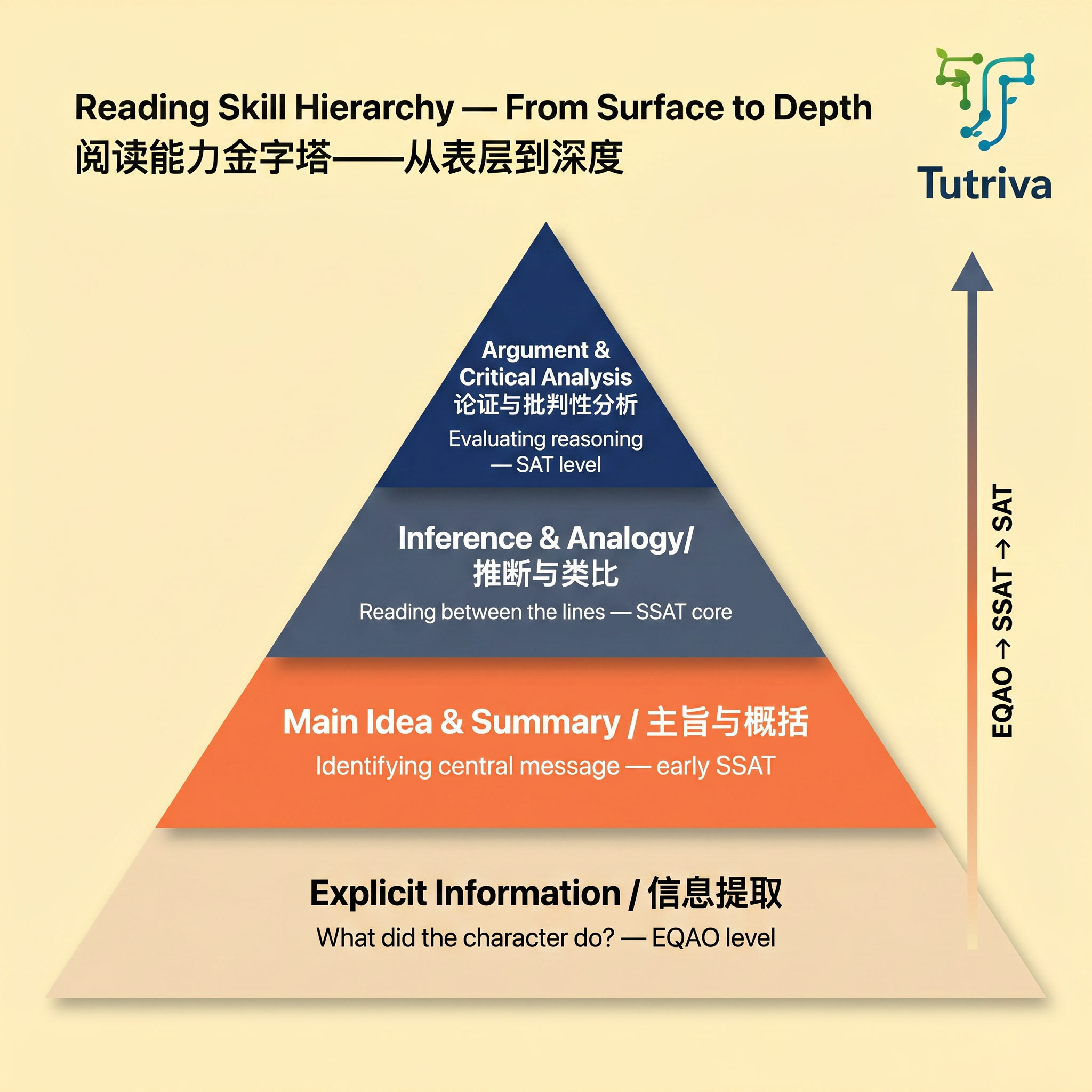
1. Explicit Information Retrieval
Locating facts directly stated in the text
2. Main Idea Identification
Recognizing the general meaning of a passage
3. Basic Inference
Making short, surface-level logical connections
What Is Largely Absent
EQAO rarely requires:
Multi-layered reasoning
Structural analysis of texts
Evaluation of author’s purpose or tone
Handling abstract or unfamiliar concepts
As a result:
EQAO measures whether a student can read smoothly — not whether they can think deeply.
This explains a common phenomenon:
Students may perform well on EQAO, yet lack true academic reading and writing ability.
3. The Turning Point: What SSAT Actually Assesses
SSAT is often perceived as simply an entrance exam for private schools.
In reality, its structure reveals something much more important:
It is a system for evaluating academic thinking ability.
Official Perspective
“SSAT is based on skills and concepts that differ from those used on a day-to-day basis in school.”
Types of SSAT Reading Passages
Students are expected to engage with:
Literary fiction
Historical narratives
Scientific nonfiction
Social science texts
The shift is fundamental:
Texts are no longer about understanding content — they are about analyzing structure and reasoning.
4. Core Skill Areas in SSAT
1. Vocabulary in Context (Precision)
This goes far beyond memorization.
Students must:
Interpret nuanced meanings of words
Select the most precise option within a specific context
The skill is not vocabulary size — it is semantic precision.
2. Inference and Interpretation
Typical questions include:
What can be inferred about the author’s attitude?
Why does the author include a specific example?
Students must:
Integrate information across sentences
Identify implied meaning rather than explicit statements
3. Structure and Function Analysis
For example:
What is the purpose of paragraph 3?
How is the passage organized?
This requires recognizing how ideas are constructed, not just what they say.
4. Analogies (Relational Thinking)
A distinctive SSAT component:
bridge : river :: tunnel : ___
Students must identify:
Functional relationships
Structural similarities
Abstract patterns
This is a direct test of logical mapping ability.
Summary
SSAT does not test what students know.
It tests how they process information.
5. Why SSAT Is Foundational for SAT
Many students struggle with SAT not because it is “harder,” but because:
The underlying skills were never fully developed earlier.
SAT Reading
Long, dense nonfiction texts
Argument analysis
Paired passages
Typical questions:
Which claim is best supported by evidence?
How does the author develop the argument?
SAT Writing & Language
Sentence structure refinement
Logical transitions
Tone and style consistency
These require precise reasoning and structured thinking.
6. The Continuum of Academic Skill Development
EQAO → SSAT → SAT
If the middle stage is missing:
Reading remains superficial
Writing lacks structure
SAT performance becomes difficult to improve
7. Where These Skills Come From
The development of SSAT and SAT-level ability is not driven by test practice alone.
It is built through:
Breadth of Reading
Literature
Science
History
Social sciences
Depth of Reading
Structural awareness
Argument tracking
Logical inference
Content Knowledge
Background knowledge across disciplines
Academic vocabulary in context
Reading becomes not just input, but a process of building cognitive structure.
8. Strategy as Cognitive Execution
Standardized testing at this level also requires:
Time Allocation
Managing different question types
Prioritizing effectively
Strategic Decision-Making
Skipping vs. attempting
Identifying evidence efficiently
Answer Optimization
Eliminating close distractors
Selecting the most precise option
These are not shortcuts — they are forms of high-level execution under constraint.
9. The Critical Transition Period
Grades 5–6 (Foundation Stage)
Reading habits
Attention span
Basic expression
Grades 7–8 (Transformation Stage)
Students begin to:
Shift from narrative reading to classical and nonfiction texts
Move from storytelling to analytical writing
Encounter early forms of critical thinking
At this stage, differences become visible:
Limited depth of ideas
Weak argument structure
Difficulty expressing viewpoints
The underlying causes are structural:
Narrow reading exposure
Lack of systematic training
10. A Key Clarification
Extensive reading alone does not automatically lead to academic proficiency.
Without:
Structural training
Writing output
Analytical frameworks
Students often reach a plateau:
They read more, but do not become stronger thinkers.
11. About the Platform
We are not a tutoring center, and we do not operate as an intermediary.
We function as a two-sided academic network.
For Tutors
Create your own profile
Set your own rates
Connect directly with students
For Students and Families
Browse available tutors
Or post a learning request
Find the right fit based on your needs
Our goal is simple:
To connect high-quality educators with students who are building long-term academic capability.
Conclusion
SSAT and SAT are not isolated exams.
They are part of a continuous progression:
From understanding → to analysis → to expression
The difference between students is not created overnight.
It emerges gradually through this progression.
And ultimately:
The ability to think in English — not just use it — is what defines long-term academic success.
Hi Simon,在每篇 Blog 文章的底部,建议加一个清晰的 CTA 链接(可以是 Find Tutor , Become Tutor 或 student requests)。
主要是方便用户读完后可以直接进入下一步操作。谢谢!
Find an SSAT / SAT Tutor on Tutriva
If your child is preparing for SSAT private school admission or SAT college application, on Tutriva you can:
- Browse SSAT / SAT tutor profiles: [tutriva.com/find-tutors/](https://tutriva.com/find-tutors/) — filter by city, exam, and rate
- Post a reverse-search request: write your child’s grade, target score, and schedule in 60 seconds (e.g., “Grade 9 student preparing SSAT Upper Level, Toronto, weekends, target 90%+”); receive offers from matching tutors within 24 hours
- Become an SSAT / SAT tutor on Tutriva: [tutriva.com/signup/?userType=tutor](https://tutriva.com/signup/?userType=tutor)
Each tutor self-discloses their qualifications and teaching background in their own profile; you compare and decide who to message.