The Work Parents Cannot Outsource
Tutriva’s Parent Corner explores what it means to support children’s growth beyond grades. Browse tutor profiles and get started →
In North American parenting culture, one phrase appears again and again because it names a truth many parents feel before they can explain it: the days are long, but the years are short. Gretchen Rubin helped popularize the line, and it has endured because it captures the strange rhythm of raising children. A single afternoon can feel endless. A childhood can seem to pass in an instant.
Parents often understand this too late. They spend years working, planning, paying for lessons, arranging rides, finding tutors, and trying to give a child every possible advantage. Those efforts matter. But at some point many parents discover a harder truth: education cannot be fully outsourced. A school can teach. A tutor can explain. A coach can train. A mentor can guide. But parents still occupy a role no one else can replace.
That role is not to control every outcome. It is not to hover over every assignment or turn childhood into a project-management spreadsheet. The parent’s work is more difficult and more human: to notice, to translate, to plan, to advocate, to steady the child when learning becomes frightening, and to step back when the child is ready to stand alone.
Hillary Clinton’s book title, It Takes a Village, became part of American political and parenting language because it points to something real: children grow inside networks of adults. Teachers, coaches, relatives, neighbors, counselors, and mentors all matter. But a village does not remove the parent. It gives parents more partners. The parent remains the person who knows the child’s history, fears, temperament, and quiet signals of distress.
A Soccer Field Can Teach a Parent What a Classroom Cannot
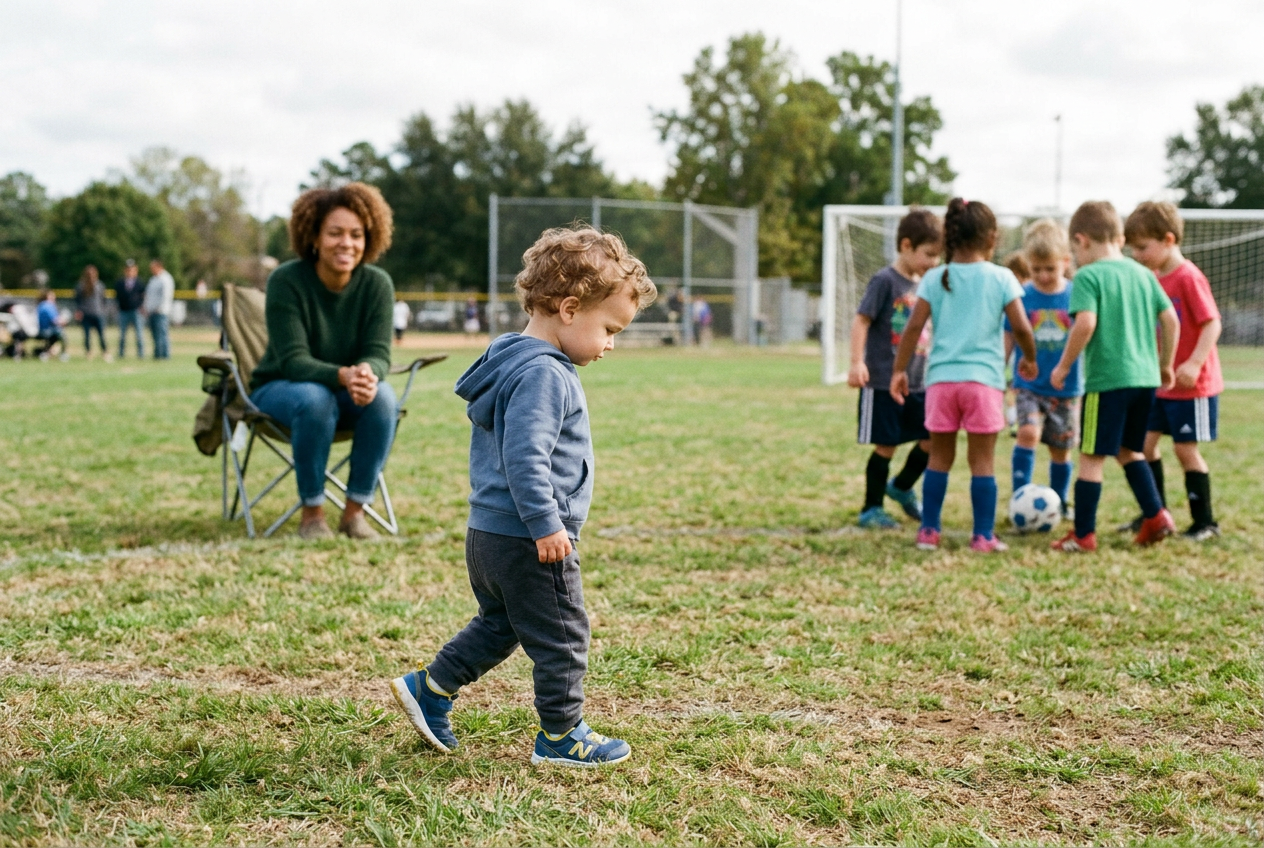
Many parents learn this lesson in ordinary places. A Saturday morning soccer field may not look like an education setting, but for a young child it can be a first encounter with a larger world. There are cones on the grass, a coach calling instructions, children running in different directions, parents standing along the sideline, and a child who suddenly realizes that a group has rules he does not yet understand.
A two- or three-year-old does not automatically know how to wait in line, follow a whistle, take turns, listen to a coach, or run with twenty other children. To adults, the activity looks simple. To the child, it may feel like a foreign country. The challenge is not soccer. The challenge is entering a social world.
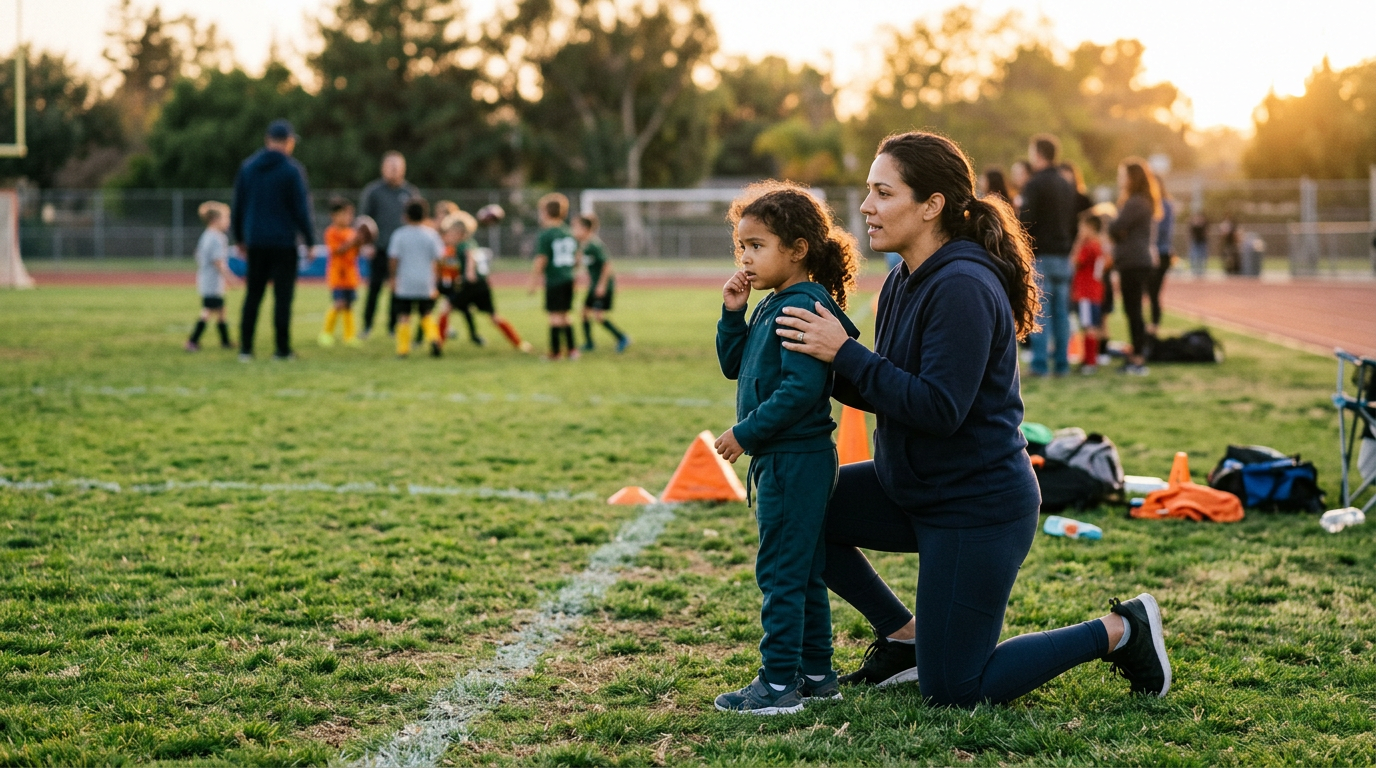
At that moment, a parent’s job is not to become the coach. It is to become a bridge. The parent kneels, names what is happening, repeats the instruction, points toward the group, encourages one small action, and waits. The parent does not shame the child for standing still. The parent does not rush the child into independence before the child has enough confidence to move.
Educational psychologists often call this kind of support scaffolding. Jerome Bruner and other researchers helped shape the idea that children learn best when adults provide enough structure for the next step and gradually remove that support as the child becomes capable. Parents know this intuitively. They hold the bicycle seat, then loosen their grip. They walk a child to the classroom door, then stop at the hallway. They sit beside a child during homework, then move to the other side of the table.
Good parenting is not permanent holding. It is well-timed support followed by well-timed release.
Hiring a Teacher Is Not the End of a Parent’s Responsibility
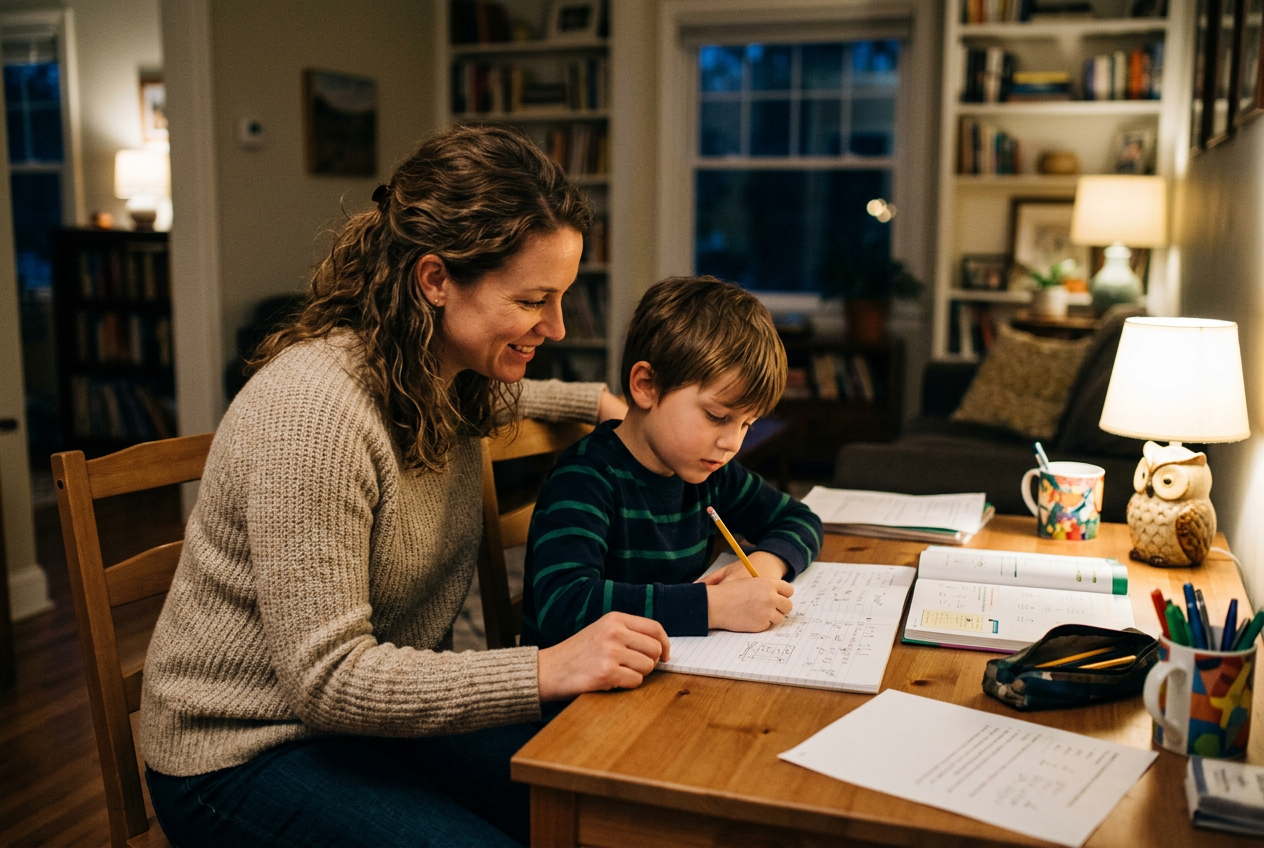
A second lesson often arrives later, when school becomes more demanding. A parent may believe that providing good teachers, good tutoring, and good opportunities is enough. This belief is understandable. Many parents work long hours precisely so they can give their children access to better education.
But a child can sit with excellent teachers and still feel lost. A student can have tutoring and still believe she is not smart. A child can appear lazy when she is actually afraid, disorganized, overwhelmed, or trapped in a cycle of repeated failure.
One common family story begins with a child who falls behind in fifth grade or middle school. The grades decline. Homework takes too long. A simple problem creates tears, eraser marks, and silence. The teacher may think the child is not trying. The child may think she is not capable. The parent, standing between the two, may feel both protective and frustrated.
The turning point often comes when a parent stops asking only, “Why won’t my child work harder?” and begins asking, “What is making this hard for my child?”
The answer may not be intelligence. It may be fear of being wrong. It may be weak executive function: difficulty starting tasks, organizing steps, tracking instructions, or finishing work without constant prompting. It may be a gap in reading comprehension, math foundations, attention, confidence, or classroom communication. Once the real problem is named, the family can stop treating the child’s struggle as a character flaw and start treating it as a learning problem that can be addressed.
This is where parents often become translators. They translate the teacher’s expectations into language the child can understand. They translate the child’s confusion back to the teacher. They help a tutor see that a student who looks careless may actually be anxious. They help the child understand that a teacher’s correction is not rejection. This kind of work is invisible. It rarely appears on a report card. But it can change the course of a child’s education.
Parents Should Support Without Taking Over
The danger, of course, is that support can become control. Julie Lythcott-Haims, the former Stanford dean and author of How to Raise an Adult, has warned North American parents about the cost of overparenting. When adults manage every decision, rescue every forgotten item, and remove every difficulty, children can become less prepared for adulthood, not more.
That warning matters. A parent’s presence should not erase a child’s responsibility. The goal is not to make childhood frictionless. The goal is to help children develop the ability to face friction with more tools, more confidence, and less fear.
A parent who sits beside a struggling child is not necessarily overparenting. A parent who diagnoses patterns, builds routines, communicates with teachers, and gradually transfers responsibility is doing something different. That parent is not replacing the child’s growth. The parent is creating the conditions in which growth can happen.
A healthy learning system usually follows a gradual shift. At first, the parent helps the child begin. Then the parent helps the child notice what went wrong. Then the child begins to plan, check, ask questions, and recover from mistakes. Over time, the parent moves from manager to coach, from coach to adviser, and from adviser to witness. The strongest families do not ask children to become independent all at once. They teach independence in stages.
Planning Is Not Pressure When It Is Rooted in Understanding
Many parents worry that planning will make them seem too demanding. In reality, children often need adults to see farther than they can. Planning becomes harmful when it is driven by comparison, fear, or status. It becomes useful when it is rooted in the child’s actual stage of development.
A parent does not need to plan a child’s entire life. But a parent does need to ask good questions. Does this child need confidence before acceleration? Does this child need reading support before more advanced math? Does this teenager need help with time management before adding another AP or IB course? Does this high school student need career exposure before choosing a university pathway?
North American schools often use the language of readiness: school readiness, college readiness, career readiness. The word is useful because it reminds parents that timing matters. A child benefits most from an opportunity when the child has the foundation to use it. This is why parental planning is not the same as parental pressure. Pressure asks, “How can my child do more?” Planning asks, “What does my child need next?”
The Parent as a Secure Base

Attachment theory uses the idea of a secure base: a child explores the world more confidently when there is a reliable adult from whom to move out and to whom to return. The phrase belongs to psychology, but parents understand it in daily life. A child runs onto the field and looks back. A teenager walks into an exam and remembers a parent’s steady voice. A student tries again because someone at home believes a bad result is information, not identity.
This does not mean children should remain dependent. It means that independence is often built from security, not from abandonment. Children take risks more readily when they know they are not alone. They learn to recover because someone first helped them recover. They learn to plan because someone first planned with them.
Eventually, the parent must step back. This is one of the hardest parts of raising a child. The parent who once translated every instruction, sat beside every worksheet, and explained every misunderstanding must slowly allow the child to speak, choose, fail, repair, and continue.
The image many North American parents recognize is the bicycle lesson. At first, the parent runs behind the child, one hand on the seat. The child wobbles, looks back, and checks whether the hand is still there. Then, at some point, the parent lets go. The child keeps moving, partly because she does not yet know she is riding alone. That moment is not a betrayal. It is the purpose of all the holding that came before.
What Tutriva Means by Supporting Growth Beyond Grades
Tutriva’s Parent Corner is built on a simple belief: grades matter, but children are more than their grades. A strong education system should help children build knowledge, confidence, habits, judgment, and direction. Teachers, tutors, coaches, and mentors all play essential roles in that work. Parents do too.
Parents cannot outsource noticing. They cannot outsource the long memory of who a child has been. They cannot outsource the quiet work of encouragement, repair, routine, and advocacy. They cannot outsource the responsibility to help a child understand that difficulty is not the end of the story.
At the same time, parents should not be asked to do everything alone. The healthiest model is partnership. A teacher brings professional judgment. A tutor brings instructional skill. A mentor brings experience and perspective. A parent brings presence, continuity, and love shaped by responsibility. Together, those adults can help a child move from fear to effort, from confusion to structure, from dependence to ownership, and from grades alone to a larger sense of growth.
The days may be long. The years are still short. What children carry forward is not only what parents provided, but the feeling that someone stayed close enough to understand them, and wise enough to let them grow.
On Tutriva, you can browse tutor profiles, read reviews, and message tutors directly to find the right support for your child’s stage right now. Get started →