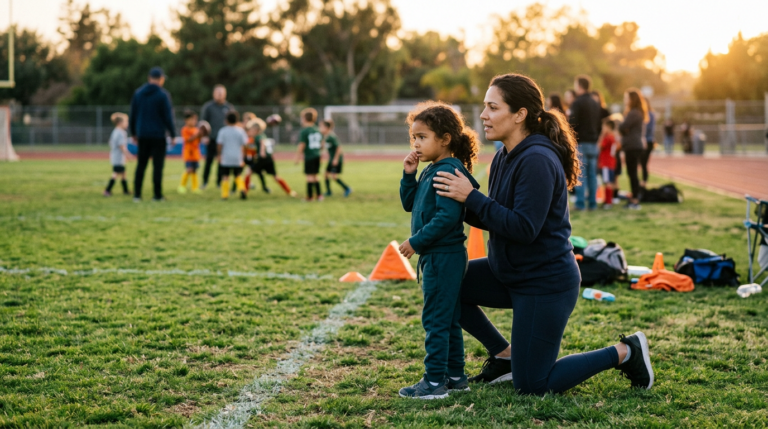
The Best Educational Partnerships Are Built Like Teams
How parents can build healthy, long-term relationships with teachers and mentors
In many families, the first sign of trouble is not dramatic. A child comes home quiet after math class. A weekly quiz is lower than expected. A teacher writes that assignments are missing. A parent opens the school portal at night and sees a pattern that did not exist a month ago.
The parent’s instinct is understandable: something is wrong, and someone must be responsible.
But the strongest education partnerships rarely begin with blame. They begin with diagnosis. A parent, teacher, tutor, or mentor needs to understand what has changed before anyone can decide what should happen next.
Stephen Covey gave many North American workplaces and families a useful phrase: “Seek first to understand, then to be understood.” In education, that idea is not a slogan. It is a practical rule. Children learn best when the adults around them can slow down long enough to understand the problem before arguing about the solution.
A healthy partnership does not ask parents to be passive. It asks parents and educators to work like a team. Each adult sees a different part of the child’s life. The parent sees sleep, mood, routines, motivation, and stress at home. The teacher sees class participation, academic patterns, peer dynamics, and daily performance. The mentor may see how a student thinks one-on-one, where the student hesitates, and what kind of support helps the student regain confidence. When these perspectives are combined, the child gets a better system of support.
Start with the learning problem, not the complaint
A child may say, “The teacher does not explain well.” Another child may say, “I understood it in class, but I could not do the homework.” A teenager may say nothing while grades slowly fall. A parent should take these signals seriously, but the first response should be inquiry, not accusation.
The issue may be a missing foundation. It may be weak reading comprehension. It may be that the student has moved into a more demanding stage of school and has not yet developed the study habits to match it. It may be test anxiety, fatigue, disorganization, or reluctance to ask questions in front of classmates.
A useful conversation begins with questions that make the problem visible: What have you noticed? Where does my child seem confident? Where does the work break down? What should we try for the next two weeks? What should we measure to know whether the plan is working?
This approach is close to the school-family-community partnership model associated with education scholar Joyce Epstein, whose work emphasizes that student success is supported by multiple forms of involvement: parenting, communication, learning at home, decision-making, volunteering, and community collaboration. The point is simple: a child does not learn inside one relationship. A child learns inside a network of relationships.
That network works best when adults share information instead of competing for control.

Safety is the first condition of trust
In North American education, child safety is often treated as so basic that it can become invisible. It should not be invisible. For minors, safety is not an extra feature of a tutoring or mentoring relationship. It is the foundation of the relationship.
A teacher may be brilliant. A tutor may have an elite degree. A mentor may have impressive professional experience. None of that replaces appropriate boundaries, transparent scheduling, respectful communication, safe learning settings, and clear expectations about how adults interact with children.
Parents should feel comfortable asking practical questions: How will sessions be scheduled? How will progress be communicated? What boundaries exist for messaging? What happens if the child feels uncomfortable? How are cancellations, feedback, and concerns handled?
These questions do not imply distrust. They create the conditions for trust. In a strong education relationship, safety is not assumed. It is designed.
The most prestigious educator is not always the right educator
Many parents begin the search for academic help by looking for signals of prestige. They notice universities, degrees, awards, test scores, and professional titles. Those signals can matter. They may show discipline, subject knowledge, and a high level of achievement.
But prestige does not automatically create fit.
A Harvard graduate may not be the right teacher for a six-year-old who needs warmth, patience, rhythm, and confidence. A math-competition coach may be excellent for an advanced student but overwhelming for a child rebuilding foundations. A university researcher may inspire a mature high school student but confuse a beginner who first needs structure and encouragement.
North American parents already understand this principle in sports, music, and medicine. The coach who trains Olympic-level athletes is not always the best first coach for a child learning to enjoy the game. The surgeon who handles complex cases is not necessarily the right professional for basic preventive care. Expertise must match the problem.
Atul Gawande, the surgeon and writer, once wrote in The New Yorker about the importance of coaching even for highly trained professionals. His larger point applies to education as well: improvement depends not only on talent, but also on the right kind of observation, feedback, and guidance at the right time.
Different stages require different kinds of adults
A strong parent-teacher partnership begins with the child’s developmental stage.
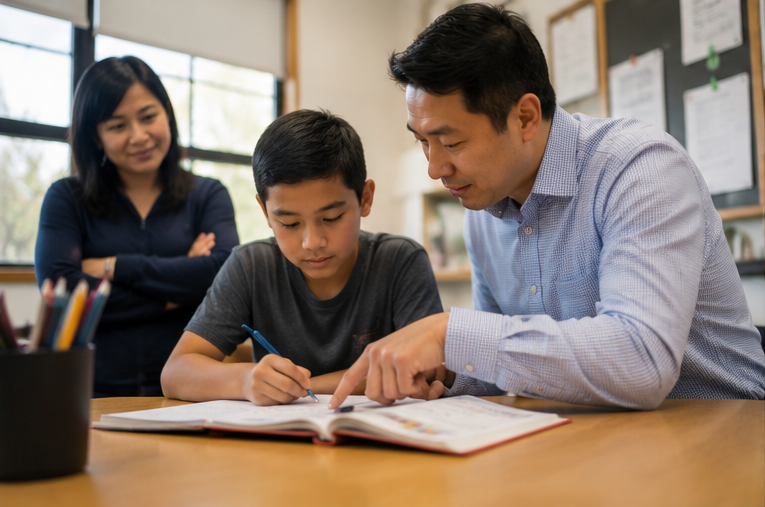
In early elementary school, many children need adults who protect curiosity, build routines, and make effort feel safe. At this age, patience is not a soft quality. It is an instructional tool. A child who feels rushed or constantly corrected may begin to associate learning with anxiety rather than confidence.
In middle school, students usually need a different kind of support. They need adults who can strengthen reading, reasoning, time management, and problem-solving habits. They also need help learning how to recover from mistakes. Middle school is often when children first discover that being smart is not enough; they need systems.
In high school, many students need mentors as much as tutors. They still need subject support, but they also begin making decisions about course selection, testing, research, university pathways, and career interests. The educator’s role becomes less about a single worksheet and more about helping the student connect today’s effort to tomorrow’s options.
Developmental psychologist Urie Bronfenbrenner argued that children grow inside interconnected environments: family, school, peers, community, and the larger culture around them. That idea helps explain why the right teacher matters so much. A teacher or mentor is not simply delivering content. That adult becomes part of the child’s learning environment.
Price should be discussed as value, not just cost
Parents have real budgets. A healthy education market should respect that. Families should not be made to feel that only the most expensive option can be meaningful.
At the same time, professional teaching is more than the hour that appears on a calendar. A strong educator may diagnose gaps, prepare materials, design practice, review mistakes, communicate with parents, adjust pacing, and track progress over time. A mentor may also bring years of experience that help a student avoid wasted effort.
A low-cost option may be appropriate for homework support or basic practice. A specialist may be appropriate for advanced test preparation, competition training, research guidance, or complex academic planning. The practical question is not, “What is the lowest price?” or “What is the highest-status teacher?” The practical question is, “What problem are we trying to solve, and what kind of professional support does that problem require?”
Respecting professional value is part of healthy communication. It prevents disappointment later because both sides understand what is included, what is not included, and what success should reasonably look like.
Healthy partnerships need boundaries
Education is unusual because every parent has also been a student. That experience gives parents strong instincts, but it can also make teaching appear simpler than it is. Professional education involves diagnosis, pacing, motivation, feedback, assessment, and judgment about when to push and when to pause.
A healthy partnership does not mean parents disappear. Parents know their child’s history, personality, routines, fears, and emotional life. They often see patterns that educators do not see. But teachers and mentors bring professional judgment about academic progression, instructional design, and learning behavior.
The strongest relationships respect both roles. Parents support consistency, sleep, routines, encouragement, and communication. Educators design the learning process, interpret academic patterns, and recommend next steps. Students gradually take more ownership of their own progress.
Boundaries protect the relationship. Families and educators should clarify when updates will be shared, how often parents should expect feedback, what kind of questions are appropriate between sessions, and how concerns should be raised. Without boundaries, anxiety can turn into micromanagement. With boundaries, concern becomes collaboration.
Good communication turns a setback into information
Low-trust communication asks, “Who caused this?” High-trust communication asks, “What can we learn from this?”
A parent might say, “We noticed the recent quiz was difficult. Could you help us understand whether the issue is concept knowledge, careless errors, or test anxiety?” A teacher might respond, “The student understands the idea in class, but the written work shows missing steps. I suggest we focus on showing reasoning for the next two weeks.”
That exchange does not ignore the problem. It makes the problem usable. A grade becomes evidence. A concern becomes a plan. A relationship becomes a partnership.
This is also why the language adults use around struggle matters. If adults treat every disappointing result as proof that the student is not capable, the student may internalize failure. If adults treat the result as a signal that the current strategy needs adjustment, the student is more likely to keep working. The difference is not blind optimism. It is disciplined problem-solving.
The adults around a child shape more than grades
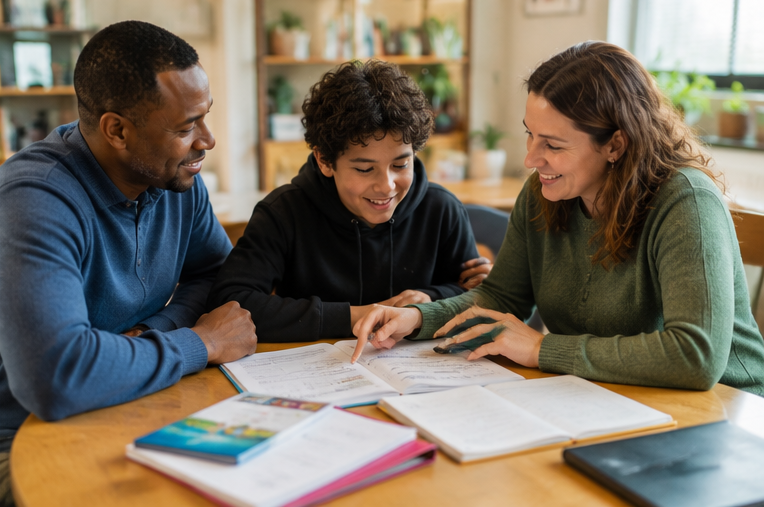
Years later, many students do not remember every worksheet or every test. They remember the adult who believed they could recover after a difficult semester. They remember the teacher who corrected them firmly without humiliating them. They remember the mentor who noticed effort before the result improved. They remember the tutor who helped them feel capable again.
Choosing a teacher or mentor is therefore not only an academic decision. It is a developmental decision. Adults who spend meaningful time with a child shape how the child understands effort, mistakes, authority, confidence, and responsibility.
Parents do not need to find a perfect educator. Perfect educators do not exist. Parents need to find a trustworthy, age-appropriate, professionally competent adult who can help the child take the next right step.
The best educational partnerships are not built on control. They are built on trust, clarity, safety, and the patience to keep walking in the same direction.
The Tutriva view
Tutriva’s Parent Corner begins with a simple belief: education works best when families and educators act as partners rather than opponents. A strong partnership protects the child’s safety, respects professional roles, clarifies expectations, and keeps the focus on growth beyond grades.
The right teacher may not be the most famous teacher. The right mentor may not be the most expensive mentor. The right adult is the one who understands the child’s current stage, communicates with respect, and helps the child grow in confidence as well as competence.
A healthy education relationship does not require parents, teachers, and mentors to agree on everything. It requires them to work from a shared purpose: helping the child become more capable, more confident, and more prepared for the future.
When adults understand one another, children are less likely to feel caught in the middle. They are more likely to feel supported by a team.
Parent Corner
Supporting Growth Beyond Grades
Tutriva | Learn · Grow · Connect · Explore · Impact