IB English A Tutoring (SL/HL): Literature, Language & Written Tasks
IB English A is the course where a lot of capable BC students hit a wall they did not expect. A teenager can be a strong reader, a confident writer in regular English class, and still feel lost the first time they are asked to write an unseen commentary on a poem they have never read, under time pressure, with no study notes allowed. That gap is normal. It is also exactly where a good IB English A tutor in BC earns their keep — by demystifying what the course is actually assessing and building the specific habits that move a 4 toward a 6.
This guide explains how IB English A works at SL and HL, the difference between Language and Literature versus Literature, and the four pieces of assessment that decide the grade: the Individual Oral, the HL Essay, Paper 1, and Paper 2. If you are still deciding whether the Diploma Programme is right for your family, start with the IB Diploma Programme parent guide and our online IB tutor overview first, then come back here for the English-specific detail.
What “English A” actually means in the IB
In IB terminology, “English A” is the language and literature group (Studies in Language and Literature) taken in a student’s strongest academic language. It is one of the six subject groups every Diploma student chooses from — separate from the IB core of Theory of Knowledge, the Extended Essay, and CAS. For most BC students at schools like Sir Winston Churchill Secondary in Vancouver, Carson Graham in North Vancouver, or West Vancouver Secondary, English A is the natural choice in this group.
There are two distinct English A courses, and families often confuse them:
- English A: Literature — focused entirely on literary works: novels, plays, poetry, and short fiction. Students study how authors use language to create meaning.
- English A: Language and Literature (“Lang & Lit”) — splits attention between literary works and non-literary texts: advertisements, opinion columns, speeches, infographics, political cartoons, and other real-world media. This course leans heavily on analysing how context, audience, and purpose shape a text.
Both are offered at Standard Level (SL) and Higher Level (HL). The skills overlap, but the texts and the framing differ enough that a student who thrives in one can struggle in the other.
Lang & Lit vs Literature: which suits your student?
There is no universally “better” choice — it depends on how your teen thinks.
A student who loves novels, reads for pleasure, and enjoys getting deep inside a single text often prefers Literature. A student who is curious about media, politics, advertising, and how language is used to persuade in the real world usually connects more with Lang & Lit. The non-literary half of Lang & Lit also tends to feel more immediately “useful” to students headed toward business, communications, journalism, or the sciences.
Practically, the school often makes the choice for you — many BC IB schools offer only one of the two. Where there is a choice, an IB English A tutor can help your student trial a sample text from each and notice which one they can actually say something interesting about. That instinct matters more than the course label.
SL vs HL: what changes
The reading list grows and the demands deepen at HL, but the headline structural difference is one extra assessment:
- SL students complete the Individual Oral, Paper 1, and Paper 2.
- HL students complete all of the above plus the HL Essay — a formal academic essay of up to 1,500 words, developed from a line of inquiry into one text or work studied in class.
HL also requires more works overall and rewards a more sophisticated, sustained argument. If your student is strong in English and considering an arts, humanities, or law pathway at university, HL English A is a sensible signal of ability. If English is a relative weakness and the timetable is already heavy with HL sciences, SL is a perfectly respectable choice that protects the overall Diploma score. Students balancing English alongside a quantitative HL load often pair this support with a North Vancouver IB DP math tutor to keep both ends of the timetable steady.
The four assessments — and where tutoring helps most
The IB grades English A out of 7. That single number comes from a mix of internal assessment (marked by the teacher, moderated by the IB) and external assessment (sent away and marked by IB examiners). Here is what each piece is, in plain terms.
1. The Individual Oral (internal assessment)
The Individual Oral, or IO, is a roughly 15-minute spoken assessment. The student presents a prepared analysis built around a global issue (something like power, identity, belief, or the environment) and shows how that issue is explored across one literary work and one non-literary text (in Lang & Lit) or two literary works (in Literature). A short discussion with the teacher follows.
This is where many otherwise-strong writers lose marks, because speaking analytically under time pressure is a different skill from writing. Tutoring here focuses on three things: choosing a global issue that is specific enough to sustain analysis, selecting extracts that genuinely connect, and rehearsing the delivery so the student sounds analytical rather than descriptive. The goal is for the student to argue, not summarise.
2. The HL Essay (HL only)
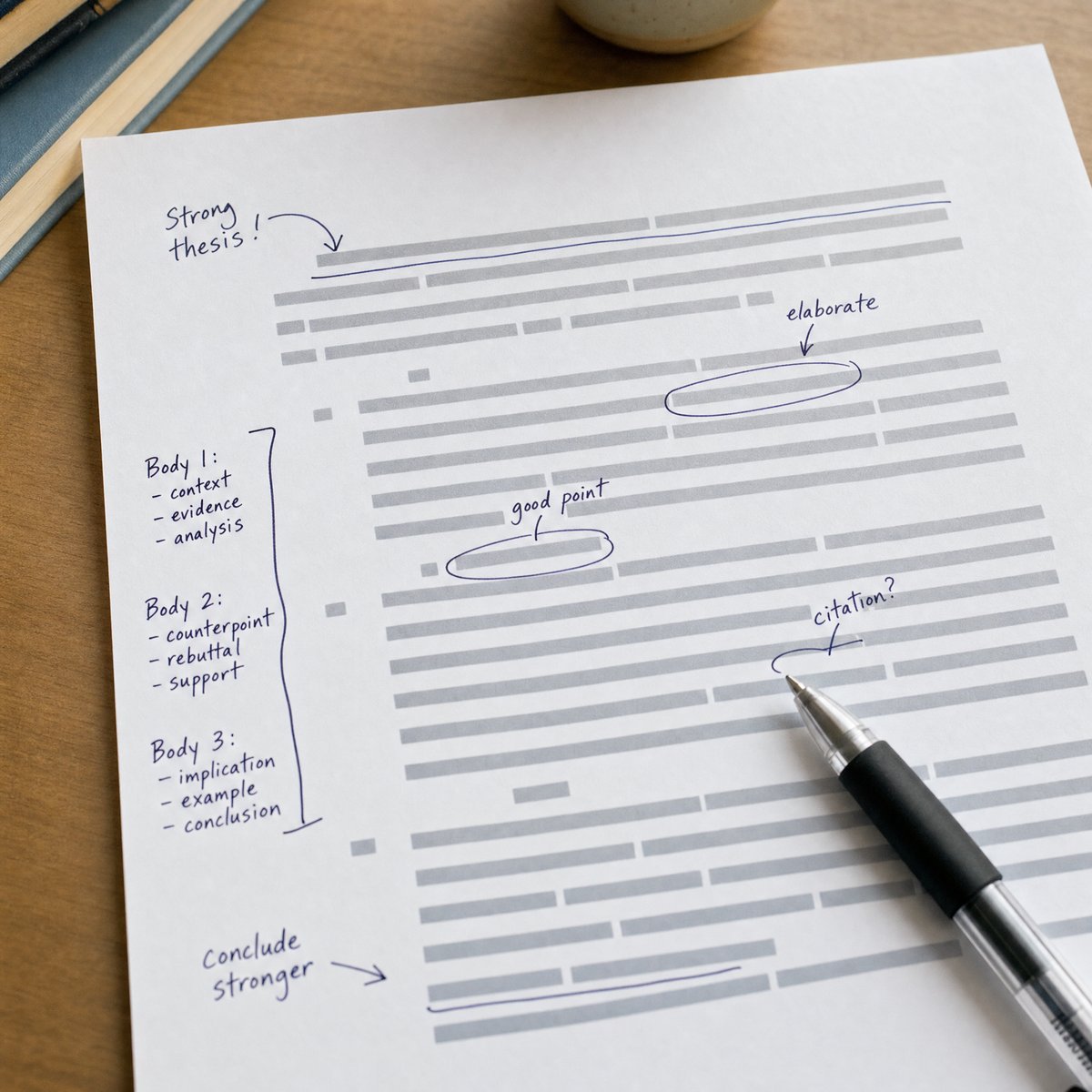
The HL Essay is a formal essay of up to 1,500 words exploring a focused question about one text or work. It is the closest thing in IB English to university-style literary criticism: a clear thesis, a sustained line of argument, close textual evidence, and academic register throughout.
Students who have never written a long analytical essay independently often need the most help here with narrowing the question. “How does the author present women?” is too broad; “How does the author use shifts in narrative perspective to complicate the reader’s sympathy in the final third of the novel?” is a question you can actually answer within the word limit. A tutor can coach the inquiry stage — the part students rush — and then help structure the argument so each paragraph advances the thesis rather than restating it. Our Vancouver English writing tutor overview covers the broader academic-writing habits that feed directly into HL Essay success.
3. Paper 1: guided literary analysis (external assessment)
Paper 1 is the unseen analysis, and it is the assessment students fear most. They are given previously unseen text(s) — a poem, a prose extract, or a non-literary text in Lang & Lit — each with a guiding question, and must produce an analytical commentary. SL students analyse one text; HL students analyse two, under more time.
The key word is unseen. There is no content to memorise, which feels unfair to students used to studying for tests by reviewing notes. The skill being tested is the ability to read closely and quickly: to spot how structure, diction, imagery, tone, and form create meaning, and to organise those observations into a coherent argument led by the guiding question. This is a trainable skill. A tutor builds it by working through a bank of varied extracts so the student develops a reliable annotation routine and a flexible essay structure they can deploy on anything the exam throws at them. The close-reading foundations matter long before IB, which is why we emphasise reading comprehension for BC kids in grades 4–9 as the groundwork that pays off years later.
4. Paper 2: comparative essay (external assessment)
Paper 2 asks students to write a comparative essay on two of the literary works they studied during the course, responding to one of several general questions. Crucially, students do not get to see the questions in advance and cannot bring the texts into the exam — so they must know two or three works well enough to discuss theme, character, structure, and authorial technique from memory.
Tutoring for Paper 2 centres on preparation discipline: building comparative grids that map how each chosen work handles common exam themes, memorising a small bank of precise quotations, and practising the comparative structure (analysing the two works together, point by point, rather than writing one essay then another). The students who do well are the ones who walked in with two flexible, well-understood works — not the ones who hoped a favourable question would appear.
What a good IB English A tutor actually does
Beyond the four assessments, effective IB English support tends to share a few features:
- Diagnoses the real gap. Is the student weak at close reading, at structuring an argument, at managing exam time, or simply at speaking analytically for the IO? The fix is different in each case.
- Works with the school’s text choices, not against them. A tutor should reinforce the works your student is actually studying, not introduce a competing reading list.
- Builds independence. The aim is a student who can annotate an unseen poem and plan a Paper 1 response without hand-holding — because no tutor sits beside them in the exam room.
- Keeps the whole Diploma in view. English A is one of six subject groups plus the core. A good tutor helps your teen spend effort where it moves the total score, and connects to the wider IB picture covered in our IB Diploma Programme parent guide.
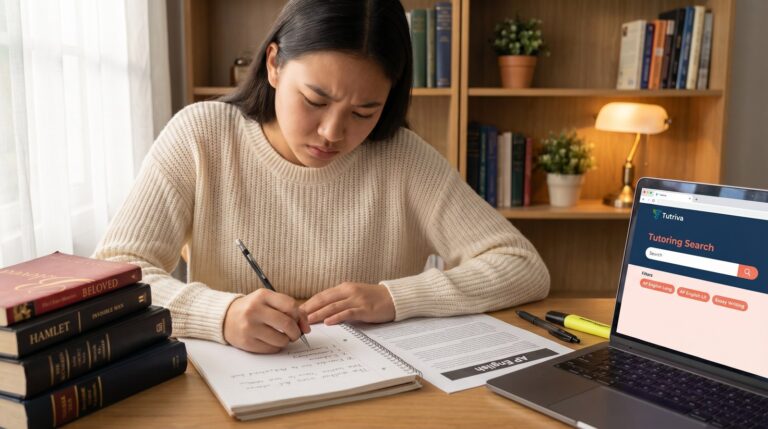
On Tutriva, families browse IB English A tutors directly, read each tutor’s full profile — subjects, background, and experience are shown openly on the profile — and book a free first lesson before committing. Because you communicate with the tutor directly and there is a transparent monthly fee with no commission taken from the tutor, you can test the fit on a real piece of your student’s coursework, not a sales pitch. We always recommend parents verify fit themselves: use the free first lesson, read the reviews other families leave, and stay in direct contact.
Frequently asked questions
When should we start IB English A tutoring?
Many families wait until a disappointing Paper 1 mock, but the most useful time to start is early in the first year, before habits set. Support in the inquiry and close-reading phase prevents the panic that comes when assessments stack up in the second year. That said, targeted help in the final months before exams can still lift a Paper 1 or Paper 2 result meaningfully.
My child reads well but freezes on Paper 1. Is that normal?
Very. Reading for pleasure and producing a timed analytical commentary on an unseen text are different skills. The freeze almost always comes from not having a reliable annotation-and-structure routine. That routine is teachable, and it is one of the highest-return things to work on with a tutor.
Should my student take English A at HL or SL?
If English is a genuine strength and points toward an arts, humanities, communications, or law future, HL signals that ability and the HL Essay is good preparation for university writing. If English is a relative weakness and the timetable is already HL-heavy in other subjects, SL is a sound, score-protecting choice. There is no penalty for being strategic.
Can an online tutor support IB English A effectively?
Yes. English A is text- and discussion-based, which suits online sessions well — a tutor can annotate a shared document live, run Individual Oral rehearsals over video, and mark essays asynchronously. Online also widens the pool so you are not limited to tutors near your neighbourhood.
Do you guarantee a 7?
No honest tutor or platform should. Grades depend on the student’s effort, the works they choose, and exam-day performance. What good support reliably provides is clarity about what each assessment rewards and the practised skills to meet it. We always recommend parents verify fit themselves — use the free first lesson, read tutor reviews, and stay in direct contact.
Get started
If your student is in the IB Diploma Programme and English A feels like the subject pulling their average down — or you simply want to lock in a strong grade — the next step is a conversation with a tutor who knows the course.
Browse IB English A tutors and book a free first lesson on Tutriva. You choose the tutor, you see the full profile, and the first lesson is free — so you can judge the fit on your own student’s work before deciding anything.
Not sure English is the priority? Start with the whole-Diploma picture in the IB Diploma Programme parent guide, then create your free Tutriva account when you are ready to find the right tutor.