
Why Strong Tutors Still Miss the Students Who Need Them
A Sunday-night search
On a Sunday evening in Vancouver, a parent opens a laptop after dinner. Her son is preparing for the SAT. His math score is not weak, but it is not yet strong enough for the university list the family has quietly built over the past year.

She types a search query and sees more than twenty tutor profiles. Several tutors have graduate degrees. Some have taught for more than a decade. One has coached math competitions. Another once taught in a school. A few list elite universities, medals, and long strings of course names.
Within ten minutes, the parent opens five profiles, sends messages to two tutors, and books a trial lesson with one.
The question is not whether the other tutors were qualified. Many of them probably were. The question is why one profile gave the parent enough confidence to take the next step.
The profile is no longer a resume
Many educators still treat a tutoring profile as a resume. They list degrees, years of experience, subjects, and test names. Those details matter. Families want competent people. But in a crowded digital marketplace, credentials do not automatically translate into trust.
A resume answers one question: What have you done? A strong educator profile answers a different question: Who can you help, how will you help them, and why should a family trust you with a child’s learning?
That distinction matters because parents do not browse tutor profiles like hiring managers reviewing full applications. They browse under pressure. They may be tired, anxious about admissions, worried about a child’s confidence, or unsure how to judge educational quality. They are not only comparing schools and certificates. They are trying to decide whether another adult understands their child’s problem.
In North American education culture, this is a familiar pattern. Families compare school staff bios, LinkedIn pages, college advising pages, camp instructor profiles, and therapist directories in the same way: first they look for fit, then they look for proof. A profile that does not communicate fit quickly may be skipped before its strongest qualifications are even read.
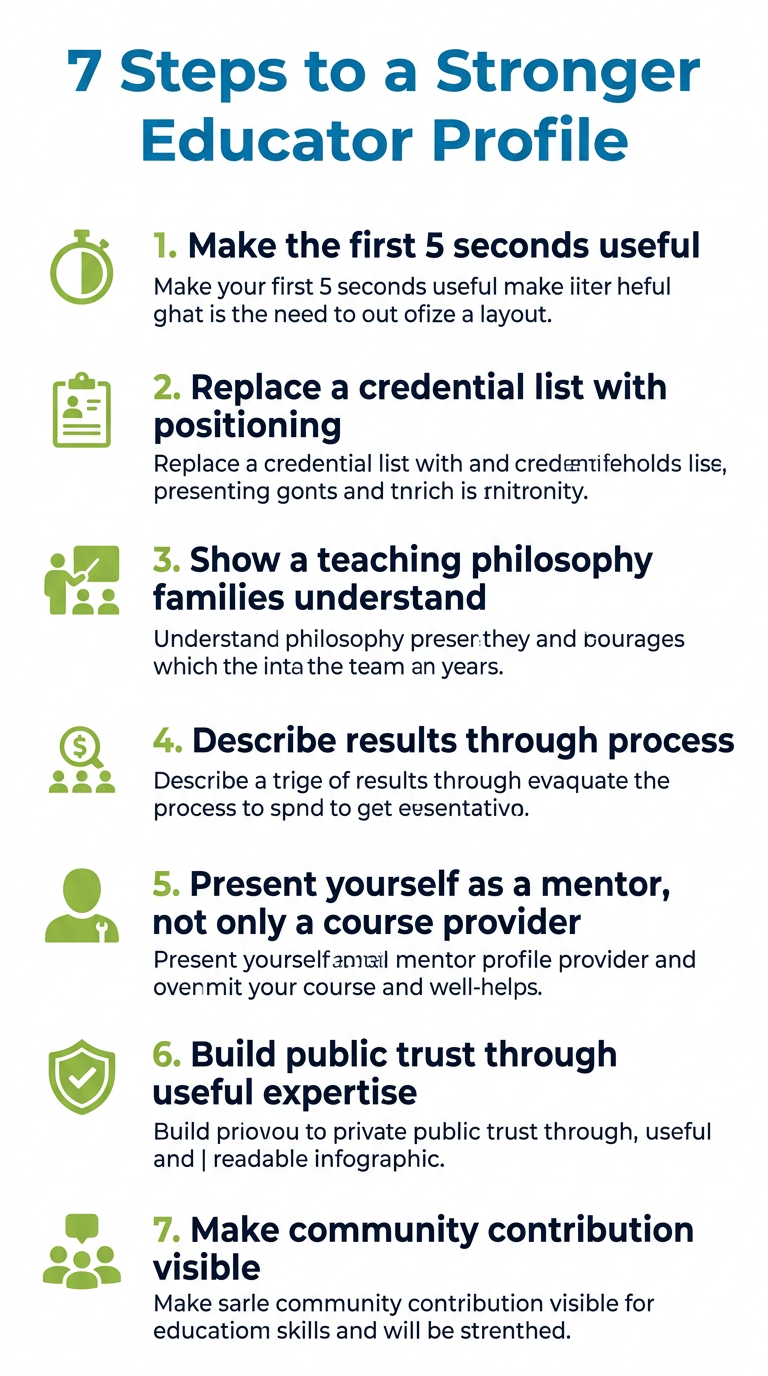
Step 1: Make the first five seconds useful
A headline such as “Math Tutor” is accurate, but it does not help a parent make a decision. It tells the family the subject, not the problem solved.
A stronger headline names the audience, the field, and the value. “SAT Math and AMC Coach for Grades 8-12” gives parents a clear category. “IB Mathematics Educator Helping Students Move from Confusion to Confidence” adds the outcome. “Former High School Teacher Specializing in Academic Recovery and Grade 8-12 Math” tells a parent why the profile may be relevant to a struggling student.
Clear language is not decoration. It is a public service to families who are already overwhelmed by choices.
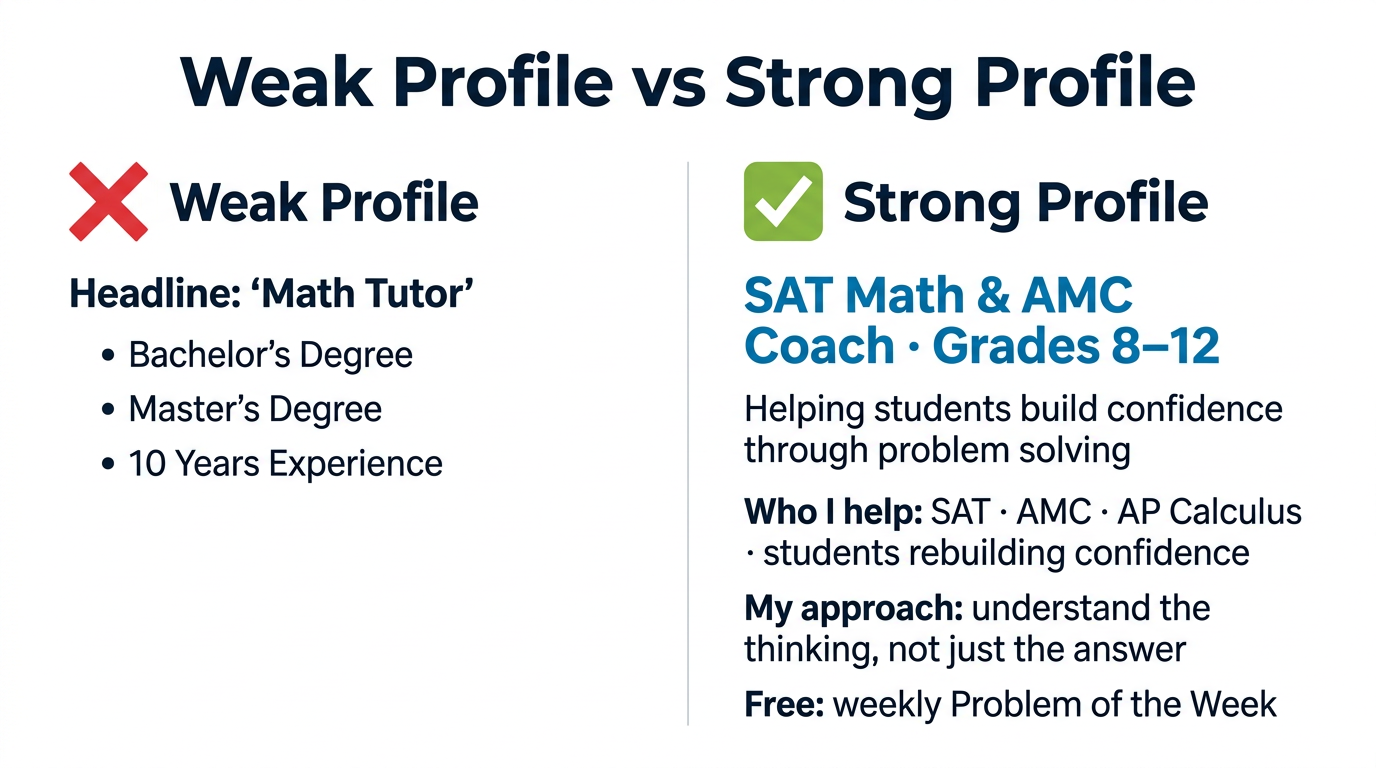
Step 2: Replace a credential list with positioning
Degrees and experience should be included, but they should not carry the whole profile. A family does not only ask, “Is this tutor impressive?” It asks, “Is this tutor right for my child?”
A strong profile explains the students an educator serves best. An SAT tutor might write that she helps students who understand the content but lose points under time pressure. An AMC coach might say he works with curious middle-school students who need a systematic contest-training path. An AP Calculus teacher might say she helps students rebuild algebra and functions before moving into derivatives and applications.
Good positioning narrows the audience. That is not a weakness. The strongest profiles do not try to speak to everyone. They help the right students recognize themselves.
Step 3: Show a teaching philosophy families can understand
Families in the United States and Canada still care about grades, scores, and admissions results. But many also care about confidence, independence, mental stamina, and long-term learning habits. A profile should therefore explain not only what the educator teaches, but how the educator thinks about learning.
An educator might write: “I do not want students to memorize steps they cannot explain. I want them to understand why a method works, where mistakes come from, and how to check their own reasoning.” Another might write: “My goal is to help students become less dependent on hints over time.”
This kind of language works because tutoring is a trust relationship before it is a transaction. A parent is not only buying a lesson. A parent is deciding whether another adult can enter a child’s learning life.
Step 4: Describe results through process
Many tutors mention that students improved by 200 points, entered selective programs, or won awards. Those results can be worth including when they are true. But a results list without a process can feel like advertising.
A stronger profile explains how improvement happens. The educator may diagnose weak foundations, rebuild a study plan, assign timed practice, review errors weekly, and teach the student to explain reasoning out loud. The process tells the family that the tutor is not relying on personality or luck. The tutor has a method.
North American parents often respond well to transparency. They want to know what will happen after the first lesson begins.
Step 5: Present yourself as a mentor, not only a course provider
Traditional tutoring platforms sort educators by subject: math, English, physics, chemistry. Families need subjects, but many students need more than subject delivery. They need an adult who can connect schoolwork to a larger path.
A student preparing for SAT math may need test strategy, but also confidence under pressure. A student interested in research may need someone who can explain what a real project looks like. A student considering engineering may need a mentor who can describe how mathematics becomes design, systems, and responsibility.
This is central to Tutriva’s broader vision. A tutor teaches content. A mentor helps a learner understand where that content can lead. The most valuable educators often do both.
Step 6: Build public trust through useful expertise
Many strong educators assume good work will naturally be discovered. In a digital environment, that is rarely enough. Visibility is not vanity when it helps families understand professional judgment.
Sharing expertise does not have to mean aggressive promotion. An educator can publish a short explanation of a common SAT mistake, a problem-solving tip, a reading recommendation, a study-planning checklist, a reflection on motivation, or a story about how students learn from errors. Each piece of public guidance gives families evidence of how the educator thinks.
Professionals in North America build credibility this way all the time. Lawyers write practical explainers. Physicians give public health talks. Professors hold office hours and public lectures. Consultants publish short notes on problems they understand. The goal is not constant advertising. The goal is to be useful in public.
Step 7: Make community contribution visible
An educator’s value does not exist only inside paid lessons. A tutor who hosts a free parent Q&A, shares a practice resource, gives a career talk, mentors a first-generation student, or helps a family understand an academic path is building trust that may not appear in a standard resume.
Future educator profiles should show more than course lists. They should be able to show learning resources, community contributions, career insights, research experience, mentorship experience, and community impact. These signals help families understand not only what an educator teaches, but how the educator contributes to a learning community.
This approach also fits a broader North American policy conversation about education equity, lifelong learning, and social capital. Opportunity is shaped not only by classroom access, but also by access to trusted adults, professional guidance, and information that well-connected families often receive informally.
A 15-minute profile improvement plan
If an educator has only 15 minutes, the first step is to rewrite the headline. The headline should identify the students served, the subject area, and the problem the educator helps solve.
The second step is to add a short teaching philosophy. The educator should answer three questions: Why do I teach? How do I teach? What should students gain beyond one lesson?
The third step is to share one useful resource. It can be one problem, one book, one learning strategy, one parent tip, or one short story about student growth. A profile becomes more trustworthy when it shows evidence of thinking.
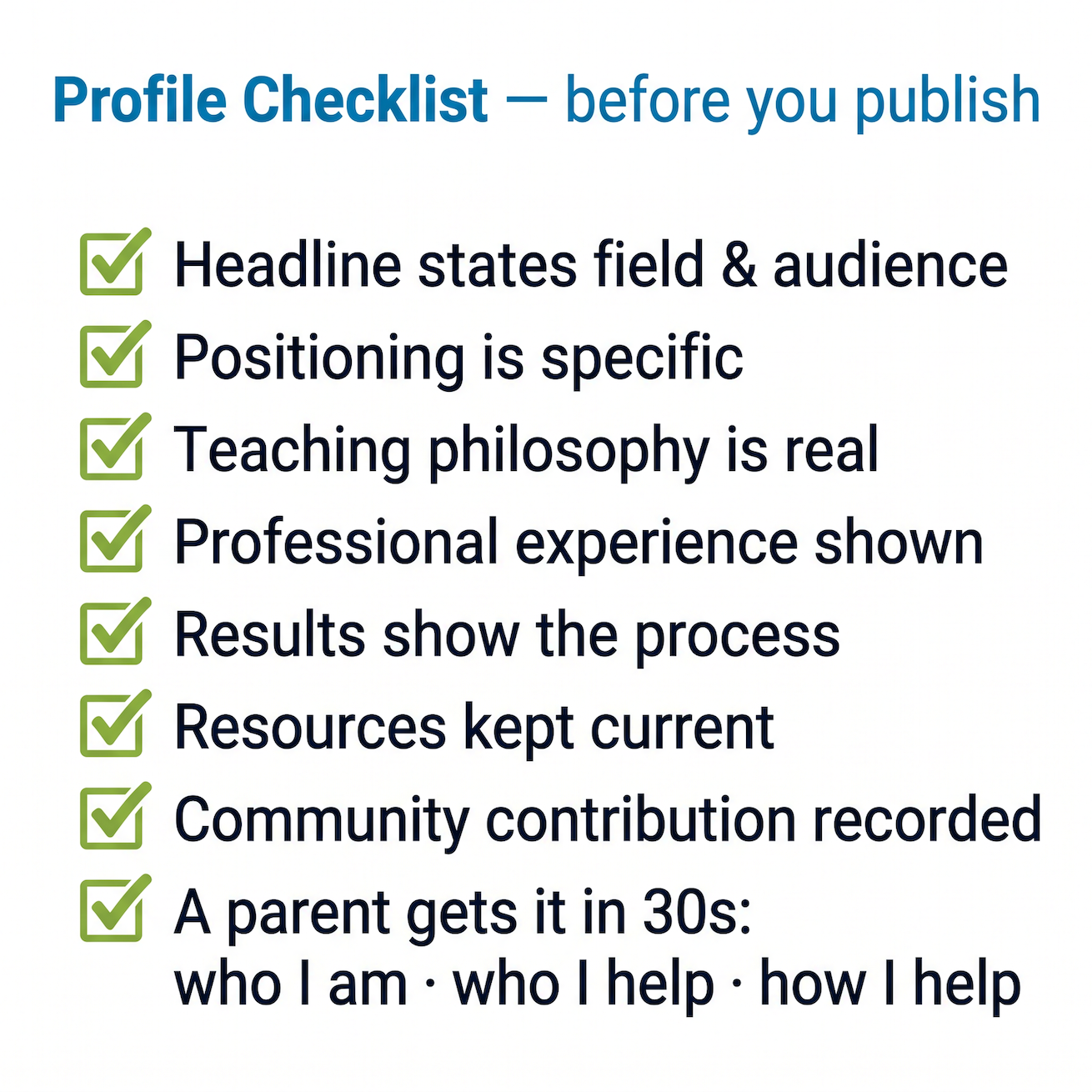
A practical checklist before publishing
Before publishing a profile, an educator should ask a few direct questions. Does the headline clearly state the focus? Does the profile explain which students the educator helps best? Does it show a teaching philosophy? Does it describe results through process? Does it show professional background beyond a course list? Does it include resources or contributions? Can a parent understand in 30 seconds who the educator is, whom the educator helps, and how the educator helps?
Strong educators do not always miss students because they lack ability. Many miss students because their profiles do not translate ability into trust. In a crowded marketplace, a strong profile is not decoration. It is the first serious conversation between an educator and a family.
A good profile will not make someone a better teacher. But it can help the students who genuinely need that teacher find the right person sooner.
Helping Educators Build Trust, Visibility, and Impact.Learn · Grow · Connect · Explore · Impact
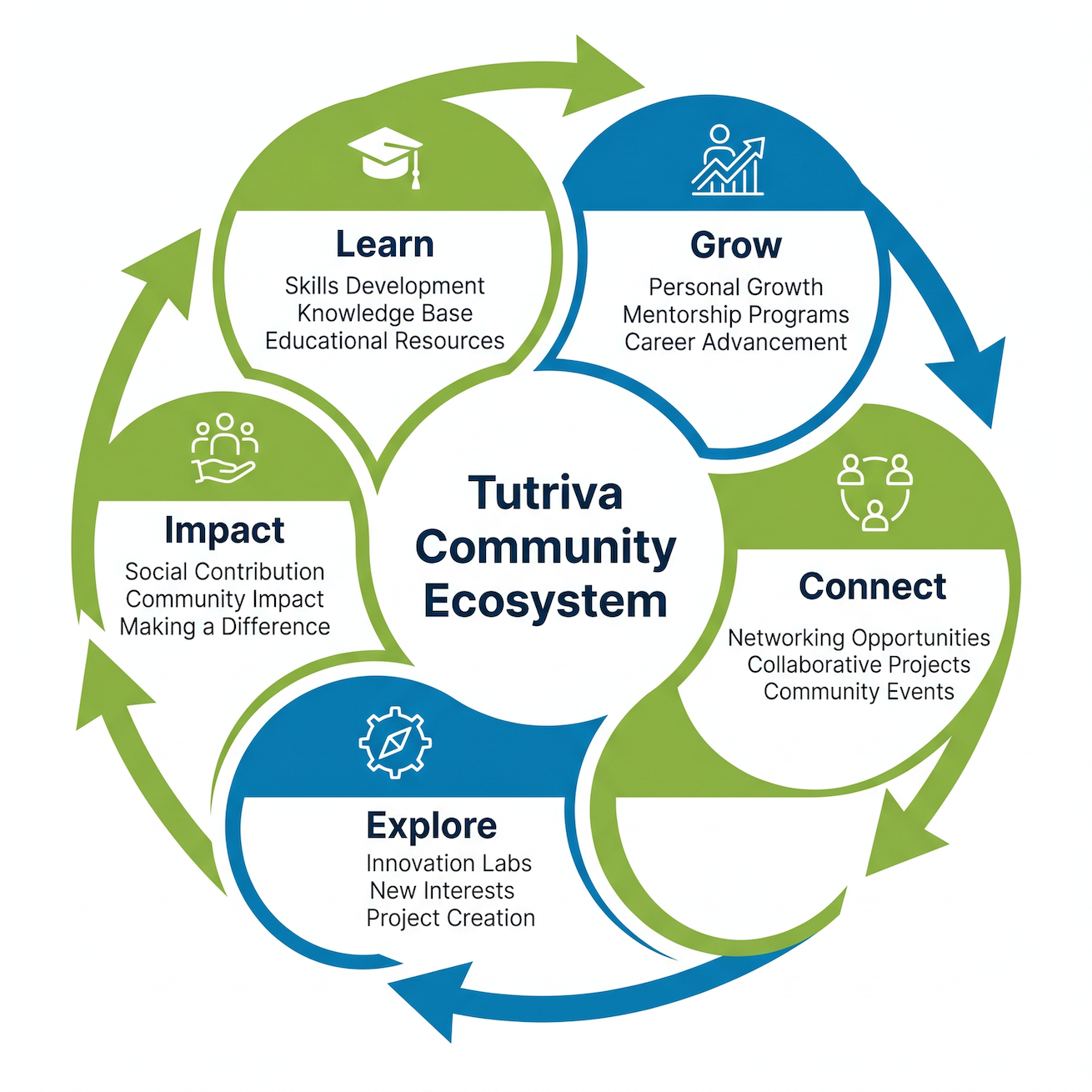
Tutriva Educator Growth
Helping Educators Build Trust, Visibility, and Impact.
Learn · Grow · Connect · Explore · Impact