SSAT Math Guide (October 2025): Why the Questions Aren’t Hard, but the High Scores Keep Slipping
In SSAT preparation, parents often believe:
👉 “Math is the easiest section.” 👉 “If the fundamentals are solid, a high score follows.”
But after the October 2025 SSAT, a clear pattern has emerged:
Overall math difficulty is stable — yet top-tier scores (780-800) have become harder to reach.
Why?
Because SSAT Math doesn’t simply test “do you know it.” It tests:
👉 Accuracy + reading comprehension + logical detail control.
Start here:
📌 Students & parents → Find an SSAT Math tutor 📌 Tutors → Join Tutriva and support SSAT Math students
1. October 2025 SSAT Math: Where the Real Shift Is
1.1 Content Knowledge: Stable (not difficult)
Core coverage remains:
- Algebra — linear equations, inequalities, quadratic basics, systems of equations
- Geometry — area, perimeter, volume, coordinate geometry
- Exponents — power rules, radical operations
- Ratio & Proportion — ratio, percentage, rate
- Number Theory — factors, multiples, parity, primes
👉 Reality: no content beyond curriculum, no complex calculation.
1.2 Difficulty: Hidden in “How the Question Is Written”
The real difficulty lies in:
- Complex question description
- Hidden conditions
- Word traps
👉 Conclusion: SSAT Math isn’t about “hard calculation.” It’s about “hard reading.”
1.3 Scoring Mechanism: Details = Points
The SSAT has a key rule:
👉 Penalty for wrong answers (1/4 point deducted per wrong answer; blank = 0).
This means:
- Carelessness = lost points
- Wrong guessing = lost points
- Misreading = lost points
👉 So: Stability matters more than speed.
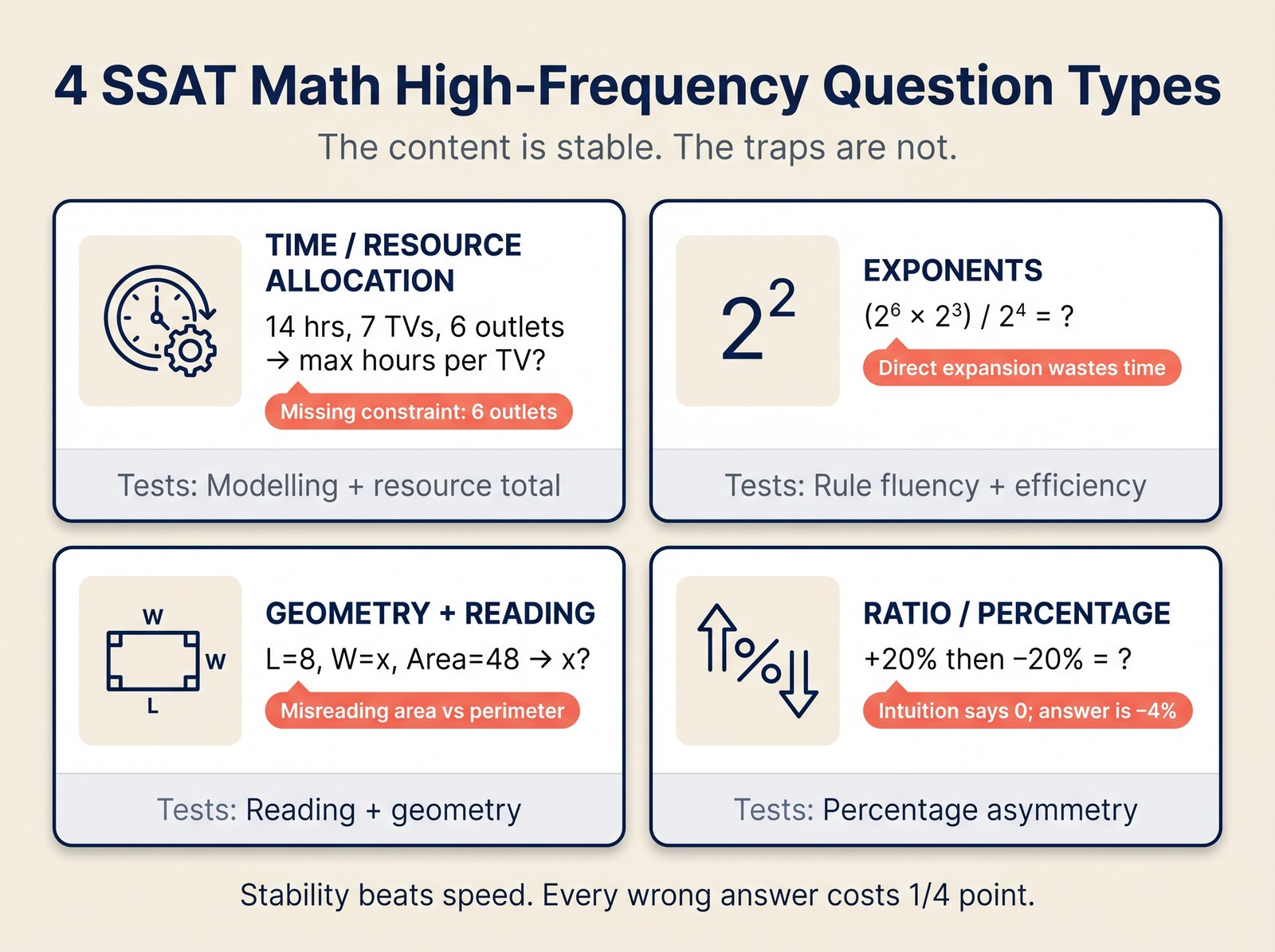
2. SSAT Math High-Frequency Question Types with Examples
Four high-frequency SSAT-style question types:
Type 1 — Time / Resource Allocation (classic high-frequency)
Example:
A room is open for 14 hours. It has 7 TVs but only 6 outlets. If the TVs rotate and each gets equal time, what is the maximum hours each TV can be used?
Solution approach:
- Total available time = 14 × 6 = 84 outlet-hours (6 outlets working for 14 hours)
- Divided equally among 7 TVs
- 👉 84 ÷ 7 = 12 hours
Common traps:
- ❌ Using 14 ÷ 7 = 2 hours (ignoring the “6 outlets” constraint)
- ❌ Using 14 × 7 ÷ 6 (wrong modelling)
👉 What it actually tests:
- ✔ Resource-total understanding (14 hours × 6 outlets = 84 outlet-hours)
- ✔ Logical modelling
Type 2 — Exponent Operations
Example:
$$\frac{2^6 \times 2^3}{2^4}$$
Solution:
$$2^{6+3-4} = 2^5 = 32$$
Common traps:
- ❌ Expanding directly (64 × 8 = 512, then 512 ÷ 16 = 32) — wastes time
- ❌ Forgetting exponent rules (order of operations for exponents)
👉 What it actually tests:
- ✔ Rule fluency
- ✔ Computational efficiency
Type 3 — Geometry + Reading Comprehension
Example:
A rectangle has length 8 and width x. Its area is 48. Find x.
Solution:
$$8x = 48 \Rightarrow x = 6$$
Common traps:
- ❌ Misreading the condition (confusing area with perimeter)
- ❌ Ignoring units (the test sometimes hides unit shifts)
Type 4 — Ratio / Percentage (where traps hide most)
Example:
A product’s price rises 20%, then falls 20%. What’s the final change?
Solution:
Assume initial price 100:
- → +20% → 100 × 1.2 = 120
- → −20% → 120 × 0.8 = 96
👉 Final: down 4%
Common trap:
- ❌ Believing “+20% then −20% = no change” (intuition trap)
👉 What it actually tests:
- ✔ Percentage asymmetry — the same percentage up and down produces different results because the base changes
Mid-article CTA:
📌 Students & parents → Browse SSAT Math tutors 📌 Tutors → Join Tutriva and support SSAT Math students
3. The Biggest SSAT Math Traps (Core Summary)
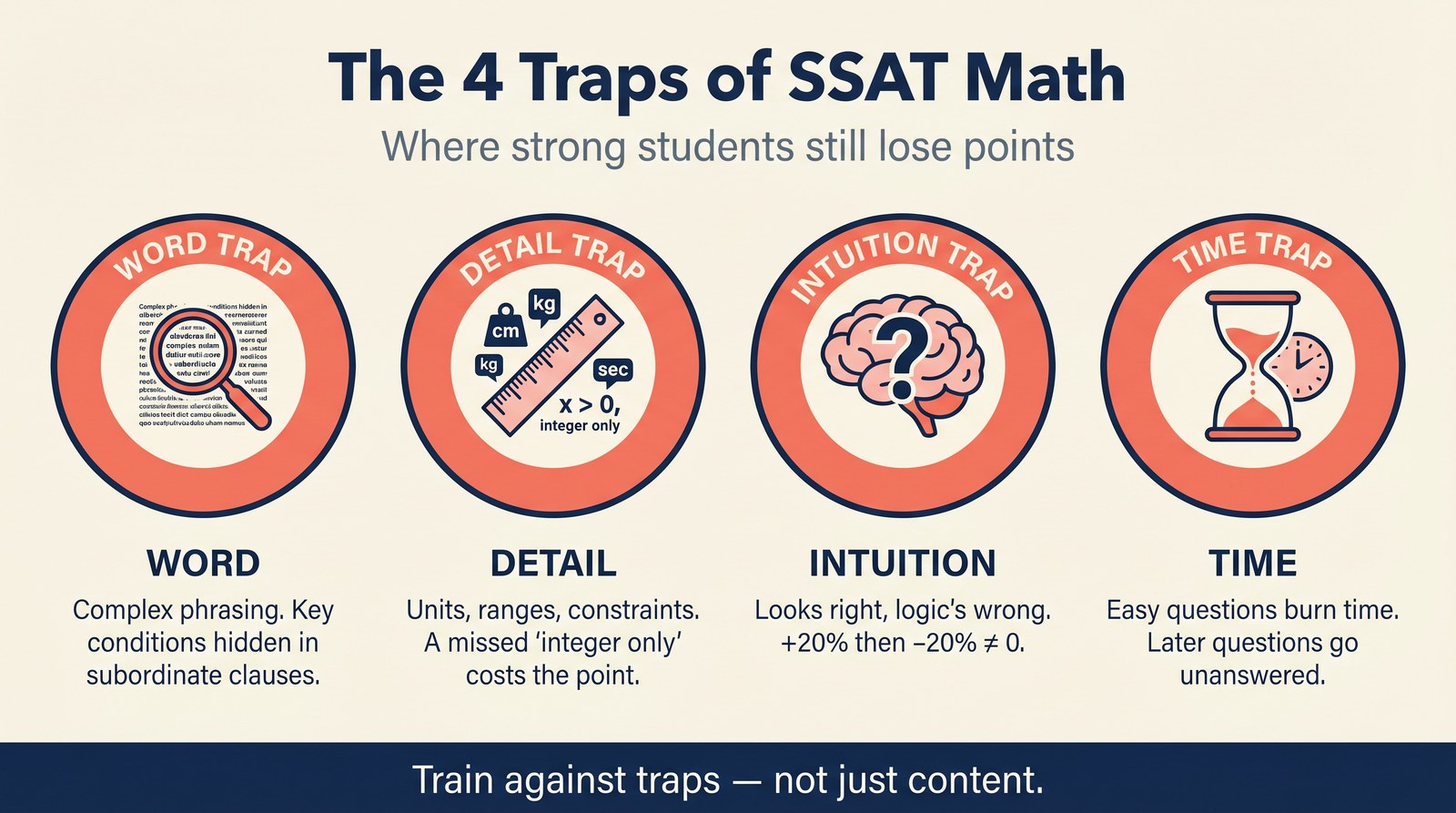
3.1 Word Trap
Complex phrasing, key conditions hidden inside relative clauses.
Example: “A team of 5 students, three of whom are seniors, is chosen…” — the “three of whom are seniors” clause is often the decisive condition.
3.2 Detail Trap
- Units (inches vs feet, cm vs m)
- Range (positive only? integer only?)
- Constraints (non-negative, less than 10, etc.)
3.3 Intuition Trap
Looks right, but the logic is wrong.
Typical examples: percentage asymmetry (+20% −20% ≠ 0), counter-intuitive probability (Monty Hall-style), geometric visual misdirection (area ratio vs side-length ratio).
3.4 Time Trap
Spending too long on easy questions → running out of time.
SSAT Math averages about 1 minute per question. If the first 10 questions took 15 minutes, only 10 minutes remain for the next 15 — which often contain easier, pickup-point questions.
4. Why “Strong Fundamentals” Still Don’t Deliver Top Scores
Because SSAT Math tests:
4.1 Accuracy
Not “can you solve it” — but “are you 100% correct.” A question you could solve but got wrong = lost points.
4.2 Consistency
Whether every question is handled without a mistake. Three wrong out of 25 can drop a student from 99th percentile to 90th.
4.3 Math Reading
Understanding the problem description. 40% of SSAT Math score actually comes from “reading the problem correctly.”
👉 Many students:
- ✔ Could solve it
- ❌ Got it wrong
That’s the root cause of “can solve but can’t score high.”
5. What SSAT Math Actually Tests (Core Capabilities)
5.1 Mathematical Modelling
Converting words into math. “14 hours × 6 outlets → 84 outlet-hours” is the first step of modelling.
5.2 Information Filtering
Finding the key conditions. 80% of a long problem is setup; 20% is key data — students need to rapidly identify the critical inputs.
5.3 Error Control
Reducing mistakes. Habits like “solve it twice,” “plug answer back in,” and “check units” keep wrong-answer loss within 1-2 questions.
6. SSAT Math Score-Improvement Pathway (Professional System)
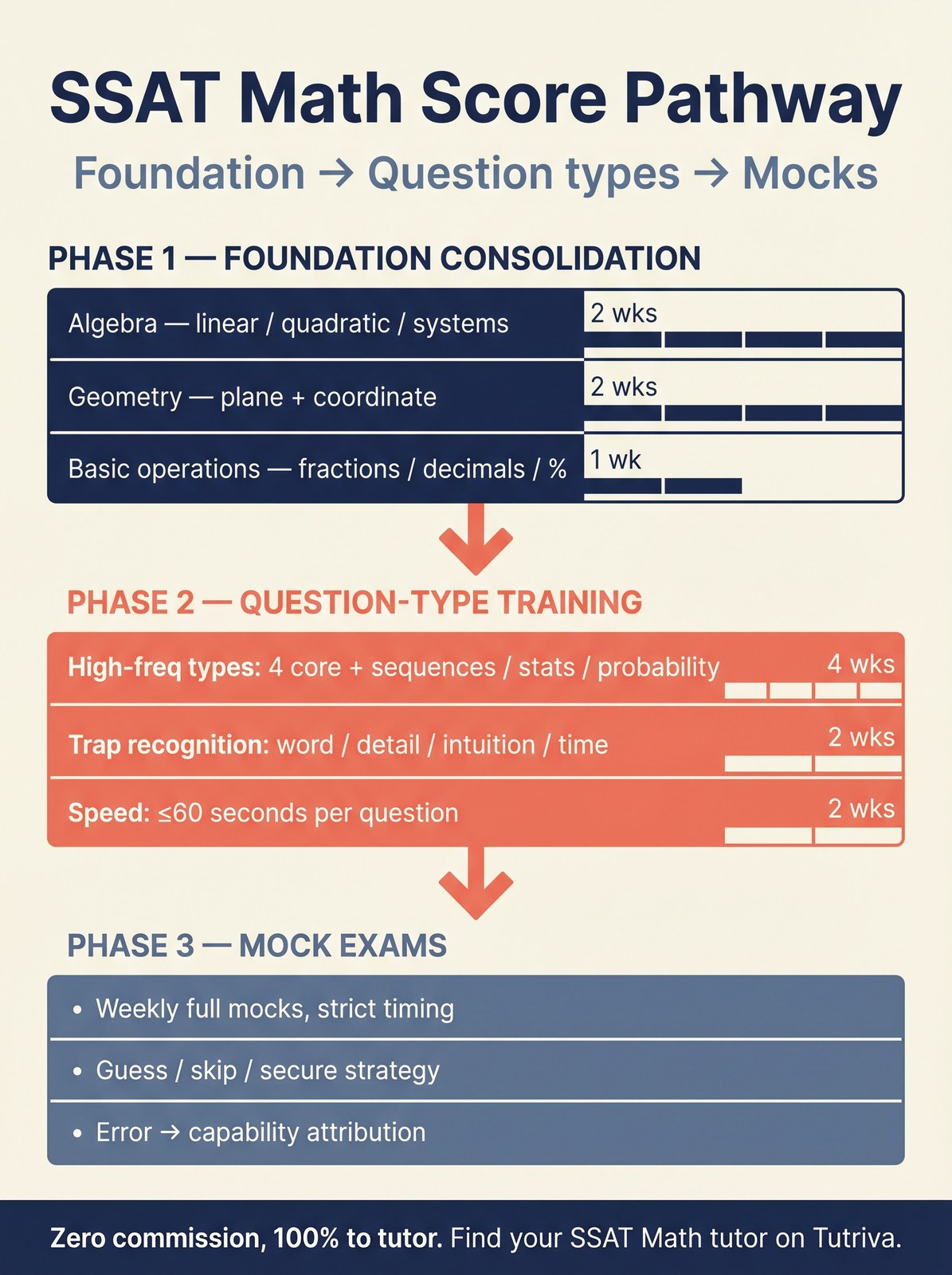
Phase 1 — Foundation Consolidation
- Algebra — linear equations, inequalities, quadratic basics, systems (2 weeks)
- Geometry — plane geometry + coordinate geometry (2 weeks)
- Basic operations — fractions, decimals, percentages, exponents (1 week)
Phase 2 — Question-Type Training
- High-frequency types — the 4 above + sequences, statistics, probability (4 weeks)
- Trap recognition — word / detail / intuition / time trap drills (2 weeks)
- Solving speed — complete each question within 60 seconds (2 weeks)
Phase 3 — Mock Exams
- Time management — 1 full mock per week, strict timing
- Strategy optimisation — which to guess, which to skip, which to secure
- Error analysis — for each wrong answer, trace it back to which capability layer failed
7. What SSAT Math Really Signals (Parents Must Know)
SSAT Math isn’t testing “difficulty.” It tests whether the student has:
- Rigor
- Consistency
- Logical ability
These capabilities directly determine:
👉 Whether the student can adapt to private-school + AP + high-school academic systems.
Future Grade 9-12 AP Calculus, AP Physics, and IB HL Math all depend on this foundation — SSAT Math is the first screening point on that academic track.
8. How to Choose an SSAT Math Tutor (Platform Perspective)
On Tutriva, prioritise tutors who:
- ✔ Can teach logic — not just walk through the answer, but explain “how to model this type of question”
- ✔ Can analyse errors — can attribute each wrong answer to a capability layer
- ✔ Have SSAT experience — taught it, tracked 2024-2025 changes
Avoid:
- ❌ Tutors who only explain answers
- ❌ Tutors who only drill “universal templates”
- ❌ Tutors who only run practice sets without diagnosis
FAQ
How is SSAT Math different from BC / Ontario school math? School math progresses grade by grade. SSAT Math tests integrated capability — one question may require algebra + geometry + logic simultaneously. A strong Grade 6-8 school math student typically scores 650-700 on SSAT Math without targeted prep. Reaching 780+ requires specialised training.
Do students need Grade 9 content? Upper Level SSAT Math covers Algebra I level (linear equations, inequalities, quadratic basics). Some questions may touch introductory Algebra II concepts (like quadratic roots), but nothing beyond Grade 10.
Wrong answers really deduct points? Should students guess? Yes — 1/4 point deducted per wrong answer (on 4-option questions); blanks = 0. Strategy: guess when at least 2 options can be eliminated; when truly stuck, leave blank.
How much does SSAT Math tutoring cost? Specialist SSAT Math tutors typically charge $50-$100 per hour. Tutors combining SSAT Math + Reading + private-school admissions counselling may charge more. Tutriva takes zero commission — 100% goes to the tutor.
Do Chinese-speaking families need a bilingual tutor? Recommended for newcomer families. Word traps are the biggest point-loss source for Chinese-speaking students — a bilingual tutor can parse the problem in the student’s first language, then switch to English for solving. Filter by Mandarin / Cantonese on Tutriva.
Is online tutoring effective for math? Yes — SSAT Math teaching has natural advantages online: screen-share drawing, real-time formula annotation, recorded replay. Often more convenient than in-person.
Final CTA:
Preparing for SSAT Math? On Tutriva, filter by:
- ✔ SSAT Math Tutor
- ✔ Algebra Tutor
- ✔ Problem Solving Tutor
Find the tutor who actually builds capability.
📌 Students & parents → Find an SSAT Math tutor 📌 Tutors → If you specialise in SSAT Math / logical training / problem-solving strategy, join Tutriva and connect with students globally.