
SSAT Reading & Vocabulary Guide (October 2025): Why Students “Know the Words But Miss the Answers”
In North American private school admissions, the SSAT has long been considered a key measure of a student’s academic potential.
But after the October 2025 SSAT, one clear shift is showing up consistently in student reports and tutor observations:
The SSAT is accelerating its transformation into a “college-prep reading capability test.”
Students across regions are experiencing the same pattern:
- They recognise the words, but can’t parse the sentences.
- They finish the passage — but can’t identify the main idea.
- On the questions, “all options look right, and all options look wrong.”
This guide breaks down the October 2025 real exam structure, dissects the question types, and maps the skills being tested — so parents and students can actually see:
👉 What the SSAT is testing 👉 Why it keeps getting harder 👉 How to build systematic improvement
Start here:
📌 Students & parents → Find an SSAT reading & vocabulary tutor 📌 Tutors → Join Tutriva and support SSAT students
1. October 2025 SSAT Reading: What Was Actually Tested
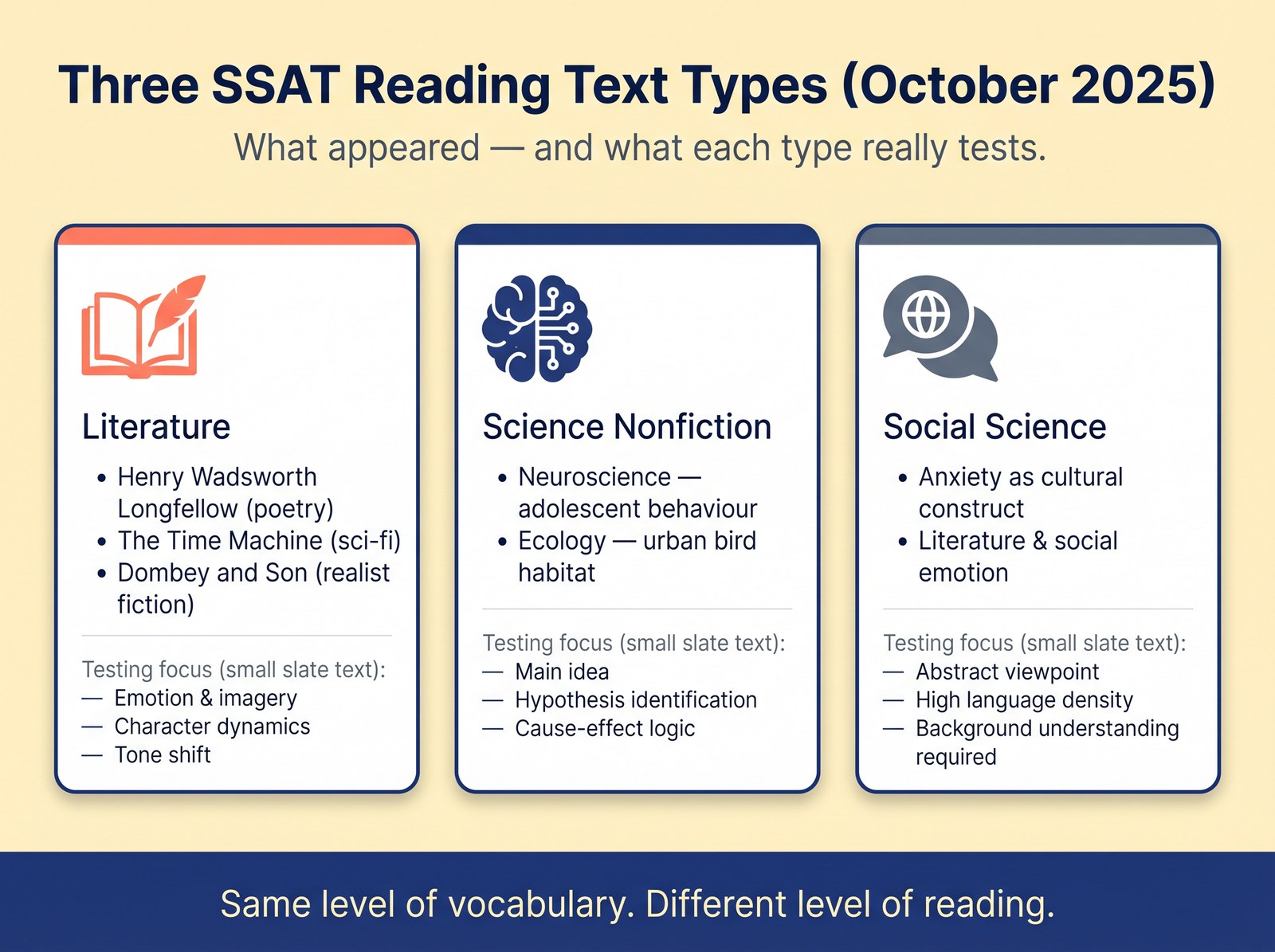
Based on the October 2025 exam content (consistent trends across North American and Asian test regions), the Reading section presented this structure:
1.1 Literary Texts
Representative sources (real style):
- Henry Wadsworth Longfellow (poetry)
- The Time Machine by H.G. Wells (science fiction)
- Dombey and Son by Charles Dickens (realist literature)
Testing focus:
- Emotion and imagery
- Character dynamics
- Tone shift
👉 The difficulty isn’t vocabulary — it’s interpreting implicit emotion. Students often understand every word but can’t identify the author’s emotional stance.
1.2 Science Nonfiction
Content types appearing:
- Neuroscience: adolescent behaviour and brain development
- Ecology: urban bird habitat simulation
Typical paragraph structure:
“Adolescents exhibit risk-taking behavior not as a flaw, but as an adaptive mechanism…”
Testing focus:
- Main idea
- Scientific hypothesis
- Cause-effect logic
👉 Difficulty: long sentences + abstract concepts + logical derivation. This isn’t a vocabulary problem — it’s an academic English reading problem.
1.3 Social Science / Academic Argument
Directions seen:
- “How anxiety is culturally constructed”
- Relationship between literature and social emotion
Characteristics:
- Abstract viewpoint
- High language density
- Requires background understanding
2. SSAT Reading Question Types: Real Examples Decoded
Three high-frequency SSAT-style question types:
Example 1 — Main Idea
Passage (simplified):
“Teen risk-taking behaviors are often viewed negatively. However, evolutionary theory suggests these behaviors promote exploration…”
Question: What is the main idea of the passage?
A. Teenagers behave irresponsibly B. Risk-taking has evolutionary benefits C. Society misunderstands teenagers D. Adolescents should be controlled
Correct approach:
- ❌ It’s not about finding “the most-mentioned word”
- ✅ It’s about identifying “what the author is trying to prove“
Correct answer: B
Example 2 — Inference
Question: What can be inferred about adolescent behavior?
Key principles:
- ✔ The answer must be reasonable
- ✔ But not directly stated in the passage
- ❌ Can’t go beyond textual evidence
Example 3 — Function
Sentence: “For example, flamingo decoys were placed…”
Question: What is the function of this sentence?
Correct understanding:
- 👉 An example supporting the argument
- Not new information — a link in the argumentation chain
Mid-article CTA:
📌 Students & parents → Browse SSAT reading / vocabulary tutors 📌 Tutors → Join Tutriva and support SSAT students
3. SSAT Vocabulary: 2025 Trend Shifts (Priority)
3.1 Synonyms — difficulty stable, but “deeper understanding” required
Examples:
trivialoptimizeapprehensive
👉 Many students “know” these words but can’t precisely distinguish shades of meaning — especially when judging meaning in context. This gap is where scores divide.
3.2 Analogy — clearly harder
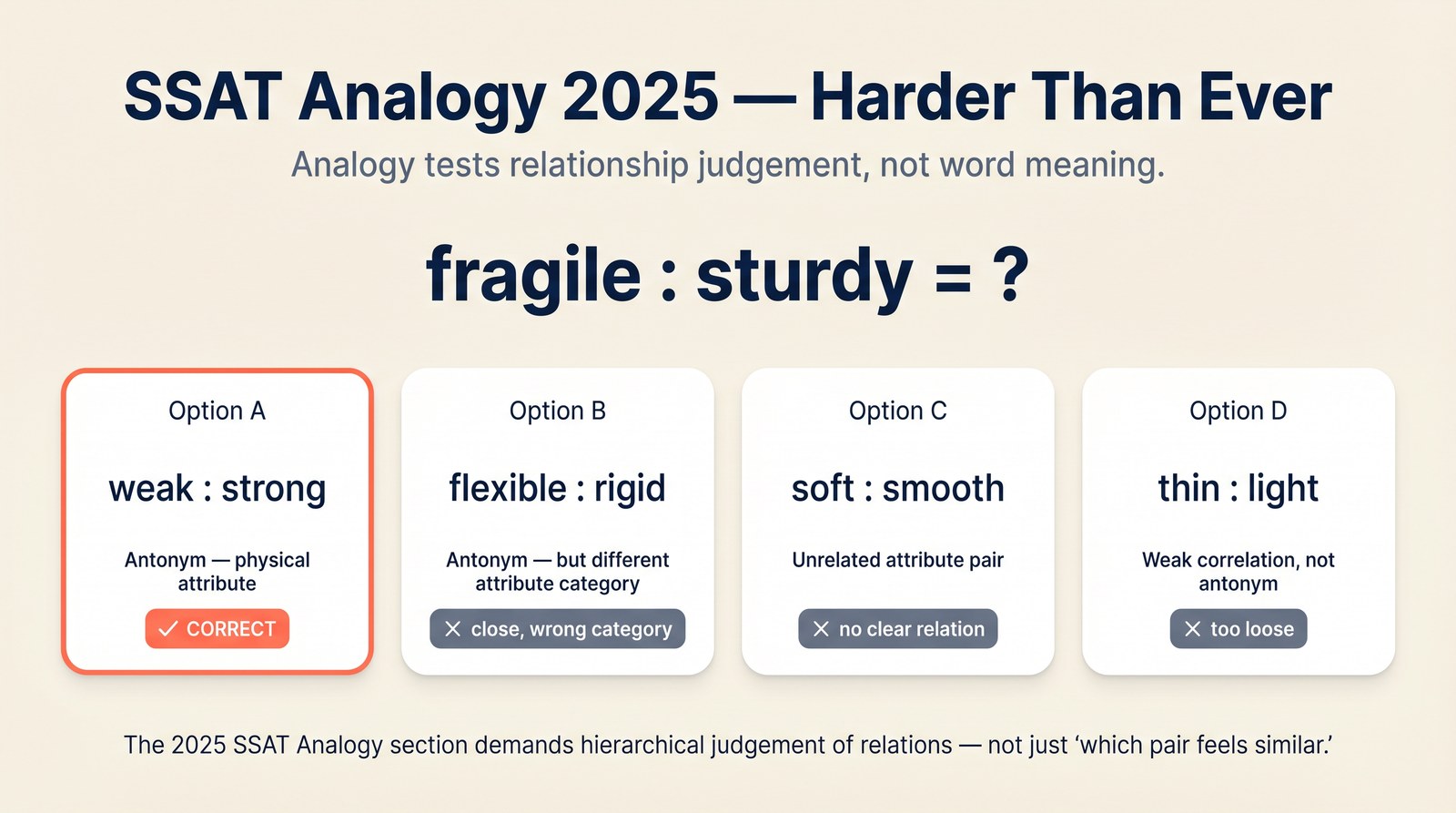
Example:
fragile : sturdy = A. weak : strong B. flexible : rigid C. soft : smooth D. thin : light
Correct answer: A Relationship: Antonym
The 2025 Analogy section demands finer hierarchical judgement of relations. B (flexible : rigid) is also an antonym pair but of a different attribute category; C / D shift the relation entirely. Only A maps exactly to “physical fragility vs physical sturdiness.”
3.3 High-frequency relation types (2025 exam)
- Function relations
- Cause-effect relations
- Degree relations
- Category (type) relations
👉 This isn’t solved by “memorising words” — it requires systematic training in judging conceptual relationships.
4. The Biggest SSAT Misconceptions (Real Traps)
❌ Misconception 1: Vocabulary = Score
Reality: Vocabulary is a foundation, not the determinant.
A student might have memorised 5,000 words and still miss Analogy questions — because the issue is relational logic, not word meaning.
❌ Misconception 2: Understanding = Correct Answer
Many students:
- ✔ Understand the passage
- ❌ Can’t pick the right option
Reason: No logical analysis ability to distinguish “option supports the main idea” from “option merely mentions something in the passage.”
❌ Misconception 3: Practice = Score Improvement
Result: Students develop “question-feel dependency” rather than actual capability. Mock scores rise, but real-exam questions with slight variation break the pattern.
❌ Misconception 4: Reviewing “what was tested” without analysing “what capability it tested”
The reformed SSAT emphasises abstract reasoning — just reviewing answers isn’t enough. Every wrong answer requires reverse analysis: which specific capability was this question testing?
5. The Three Core Capabilities the SSAT Actually Tests
5.1 Information Processing
Processing complex sentences — long-sentence parsing, pronoun reference, nested clauses.
5.2 Logical Structure
Identifying argumentation structure — where the thesis sits, which are supporting sentences, transitions, and examples.
5.3 Abstraction
Understanding non-concrete concepts — terms like “evolutionary mechanism” or “cultural construct” and the real meaning behind them.
6. SSAT Learning Pathway (Professional Version)
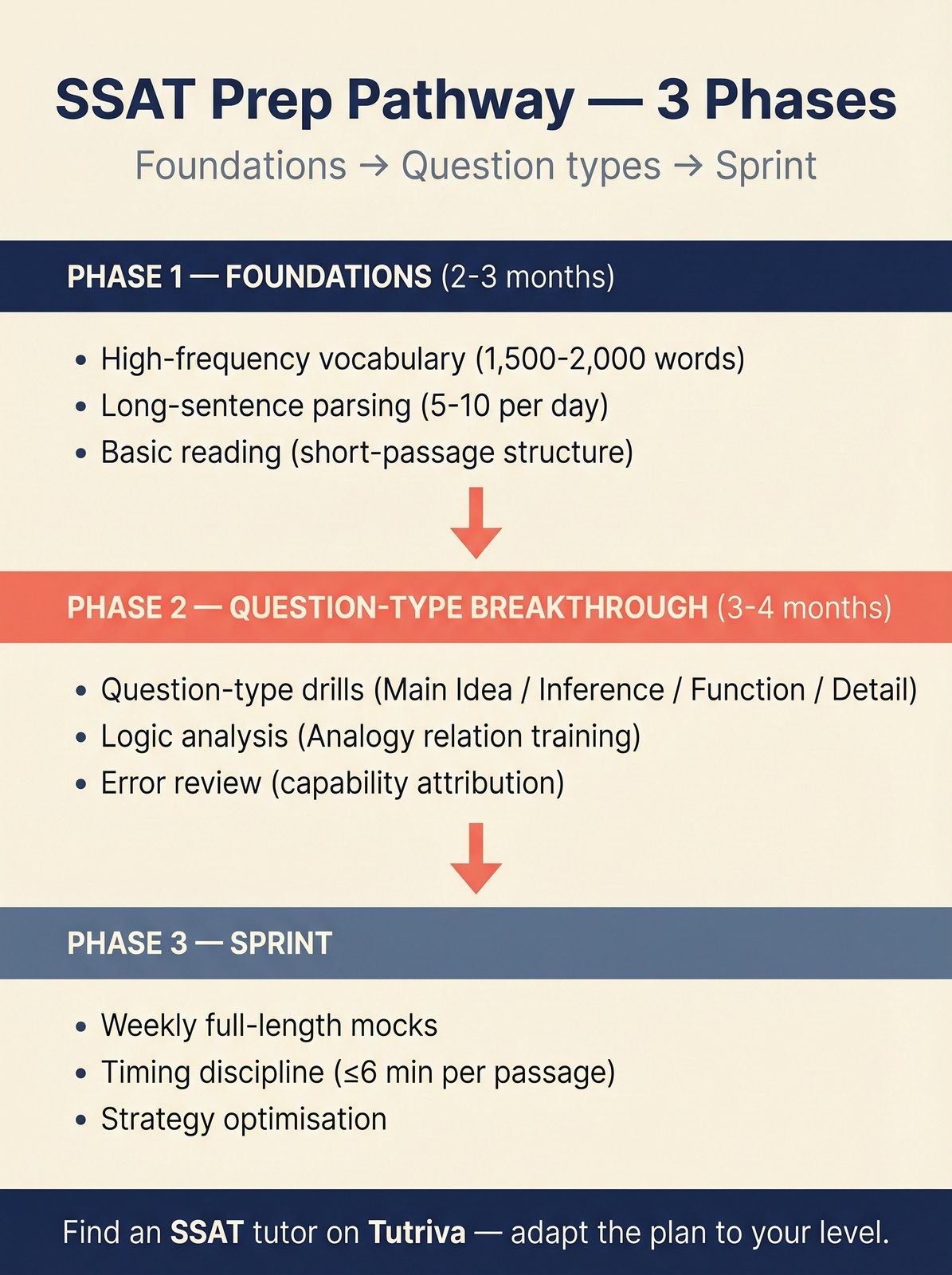
Phase 1 (2-3 months) — Foundation Building
- High-frequency vocabulary: core SSAT word lists (1,500-2,000 words)
- Long-sentence parsing: 5-10 long sentences per day
- Basic reading: short-passage structure training (main idea / supporting / conclusion)
Phase 2 (3-4 months) — Question-Type Breakthrough
- Question-type training: Main Idea / Inference / Function / Detail — specialised drills
- Logic analysis: Analogy relation training + paragraph logic
- Error review: for each wrong answer, ask “what capability was this testing?”
Phase 3 (Sprint) — Real-Exam Simulation
- Full mocks: 1 full-length mock per week
- Timing discipline: no more than 6 minutes per Reading passage
- Strategy optimisation: educated-guess rules, skip-question identification, answer order
7. What the SSAT Is Really Screening For
The SSAT isn’t about the test itself. It’s about judging:
👉 Whether a student has the capability to enter and survive a high-intensity academic environment.
That includes:
- Private schools — entry threshold for top Day Schools and Boarding Schools
- AP courses — can the student handle future academic reading volume
- High school elite tracks — IB, Honors, university-prep pathways
That’s why the SSAT isn’t testing English — it’s testing readiness to enter and function in English academic environments.
8. How to Choose the Right SSAT Tutor (Platform Perspective)
On Tutriva, prioritise tutors who:
- ✔ Can teach reading structure — not just vocabulary
- ✔ Can teach logical relationships — can actually explain Analogy at the level of relational hierarchy
- ✔ Have genuine SSAT experience — took it, taught it, tracked it
Avoid:
- ❌ Tutors who only explain answers
- ❌ Tutors who only drill questions without teaching capability
- ❌ Tutors who haven’t tracked 2024-2025 SSAT changes
FAQ
When should my child start SSAT preparation? Generally start foundation training in Grade 6 second semester or Grade 7, with the full sprint in Grade 7-8 (Upper Level SSAT). Reading and vocabulary capability requires long-term accumulation — short-term sprints have limited effect.
What’s the difference between SSAT and TOEFL / IELTS? SSAT doesn’t test listening or speaking. It focuses on reading, vocabulary, math, and writing. TOEFL/IELTS are language proficiency tests; the SSAT is an academic capability test, closer in logic to the SAT — just aimed at students applying from middle to high school.
Is there a big difference between Upper Level and Middle Level SSAT? Upper Level (Grade 8-11 applying to Grade 9-12) is noticeably harder than Middle Level. Larger vocabulary, more abstract reading, deeper coverage of algebra and geometry. Students transitioning from Middle to Upper should do specific transition training.
Is online tutoring effective for SSAT? Very effective. SSAT Reading and logical analysis are naturally suited to online format — screen-share passage annotation, option-elimination discussion, and recorded replay all work well. Most SSAT tutors on Tutriva support online delivery.
How much does SSAT tutoring cost? Specialist SSAT tutors typically charge $60-$120 per hour. Experienced tutors combining private-school admissions counselling with SSAT prep may charge more. Tutriva takes zero commission — 100% of the rate goes to the tutor.
Can bilingual Chinese families find bilingual SSAT tutors? Yes. Filter by Mandarin or Cantonese tags on Tutriva. Bilingual SSAT tutors are especially valuable for newcomer families — they can explain Analogy’s relational logic in the student’s first language first, then switch to English training.
Final CTA:
If you’re preparing for the SSAT, use Tutriva to filter by:
- ✔ SSAT Reading Tutor
- ✔ SSAT Vocabulary Tutor
- ✔ Private School Prep Tutor
Find the tutor who actually builds your child’s capability — not just their mock-exam score.
📌 Students & parents → Find an SSAT tutor 📌 Tutors → If you specialise in SSAT Reading / Vocabulary / academic English / private school admissions, join Tutriva and connect with students globally.