The Digital SAT in 2026: A BC Parent and Student Guide
| Title | The Digital SAT in 2026: A BC Parent and Student Guide |
| Meta description | A 2026 guide for BC families on the Digital SAT: what changed, how the adaptive format works, and how to prepare without burning out. |
| Primary category | Test Prep (id 18) |
| Tags | for-parents, for-students, test-prep, sat, digital-sat, vancouver, richmond, ages-13-17 |
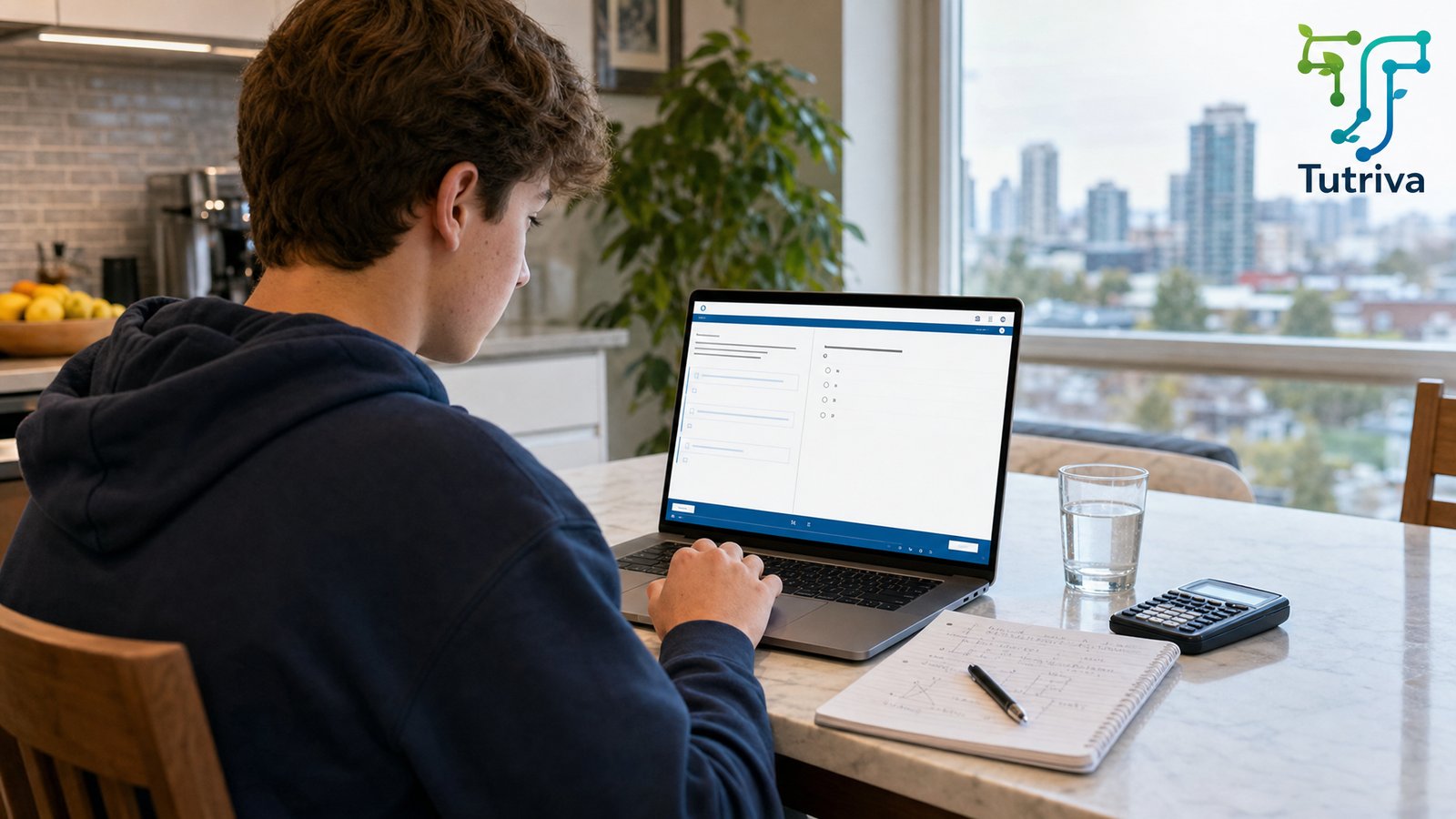
| Featured Image alt | A Grade 11 student in Vancouver studying for the Digital SAT on a laptop with the Bluebook app open |
| Inline Image alt | A close-up of a student using the Desmos graphing calculator on a Digital SAT practice question |
If your BC student is thinking about applying to universities in the United States, the SAT is probably on the horizon, and the test they will sit is not the SAT you remember. The College Board moved the SAT to a fully digital, adaptive format for international students in March 2023 and in the United States in March 2024. By 2026, the Digital SAT is the only version of the SAT a student in Greater Vancouver can take.
This guide is for parents and students in Vancouver, Burnaby, Richmond, Surrey, Coquitlam, North Vancouver, West Vancouver, and White Rock who want a clear picture of the Digital SAT, what changed, and how to prepare without burning out.
What the Digital SAT actually is
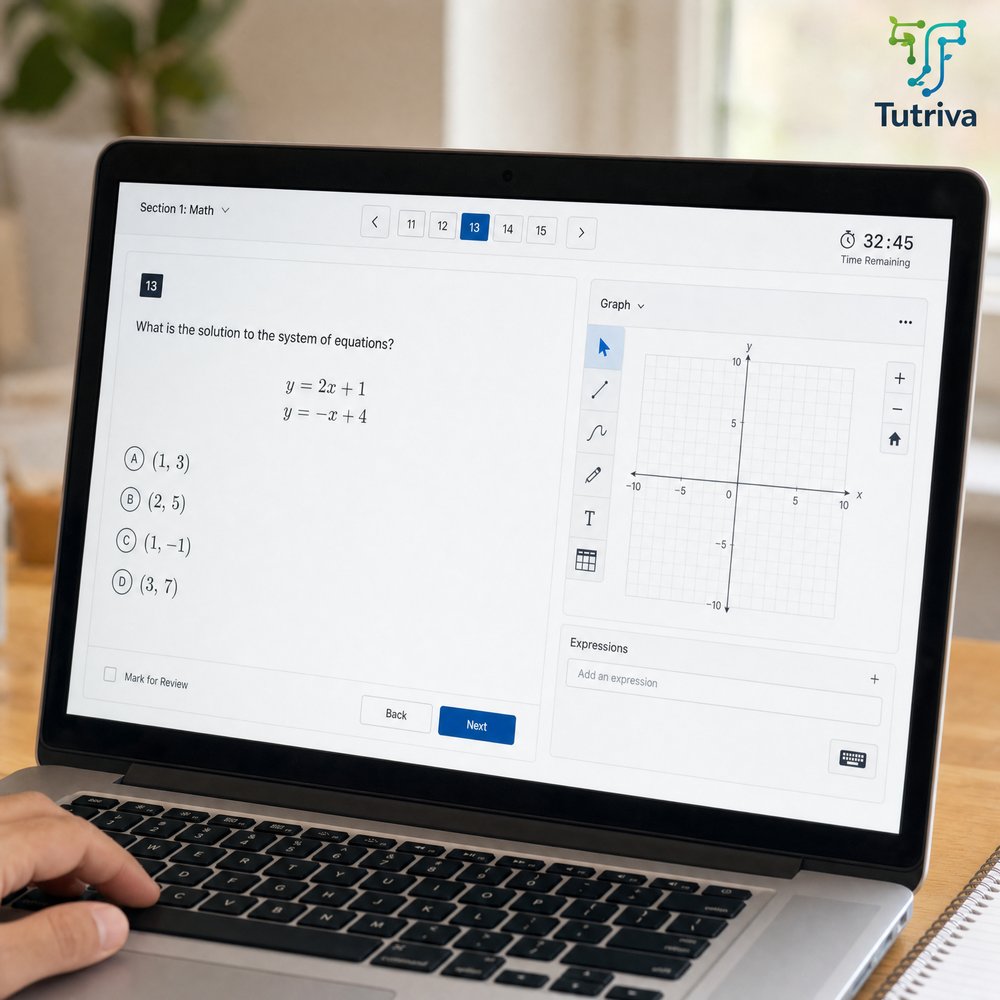
The Digital SAT is delivered through the College Board’s Bluebook app on a laptop or tablet that the student usually brings to the test centre. The format differs from the older paper SAT in three meaningful ways:
1. It is shorter. Total testing time is roughly 2 hours and 14 minutes, compared with over three hours on the old paper SAT.
2. It is adaptive at the section level. Each section (Reading and Writing, then Math) has two modules. Module 2’s difficulty depends on the student’s performance on Module 1. A student who does well on Module 1 sees a harder Module 2 with higher score-ceiling potential. A student who struggles on Module 1 sees an easier Module 2 with a lower score ceiling.
3. The Math section allows a calculator throughout. A built-in Desmos graphing calculator is available on every math question, and students can bring an approved external calculator as well. The old “no-calculator” math section is gone.
Total score is still out of 1600: 800 Reading and Writing, 800 Math.
What is on the test
Reading and Writing. Short passages (about 25 to 150 words each), each followed by one question. Topics span literature, history, social science, humanities, and natural sciences. Question types cover main idea, inference, vocabulary in context, evidence, transitions, grammar, and rhetoric. There are 54 questions across the two Reading and Writing modules (a small number are unscored pretest items).
Math. A mix of algebra, advanced math (functions and quadratics), problem-solving and data analysis, and a small amount of geometry and trigonometry. There are 44 questions across the two Math modules (again, with a small unscored pretest count), including some “student-produced response” questions where the student types a number rather than selecting from choices.
The content map is similar to the old SAT, but the pacing is faster: shorter passages, more questions per minute, and an adaptive engine that rewards consistency.
Why BC students take the SAT (or do not)
For most BC families, the SAT decision turns on where the student is applying:
- Applying mainly to UBC, SFU, UVic, or other Canadian universities. The SAT is typically not required. Some scholarship competitions consider strong SAT scores, but the core application rests on the BC senior school transcript.
- Applying to US universities. Many US institutions have moved between test-required, test-optional, and test-flexible policies over recent years. By 2025–2026, several selective universities have reinstated SAT or ACT requirements, while many remain test-optional. Confirm each target school’s current policy directly.
- Applying to UK or European universities. A-level or IB scores are usually the primary credentials; the SAT is sometimes considered alongside them but is rarely decisive.
If a BC student is not seriously considering US universities, the SAT is usually optional. If they are, it remains a meaningful part of the application even at test-optional schools, where strong scores can still help.
How the adaptive format changes preparation
The single biggest practical shift in the Digital SAT is the adaptive section structure. Module 1 of each section becomes disproportionately important: a student who underperforms there is routed into an easier Module 2 with a capped scoring range. Preparation should reflect this.
What this means in practice:
- Module 1 stamina matters. A student who is tired or distracted at the start of Module 1 may lock themselves out of the higher score ceiling for the entire section. Practice should include full-length sessions, not just question packs.
- Early-question accuracy is high-value. The Digital SAT does not let students return to skipped Module 1 questions once they move to Module 2. Skipping confidently and answering accurately early matters more than on the old paper test.
- Time management is module-by-module. Each module is time-boxed; students cannot carry time from one module to the next. A clear pacing plan for each module is more useful than a single overall pacing plan.
The good news: Bluebook includes a built-in timer, annotation tools, and a flag-for-review function that work well once a student has practised with them across several full sessions.
A realistic preparation timeline for BC students
There is no single right schedule, but a workable timeline for most BC students looks like this:
- 9 to 12 months out. Take one official Bluebook practice test cold. Record the scaled score truthfully. This is the baseline for everything that follows.
- 6 to 9 months out. Identify the two or three weakest skill areas (often: grammar transitions, evidence questions, geometry, or word problems). Work on these in focused blocks of 30 to 45 minutes, four to five times a week. Avoid trying to “do” the whole test every weekend.
- 3 to 6 months out. Start adding full-length practice tests every two to three weeks. Review every wrong answer in writing.
- 6 to 8 weeks out. Increase practice test frequency to every two weeks. Focus heavily on Module 1 stamina and accuracy.
- Last 2 weeks. Pull back. Sleep, food, a single final practice test for confidence. No new content.
Total focused preparation can range from a few dozen hours to well over a hundred, depending on baseline, target, and how concentrated the schedule is. Aiming higher than that on a tight schedule usually produces diminishing returns.
When a tutor genuinely helps
A tutor is worth bringing in when:
- The student’s baseline practice score is noticeably below where their target US schools typically sit, and the timeline is under nine months.
- The student has a clearly identifiable weak section (Reading and Writing or Math) where a structured approach would help.
- The student has tried independent prep, hit a plateau, and wants help breaking through it.
- The family wants someone who can review the student’s full Bluebook practice tests and analyze patterns the student cannot see.
A tutor is usually not worth it when:
- The student is reading widely, doing focused independent prep, and is already close to their target on practice tests.
- The student is being prepped against their will. Resentful prep tends to produce poorer results regardless of the hours invested.
- The student’s target schools are all test-optional and the student would prefer to invest the time in a stronger transcript or extracurricular profile.
How to find a Digital SAT tutor in Greater Vancouver
Ask about Bluebook. A strong Digital SAT tutor uses official Bluebook practice tests as the backbone of preparation, not third-party imitations. The official tests remain the most accurate predictors of test-day performance.
Ask about adaptive strategy. “How do you coach Module 1 stamina and pacing?” A tutor who has thought about the adaptive structure will answer in specific terms. A tutor still teaching from old paper SAT habits will not.
Ask about Desmos. The built-in Desmos graphing calculator is a major scoring lever on Math. A tutor who can teach a student to use Desmos efficiently (function plotting, regressions, intersections, table view) is the right fit; one who treats it as an afterthought is not.
Online works well for the Digital SAT. Since the test itself is delivered on a laptop, online tutoring with a shared screen mirrors test-day conditions naturally — useful for a Surrey or Coquitlam family whose nearest reliable test centre is on the other side of the Lower Mainland.
Tutriva and Digital SAT support
Tutriva is a tutor–student platform serving Greater Vancouver: Vancouver, Burnaby, Richmond, Surrey, Coquitlam, North Vancouver, West Vancouver, and White Rock. Tutors set their own rates and keep what they earn; Tutriva does not take a commission on lessons. Students and parents browse tutors by subject and location, message directly, and book a free intro session before committing.
Students preparing for the Digital SAT can post a short request, for example “Grade 11 student in Richmond, baseline 1180, target 1400, applying mostly to US universities, looking for a Digital SAT tutor who works in Bluebook and is strong on Math Module 2”, and get matched with tutors whose background fits. (Students working in parallel on AP coursework or extension activities may also want our parent’s guide to academic competitions in Greater Vancouver.)
Frequently asked questions
Do BC students still need the SAT?
Only if they are applying to universities that require or recommend it. Most Canadian universities do not require the SAT. Many US universities continue to use it, and some that went test-optional during the pandemic have reinstated it for the 2025–2026 cycle. Confirm each target school’s policy directly.
Is the Digital SAT easier than the old paper SAT?
Different rather than easier. The adaptive format and shorter length suit some students better, but the question difficulty in a harder Module 2 is real. Strong preparation tends to be rewarded; weaker preparation tends to be exposed earlier.
Should we take the SAT or the ACT?
For BC students, the SAT is more common and more widely supported by local prep. The ACT is a legitimate alternative if the student strongly prefers a faster, more content-focused format and is willing to import practice material. Most BC families default to the SAT, and that is usually a reasonable choice.
How many times should a student take the Digital SAT?
Many students sit it twice or three times. Beyond that, the cost (financial, emotional, time) often starts to outweigh the additional score gain.
Is online tutoring effective for the Digital SAT?
Yes. The test is digital, the practice material is digital, and shared-screen online tutoring mirrors test conditions naturally.
The honest takeaway
The Digital SAT is shorter, faster, and adaptive, but it is still a multi-month project for any student aiming at a meaningful result. Students who start early, practise in Bluebook, take Module 1 stamina seriously, and bring in targeted help where the baseline shows they need it tend to find the process manageable.
Looking for a Digital SAT tutor in Greater Vancouver? Browse test prep tutors by city on Tutriva, or post a one-minute request describing your target schools and your current baseline.