From DELF to AP and IB French — A Complete Learning Pathway for French Language Students
**About Tutriva** — Tutriva is a tutor-parent matching platform. Tutors create their own profiles with the qualifications, experience, and rates they choose to share; parents post requests; both sides connect directly and decide on lesson terms together. Tutriva provides the marketplace and tools — what each user evaluates, trusts, and books is up to them.
From DELF to AP and IB French: A Complete Learning Pathway for French Language Study
Course Structure, Exam Design, Major Themes, and Long-Term Academic Planning
In North American and international education systems, French is not simply a “second language elective.” When viewed through a long-term academic lens, French learning can form a coherent pathway:
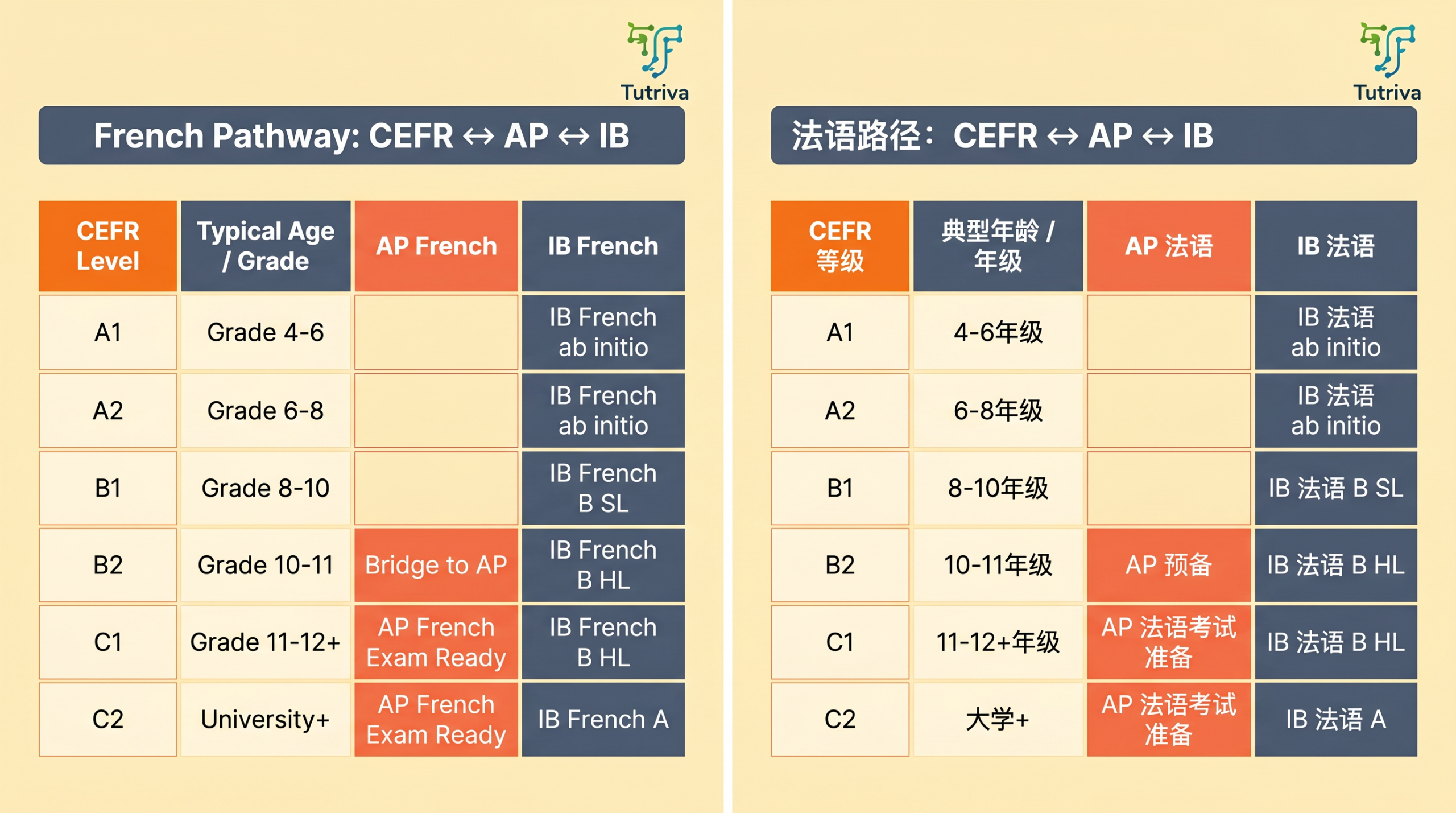
early language exposure → CEFR / DELF proficiency benchmarks → AP French Language and Culture → IB French B or French A → university-level language, literature, and intercultural studies
Many families begin with practical questions:
When should a student start preparing for AP French?
What is the difference between AP French and IB French?
Is DELF B2 close to AP French level?
If a child begins French in elementary or middle school, how should the learning path be planned?
What do AP French and IB French actually test?
Can language-based courses be completed earlier than math or science AP courses?
Will an AP score expire if a student takes the exam early?
Is school-based Core French enough for AP or IB?
These questions all point to the same central idea:
French is not best approached as short-term test preparation. It is a long-term development of language proficiency, cultural literacy, academic expression, and intercultural thinking.
1. Understanding the Three Systems: DELF, AP, and IB
DELF: A Framework for Language Proficiency
DELF, or Diplôme d’Études en Langue Française, is an official French-language diploma aligned with the CEFR, the Common European Framework of Reference for Languages. The CEFR organizes language proficiency into six levels: A1, A2, B1, B2, C1, and C2. A1 and A2 are generally considered basic-user levels, B1 and B2 independent-user levels, and C1 and C2 proficient-user levels. (Portal)
In practical learning terms, DELF provides a clear language-development benchmark:
A1: basic questions, simple introductions, familiar daily expressions
A2: everyday communication about family, school, hobbies, and routines
B1: basic opinion expression, narration, and communication in familiar situations
B2: clearer expression of more complex ideas, stronger reading and listening skills, and readiness for more academic language use
For younger students, DELF Junior or DELF Scolaire may be more appropriate than the adult version. From a planning perspective, DELF is not merely an extra certificate. It helps families and teachers understand where a student actually stands in listening, speaking, reading, and writing.
In this sense, DELF can be understood as the proficiency map of French learning.
AP French Language and Culture: Language in an Academic and Cultural Context
The full name of AP French is AP French Language and Culture.
This is important. It is not simply an “AP French language test.” It is a course and exam built around language, culture, communication, and comparison.
AP French asks students to use French in real contexts. Students must interpret written and audio materials, communicate in writing and speaking, respond to prompts, build arguments, and compare cultural practices and perspectives.
The AP French Language and Culture Exam has consistent question types, weighting, and scoring guidelines each year, and the exam includes both multiple-choice interpretation tasks and free-response writing and speaking tasks. (AP Central)
In terms of proficiency, AP French is often best understood as roughly around the B2 to early C1 transition range. This does not mean DELF B2 automatically equals an AP 5. Rather, it means that students who are far below B2 usually find AP French difficult because the exam requires academic expression, cultural comparison, and strong interpretive skills.
IB French: A More Structured Course-Based Pathway
In the IB Diploma Programme, French may appear in different pathways:
French ab initio: for students beginning the language or near the beginning level
French B SL / HL: for students with some prior French background
French A Language and Literature / Literature: for students who are highly proficient, close to native-level, or prepared for literary and textual analysis
IB Language B is a language acquisition course for students with previous experience in the target language. Students develop communication through language, themes, and texts. The IB Language B syllabus is organized around five prescribed themes: Identities, Experiences, Human Ingenuity, Social Organization, and Sharing the Planet. (International Baccalaureate®)
IB French therefore shares some similarities with AP French, but it is more course-based and inquiry-driven. It emphasizes sustained thematic study, intercultural understanding, personal response, writing, oral interaction, and analysis of texts.
A useful summary is:
In short:
DELF establishes the language foundation. AP applies language in academic and cultural contexts. IB develops language through structured global inquiry, and IB French A moves into literary and critical analysis.
2. How French Learning Can Be Planned from Early Years to High School
French differs from math and science in an important way.
Math and science often follow strict academic sequences:
Algebra → Pre-Calculus → Calculus
General Science → Biology / Chemistry / Physics → AP or IB Science
French, however, develops more like reading, music, and writing. It benefits from long-term exposure, repeated use, listening, speaking, cultural context, and gradual literacy development.
For this reason, French is usually not best approached as something to “start suddenly” in Grade 10 for AP. A stronger path begins earlier and builds gradually.
Stage 1: Elementary School, Grades 1–5
Goal: pronunciation, interest, early vocabulary, and language intuition
At this stage, the focus should not be AP or IB. The focus should be:
pronunciation
basic listening
simple questions and answers
picture books
songs and stories
daily-life vocabulary
family, school, food, weather, hobbies, and routines
basic cultural awareness
Useful directions may include:
French for young learners
French story reading
basic conversation
DELF Prim or early A1 exposure
age-appropriate French audio and picture books
The key idea is:
exposure before performance.
A young learner should first hear, imitate, enjoy, and recognize the language before being expected to produce complex grammar or formal writing.
Stage 2: Upper Elementary to Middle School, Grades 5–8
Goal: A1–A2–B1 foundation
This is the stage where French can become more systematic.
Students may begin to develop:
basic grammar
verb conjugations
sentence patterns
short reading passages
simple writing
listening comprehension
daily conversation
school, family, friendship, travel, hobbies, and routine topics
At this stage, DELF A1, A2, and eventually B1 can provide useful checkpoints.
For students in French Immersion, Core French, or bilingual programs, DELF-style benchmarks can also help evaluate actual proficiency beyond school grade level.
Stage 3: Late Middle School to Early High School, Grades 8–10
Goal: transition from language foundation to academic expression
This is often the most important transition point.
Many students can understand everyday French, but struggle with:
interviews, news, and authentic audio
longer reading passages
formal writing
argument structure
cultural comparison
abstract vocabulary
spontaneous speaking
opinion-based writing
This is the gap between “knowing French” and using French academically.
At this stage, students should begin working on:
argument structure
formal email writing
cultural comparison
oral presentation
audio interpretation
longer reading
opinion writing
transition phrases
abstract and thematic vocabulary
A realistic goal is:
DELF B2 readiness + Pre-AP / Pre-IB French readiness
Stage 4: High School, Grades 10–12
Goal: AP French, IB French B, or IB French A
If a student has a strong foundation, Grade 10 or 11 may be an appropriate time to consider AP French Language and Culture. IB students may enter French B SL or HL depending on school placement and proficiency. A smaller group of highly advanced students may be ready for French A.
AP French does not have a universal grade requirement. Readiness depends on proficiency, not age. The AP exam schedule is set by College Board; for 2026, AP exams are administered during May 4–8 and May 11–15. (AP Central)
AP scores do not automatically “expire” because a student took the exam early. However, universities vary in how they use AP scores for credit or placement. The more practical concern is that language ability can decline if a student stops using French for several years after taking the exam.
A balanced recommendation is:
strong students may begin AP preparation in Grade 9 or 10
many students prepare and test in Grade 10 or 11
IB students follow their DP placement into French B SL/HL or French A
The best timing is not simply “as early as possible.” It is when language maturity, academic readiness, and long-term use are aligned.
3. Textbooks and Resources: Why Materials Matter Early
Families and teachers often want to know not only whether AP or IB French is difficult, but also what materials can help students build toward that level.
This matters because AP and IB French are not built only on grammar drills. They require authentic input, cultural knowledge, listening comprehension, and structured expression.
DELF / CEFR-Oriented Materials
DELF-oriented materials are useful because they build all four core skills:
listening
speaking
reading
writing
They also provide clear levels from A1 to B2. This helps students understand what it means to move from simple communication to opinion-based and more complex expression.
Common French Textbook Series
Frequently used French-learning resources include:
Alter Ego
Often used in CEFR-aligned learning paths from beginner to intermediate and advanced levels.
Édito
Useful for authentic texts, culture, writing, and more mature expression.
Chez Nous
Commonly used in North American high-school or university French courses.
The value of these materials is that they do not treat French as isolated grammar. They introduce language through contexts, tasks, texts, and cultural content.
AP French Resources
At the AP stage, students should also use:
College Board AP Classroom
past AP French free-response questions
scoring guidelines
sample student responses
Barron’s AP French
authentic audio, news, interviews, and podcasts
College Board provides past free-response questions, scoring information, samples, and commentary for AP French, which are especially useful for understanding how writing and speaking are evaluated. (AP Central)
IB French Resources
For IB French B, useful materials include:
IB Language B guide
IB French B coursebooks
theme-based reading materials
individual oral practice
Paper 1 writing practice
Paper 2 listening and reading practice
authentic articles, interviews, and media texts
IB French is not simply about test practice. It is built around themes, text types, inquiry, and communication.
Authentic French Input
Students at the intermediate and advanced levels should gradually include authentic materials such as:
TV5MONDE
France 24
Radio-Canada
French interviews
short documentaries
French news clips
podcasts
young adult readers
literary excerpts
cultural commentary
Both AP and IB expect students to interpret language in context. Textbooks alone are not enough.
4. AP French Language and Culture: The Six Major Themes
AP French is organized around six major themes. These themes are not just unit labels. They form the conceptual framework for the course and exam.
Students encounter these themes in reading passages, audio materials, email prompts, essays, conversations, and cultural comparison tasks.
Unit 1: Families in Different Societies
This theme explores family structures, relationships, childhood, adolescence, friendship, love, social relationships, and community life.
Possible questions include:
How do French-speaking societies define family?
How are traditional and modern family structures changing?
How do young people form identity within family and society?
How do friendship, love, and social relationships shape personal development?
How do different cultures understand family responsibility and independence?
Skill focus:
describing family and relationships
comparing family structures across cultures
discussing childhood and adolescence
expressing ideas about responsibility, family expectations, and generational differences
This theme appears simple, but it can be culturally rich. Family structure, education, social responsibility, and independence may be understood differently in France, Quebec, Francophone Africa, the Caribbean, and other French-speaking communities.
Unit 2: The Influence of Language and Culture on Identity
This is one of the most intellectually important AP French themes.
It includes:
language identity
multiculturalism
national identity
immigration and integration
patriotism
belonging
language policy
Francophone identity
Possible questions include:
How does language shape identity?
How does bilingualism or multilingualism affect cultural belonging?
How do immigrants preserve or transform cultural identity?
Does French mean the same thing in France, Quebec, Africa, and the Caribbean?
Is language only a communication tool, or also a marker of culture, history, and power?
Skill focus:
discussing identity
analyzing language and culture
comparing immigration experiences
explaining multiculturalism and national identity
This theme helps students move from “what language do I speak?” to “how does language shape who I am?”
Unit 3: Influences of Beauty and Art
This theme includes:
visual arts
architecture
literature
music
film
fashion
food
aesthetic values
the role of artists in society
Possible questions include:
How do different cultures define beauty?
How does art reflect social values?
How do literature, film, music, and visual arts shape cultural identity?
Why are art, architecture, fashion, and cuisine so closely connected to French cultural expression?
Is art personal expression, social critique, or both?
Skill focus:
describing artworks
evaluating aesthetic values
discussing the role of art in society
analyzing writers, artists, filmmakers, musicians, and cultural producers
This theme also connects naturally with IB French A, where students may analyze literary and non-literary texts more deeply.
Unit 4: How Science and Technology Affect Our Lives
This theme focuses on:
scientific discovery
future technology
social media
artificial intelligence
medical development
technology ethics
media and communication
the impact of technology on relationships
Possible questions include:
How has technology changed communication?
How does social media affect identity and self-expression?
How might artificial intelligence affect education?
How do medical technologies influence quality of life?
How do French-speaking societies discuss technology and ethics?
Skill focus:
discussing advantages and disadvantages
expressing opinions about future technology
explaining the relationship between technology and society
analyzing the influence of media on communication
This theme is especially useful for argumentative writing because it naturally invites multiple perspectives.
Unit 5: Factors That Impact the Quality of Life
This theme includes:
health
education
employment
social status
housing
cultural perspectives
access to resources
lifestyle
consumer decisions
Possible questions include:
What determines quality of life?
How do education and employment affect personal development?
How does social class influence access to resources?
Are health, leisure, culture, and public services part of quality of life?
How do France, Canada, the United States, and other societies differ in education or public services?
Skill focus:
discussing quality of life
comparing social systems
analyzing education, work, health, and resources
expressing views on fairness and opportunity
This theme connects well with sociology, economics, public policy, and education.
Unit 6: Environmental, Political, and Societal Challenges
This is the most global and policy-oriented AP French theme.
It includes:
environment
climate change
human rights
war and peace
tolerance
immigration
political participation
social conflict
international cooperation
Possible questions include:
How do French-speaking countries respond to environmental issues?
What role do immigrants and refugees play in society?
How does laïcité shape public debate in France?
What development challenges exist in Francophone regions?
How do global problems affect everyday life?
Skill focus:
discussing global issues
describing government systems and social policies
comparing France, Francophone communities, and one’s own society
suggesting possible solutions
conducting cross-cultural analysis
This theme is highly relevant to argumentative writing, cultural comparison, and advanced oral discussion.
5. AP French Exam Structure and Skills
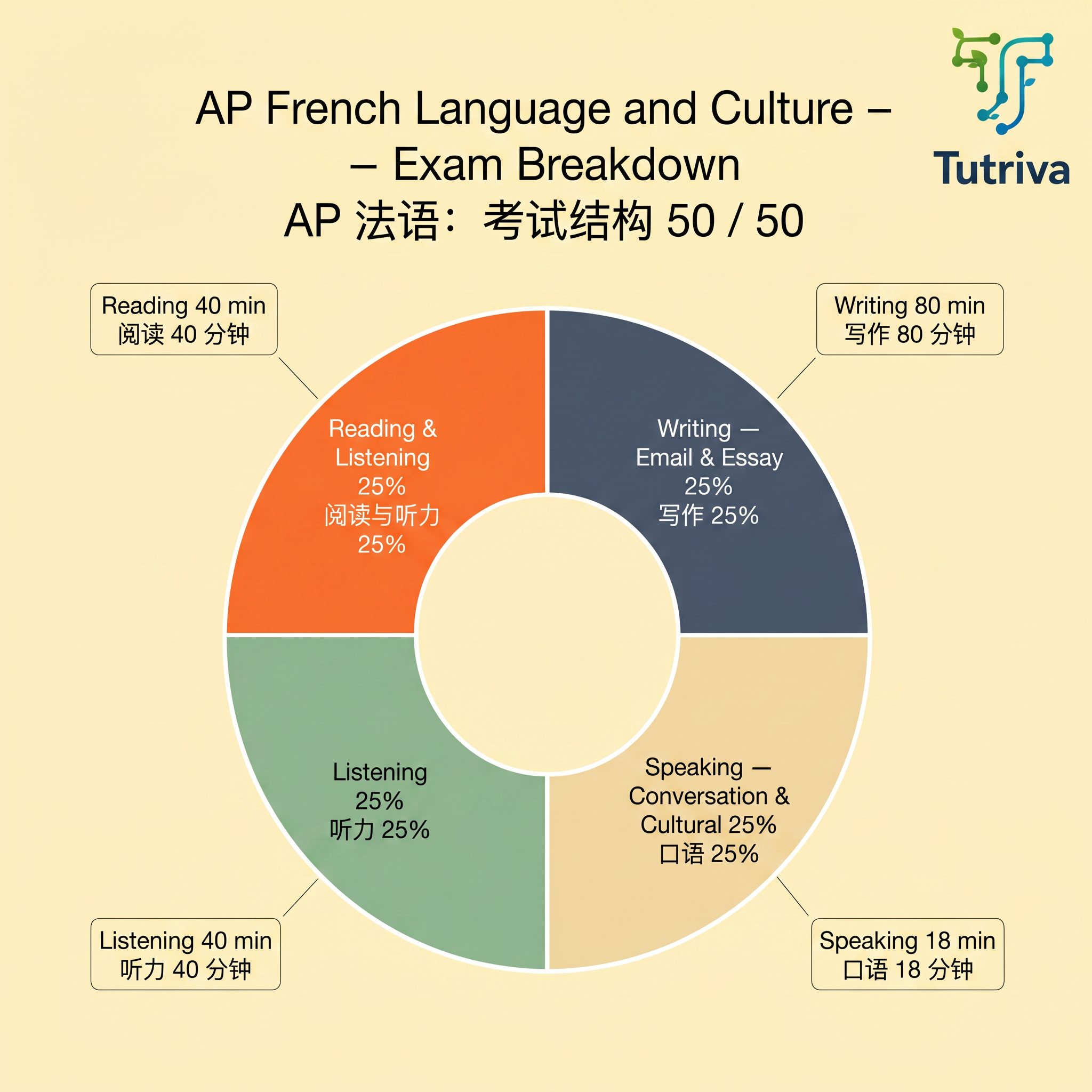
The AP French Language and Culture Exam has two major sections, each worth 50% of the score.
The exam format includes multiple-choice interpretive tasks as well as free-response writing and speaking tasks. (AP Central)
Section I: Multiple Choice, 50%
Part A: Interpretive Communication: Print Texts
approximately 30 questions, about 40 minutes
Part B: Interpretive Communication: Print and Audio Texts / Audio Texts
approximately 35 questions, about 55 minutes
Students may encounter:
articles
advertisements
letters
charts
interviews
podcasts
conversations
news reports
announcements
Students need to identify:
main idea
details
author’s purpose
tone
audience
inference
vocabulary in context
cultural meaning
Section II: Free Response, 50%
This section includes four main tasks.
Email Reply
Students respond to an email in an appropriate register.
Strong responses usually:
answer all required points
use an appropriate tone
follow email format
develop ideas
use varied language
remain clear and natural
Argumentative Essay
Students use multiple sources, often including print, data, and audio, to develop an argument.
Strong essays usually:
state a clear position
integrate evidence
organize ideas logically
use transitions
explain rather than list
maintain language accuracy
Conversation
Students complete a simulated conversation, usually in several short turns.
Strong responses usually:
respond directly
continue the exchange
give specific details
speak at a controlled pace
avoid silence
extend naturally when possible
Cultural Comparison
Students compare a cultural feature, practice, or perspective from a French-speaking community with one from another community familiar to them.
Strong responses usually:
include a specific Francophone example
do more than describe
explain the cultural significance
compare clearly
connect the topic to social, historical, or value-based context
This task is often where students reveal whether they have developed real cultural understanding or have only memorized surface-level facts.
6. Common Learning Gaps in AP French
From Grammar Accuracy to Meaningful Expression
A student may write grammatically correct sentences but still struggle to develop ideas.
AP French requires students not only to say:
“Technology is important.”
but to explain how technology changes education, health care, communication, relationships, culture, and social expectations.
From Cultural Knowledge to Cultural Analysis
Culture is not simply a list of famous people, holidays, monuments, or food.
More advanced cultural analysis often follows this pattern:
phenomenon → historical roots → contemporary debate → cross-cultural comparison
For example, when discussing laïcité, a student should not stop at “France is secular.” A stronger response would connect secularism to French history, public education, religion in public life, immigration, and contemporary debate.
From Understanding Sentences to Understanding Authentic Materials
AP French listening materials may include interviews, podcasts, news segments, and conversations. Students must become comfortable with:
natural speed
different accents
dense information
transitions
speaker attitude
implicit meaning
Listening cannot be built only in the final month before the exam. It requires sustained exposure.
From Speaking Fluently to Speaking with Structure
Speaking quickly is not the same as speaking well.
In a Cultural Comparison task, students need to organize a short response:
introduce the topic
present a Francophone example
present another cultural example
compare the two
draw a conclusion
Without structure, students often produce fragmented descriptions rather than a coherent comparison.
7. IB French B: Themes and Course Focus
IB French B is part of the IB Diploma Programme language acquisition pathway. It is intended for students who already have some experience with French.
French B can be taken at SL or HL. The course is organized around five prescribed themes: Identities, Experiences, Human Ingenuity, Social Organization, and Sharing the Planet. (International Baccalaureate®)
These themes overlap with AP French, but IB places more emphasis on sustained inquiry, personal response, text types, and intercultural understanding.
1. Identities
This theme may include:
lifestyles
health and well-being
beliefs and values
subcultures
language and identity
Learning focus:
describing self and group identity
discussing cultural belonging
analyzing how language, family, and society shape identity
comparing identity formation across cultures
This theme aligns closely with AP French Unit 2.
2. Experiences
This theme may include:
leisure
travel
life stories
rites of passage
customs and traditions
migration experiences
Learning focus:
narrating past experiences
discussing travel, traditions, and personal growth
understanding how experience shapes worldview
comparing cultural practices around life stages and transitions
This theme connects with AP themes on family, identity, and quality of life.
3. Human Ingenuity
This theme may include:
technology
scientific innovation
communication
media
artistic expression
entertainment
Learning focus:
discussing technology and society
analyzing media, art, and innovation
evaluating the positive and negative effects of human creativity
understanding how science, art, and technology transform culture
This theme overlaps strongly with AP Unit 3 and Unit 4.
4. Social Organization
This theme may include:
education
work
social relationships
law and order
community
social structures
Learning focus:
discussing education systems
comparing work and social roles
analyzing how family, school, government, and community organize society
expressing opinions about fairness, opportunity, and public systems
This theme connects with AP Unit 1 and Unit 5.
5. Sharing the Planet
This theme may include:
environment
human rights
peace and conflict
equality
globalization
ethical issues
Learning focus:
discussing global problems
analyzing environment, resources, rights, conflict, and cooperation
suggesting solutions
comparing how different cultures and societies respond to global challenges
This theme aligns closely with AP Unit 6.
8. IB French B Assessment Structure
IB French B typically includes several assessment components.
Paper 1: Writing
Students complete a writing task based on a prompt, context, and text type. Possible text types may include an email, blog, article, speech, interview, proposal, or review.
Assessment focuses on:
task fulfillment
appropriate text type
clarity of message
language accuracy
organization
register and tone
Paper 2: Listening and Reading
Students interpret written and audio materials in different contexts.
Materials may include:
articles
announcements
interviews
dialogues
public information
media texts
opinion-based passages
Individual Oral
The individual oral requires students to speak about a visual stimulus or theme and engage in follow-up discussion.
Core skills include:
describing an image
connecting the image to a theme
expressing opinions
responding to questions
showing cultural understanding
speaking with clarity and structure
9. IB French A: Literature and Language Analysis
French A is very different from French B.
French B is a second-language acquisition course. French A is for students with a much higher level of French and focuses on literature, language, and textual analysis.
French A may involve:
literary works
non-literary texts
translated works
cultural context
language and power
text and identity
critical reading
literary technique
Students may study:
novels
short stories
poetry
drama
speeches
media texts
advertising
film texts
The goal is not simply to speak French well. It is to use French to analyze texts, culture, society, and ideas.
French A may be appropriate for:
students with long-term French immersion
near-native or heritage speakers
students with strong literary analysis skills
students pursuing humanities, literature, or international studies
advanced IB learners ready for critical textual work
10. AP French vs IB French: Key Differences
AP French is closer to:
a standardized university-level exam
practical language application
clear exam tasks
a way to demonstrate advanced high-school French ability
IB French B is closer to:
a two-year structured course
theme-based inquiry
intercultural understanding
sustained language development
IB French A is closer to:
literary and language analysis
critical thinking
textual interpretation
advanced humanities study
A simple way to compare them:
11. Suggested Pathways from DELF to AP or IB
Pathway A: Standard Second-Language Learner
Grades 3–5: pronunciation, listening, early vocabulary, interest
Grades 6–7: A1–A2, grammar foundation, reading and short writing
Grades 8–9: B1, longer writing and stronger listening/speaking
Grades 9–10: B2 readiness, Pre-AP / Pre-IB French
Grades 10–11: AP French or IB French B SL
Grades 11–12: IB French B HL or more advanced writing and culture study
Pathway B: French Immersion Student
Elementary years: strong listening and speaking exposure
Middle school: reading, writing, and content-based French
Grades 8–9: DELF B1/B2 readiness assessment
Grades 9–10: Pre-AP or AP French preparation
Grades 10–12: IB French B HL or French A, depending on proficiency
Pathway C: Heritage or Near-Native Learner
Elementary and middle school: language maintenance and literacy building
Grades 7–9: stronger reading, writing, literature, and culture
Grades 9–10: AP French readiness
Grades 10–12: AP French, IB French A, or advanced Francophone studies
12. Platform Note: We Provide Connection, Not a Standardized Course
This article is intended as an educational overview of French learning pathways and assessment systems.
Tutriva is not a traditional tutoring center and does not provide a single standardized French curriculum. Tutriva is an open tutor-student connection platform.
On the platform, students and families can:
search for French tutors based on their needs
review tutor profiles and teaching focus areas
contact suitable tutors directly
post learning requests so tutors can respond
Tutors can:
create their own teaching profiles
show expertise in AP French, IB French, DELF, French Immersion, conversational French, academic writing, or other areas
set their own rates and teaching arrangements
communicate directly with students and families
Tutriva does not design a unified course sequence, guarantee specific outcomes, or replace official school or exam requirements. Course content, fees, scheduling, and learning arrangements are discussed directly between students or families and tutors.
The value of an open platform is choice:
students at different stages can find teachers who match their actual goals, backgrounds, and learning needs.
Conclusion: French Is a Long-Term Academic Asset
French learning often becomes difficult when it is treated in one of two ways:
as a casual childhood interest with no pathway into advanced study
or as a last-minute high-school exam subject without years of language exposure
When DELF, AP French, and IB French are understood within one framework, the pathway becomes much clearer:
DELF provides the language proficiency map.
AP French applies language through culture and academic communication.
IB French B develops language through global themes and sustained inquiry.
IB French A moves into literature, text, and critical analysis.
High-quality French learning is not only about adding another language. It helps students build:
language proficiency
cultural understanding
academic expression
cross-cultural comparison
structured thinking
global awareness
This is why French is worth planning from an earlier stage and why DELF, AP, and IB should be understood as connected parts of a broader learning journey.
Language is not merely a testing tool. It is a long-term academic asset.
Find a French Tutor on Tutriva
If you’re planning your child’s pathway from DELF to AP / IB French, on Tutriva you can:
- Browse French tutor profiles: [tutriva.com/find-tutors/](https://tutriva.com/find-tutors/) — filter by city, level, and rate
- Post a reverse-search request: write your child’s specific goal in 60 seconds (e.g., “Grade 10 preparing DELF B2 + Pre-AP French, Vancouver, weekends”); receive offers from matching tutors within 24 hours
- Become a French tutor on Tutriva: [tutriva.com/signup/?userType=tutor](https://tutriva.com/signup/?userType=tutor)
Each tutor self-discloses their qualifications and teaching background in their own profile; you compare and decide who to message.