
From Pre-Calculus 11 to Pre-Calculus 12: The Real BC Math Jump
| Title | From Pre-Calculus 11 to 12: The Real BC Math Jump |
| Meta description | A 2026 Greater Vancouver guide for BC students moving from Pre-Calculus 11 to 12: what changes, where students stall, and when a tutor helps. |
| Primary category | Math Tutoring (id 14) |
| Tags | for-parents, math-tutor, pre-calculus, bc-curriculum, vancouver, burnaby, richmond, ages-13-17 |
| Featured Image alt | A BC Grade 12 student in Vancouver working on a Pre-Calculus problem with a graphing calculator and notebook |
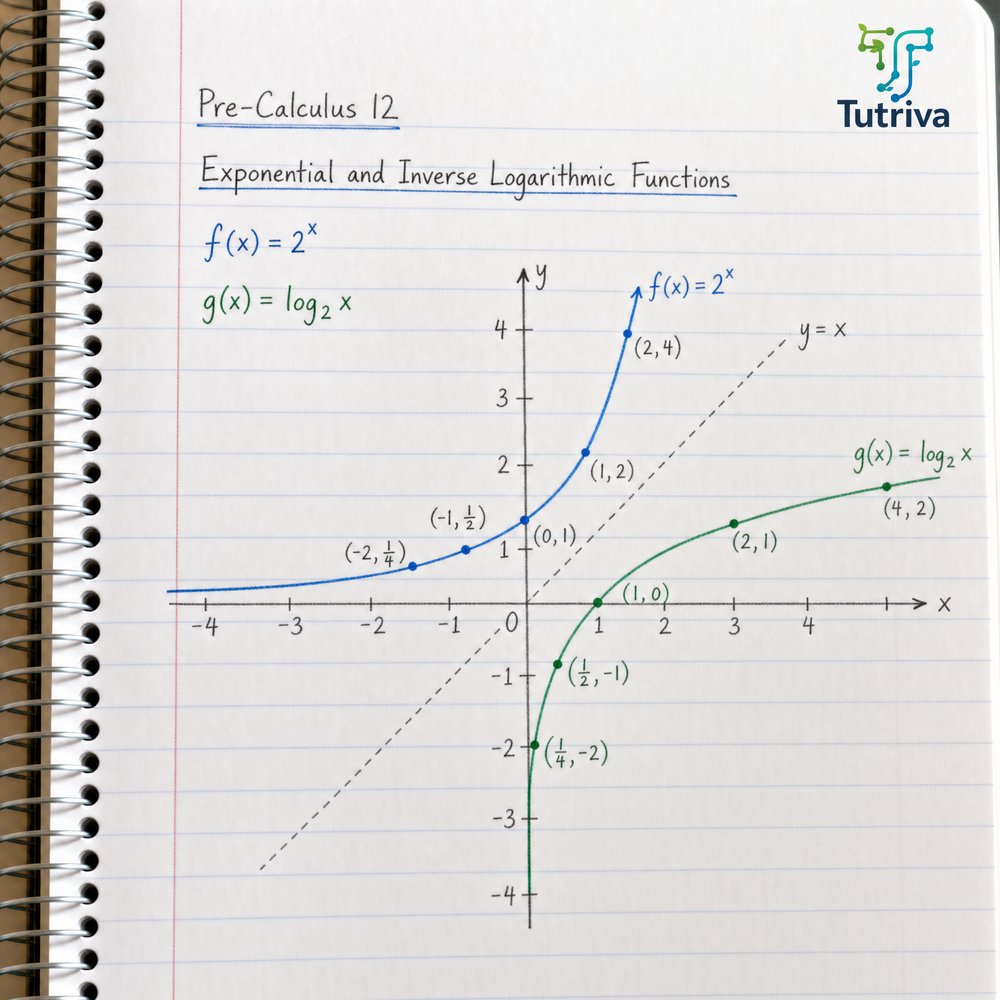
| Inline Image alt | A close-up of a Pre-Calculus 12 notebook showing logarithmic and exponential function graphs |
A BC student who earned a strong B+ in Pre-Calculus 11 walks into Pre-Calculus 12 in September feeling confident. By the second unit, the same student is failing tests and quietly wondering whether they should drop the course. Pre-Calculus 12 is a different course from Pre-Calculus 11, not a harder version of it.
This guide is for parents and students in Vancouver, Burnaby, Richmond, Surrey, Coquitlam, North Vancouver, West Vancouver, and White Rock who are heading into, or already inside, the Pre-Calculus 11 to 12 transition.
Pre-Calculus 11 and Pre-Calculus 12 are different courses
Pre-Calculus 11 leans on extending arithmetic and algebra. The big topics are quadratic functions and equations, radical and rational expressions, systems of equations, arithmetic and geometric sequences and series, financial literacy, and trigonometry of right triangles plus the sine and cosine laws. Most of this is solvable with patient, careful work: factoring, isolating, substituting, applying a known formula.
Pre-Calculus 12 changes the kind of thinking required. It introduces:
- Function transformations and operations on functions. Shifts, stretches, reflections, inverses, and combinations applied to a function in general form.
- Exponential and logarithmic functions. A new family of functions with their own rules and an inverse relationship that is genuinely abstract.
- Polynomial functions and equations. Going beyond quadratics into higher-degree behaviour and graphing.
- Trigonometric functions, identities, and equations. The unit circle, radian measure, trig identities, and solving trig equations algebraically.
- Infinite geometric series, combinatorics, and probability. Often compressed into the last term.
The arithmetic load is similar. The conceptual load is much heavier. A student who solved Pre-Calculus 11 by memorizing procedures will hit a wall in Pre-Calculus 12, because the procedures multiply faster than memory can keep up.
Where students actually stall
Four stall points come up over and over with BC Pre-Calculus 12 students:
1. Function notation. Students who never fully internalized f(x) language in earlier grades suddenly find every unit using it. f(x), f(x − 3), f(2x) + 1, f⁻¹(x). These are stumbling blocks not because the math is hard, but because the notation has to become second nature before the math becomes visible.
2. Logarithms. Logs are the textbook example of “I followed the procedure but I have no idea what I just did.” Students can solve log equations mechanically for weeks before they actually understand what a logarithm is. The students who survive Pre-Calculus 12 well spend the early hours of the log unit on meaning, then on rules.
3. The unit circle and radians. Switching from degrees in Pre-Calculus 11 trigonometry to radians in Pre-Calculus 12 is a small change that confuses many students. The unit circle itself has to be drawn, redrawn, and lived with for two weeks before it clicks.
4. Trig identities. Pre-Calculus 12 trig identities are where the gap between strong and average students opens widest. A student with solid algebra habits from Grade 10 and 11 has the tools to prove an identity. A student who has been getting by on procedures will spend hours stuck on a single proof.
These four points are the early-warning system for the year. A student breezing through them is fine. A student two or three behind by Christmas usually needs help.
When the wall is study habit, and when it is genuinely the math
Some Pre-Calculus 12 stalls are not really about the content. They are about a student carrying a Grade 11 study habit into a much harder Grade 12 course.
Signs the stall is study habit:
- The student says the material is “easy in class” but homework is being rushed or skipped.
- They are not keeping an organized notebook.
- They are not asking questions in class or going in at lunch.
- They expect a single long weekend session to make up for a week of light work.
Signs the stall is genuinely the math:
- The student is putting in real time and has organized notes, and is still confused.
- Specific units (logs, identities, polynomial behaviour) feel completely opaque while others feel fine.
- The student can do the homework but freezes on a new problem on a test.
The first kind responds to a structural change at home. The second kind is where a tutor genuinely makes the difference.
How a Pre-Calculus 12 tutor actually helps
A general “math tutor” is not always the right fit for Pre-Calculus 12. The course rewards a specific style of teaching, and the strongest Pre-Calculus 12 tutors in Greater Vancouver share three traits:
They teach concept before procedure. With logs, transformations, and identities, the procedure is much less stable in a student’s memory than the concept. A tutor who can sketch what a logarithm means before showing how to manipulate one is the right fit.
They drill the right things. Not random worksheet packs. Pre-Calculus 12 has a relatively small number of high-leverage skills (factoring fluency, working with negatives, function notation, basic identity manipulation). A strong tutor builds these aggressively even when the school is moving on.
They prepare for the final exam from October. Pre-Calculus 12 finals are cumulative, long, and dense. A tutor who only works on this week’s unit is missing the point. A strong tutor folds review of earlier units into every session, so the final in June does not require a frantic May.
When to bring in a tutor, and when to hold off
Worth bringing in a tutor when:
- The student’s first two unit tests are noticeably below their Pre-Calculus 11 average.
- The student is heading toward a math-heavy post-secondary path (engineering, computer science, sciences, business analytics, economics).
- The family wants to keep AP Calculus AB or BC open for next year, where Pre-Calculus 12 is the prerequisite.
- The student is asking for a tutor themselves. (This is rarer than you think, and worth taking seriously.)
Hold off when:
- The student is hitting a normal first-month adjustment dip and is already adapting.
- The student wants to drop down to Foundations of Mathematics 12 and the family is genuinely fine with that pathway. Foundations 12 is a complete, valued course that opens many post-secondary paths; not every BC student needs Pre-Calculus 12.
The choice between Pre-Calculus 12 and Foundations 12 is a family conversation as much as a math one. A tutor cannot decide it for you, but a good one can give you an honest read on whether the Pre-Calculus track is the right path.
Tutriva and Pre-Calculus 12 support
Tutriva is a tutor–student platform serving Greater Vancouver: Vancouver, Burnaby, Richmond, Surrey, Coquitlam, North Vancouver, West Vancouver, and White Rock. Tutors set their own rates and keep what they earn; Tutriva does not take a commission on lessons. Parents and students browse tutors by subject and location, message directly, and book a free intro session before committing.
Students or parents can post a short request, for example “Grade 12 student in West Vancouver, did well in Pre-Calc 11, struggling with logarithms and trig identities, heading toward UBC engineering, looking for a weekly tutor”, and get matched with tutors whose background fits. (For students also thinking about extension activities that strengthen the math path, see our parent’s guide to academic competitions in Greater Vancouver.)
Frequently asked questions
Is Pre-Calculus 12 harder than Pre-Calculus 11?
For most students, yes, noticeably. The arithmetic load is similar but the conceptual demand is higher, and the pace is faster. A noticeable grade drop between Pre-Calculus 11 and Pre-Calculus 12 is common even with steady effort.
Should my child take AP Calculus alongside Pre-Calculus 12?
Only with care. Pre-Calculus 12 is the foundation for AP Calculus AB. Taking them in parallel can work for a strong student, but the more common pattern is Pre-Calculus 12 first, then AP Calculus AB or BC the following year (or in summer school for advanced students).
My child is heading to UBC engineering or science. Does the Pre-Calculus 12 grade matter?
Yes, for admission, and even more for first-year readiness. UBC, SFU, and UVic first-year calculus streams assume Pre-Calculus 12 mastery. A weak Pre-Calculus 12 grade can sometimes still lead to admission, but the gap usually surfaces painfully in first year.
Is online tutoring effective for Pre-Calculus 12?
Yes. The course’s reliance on graphs and formulas suits a shared screen and document well. Many strong Pre-Calculus 12 tutors in Greater Vancouver work fully online.
The honest takeaway
Pre-Calculus 12 is one of the genuine difficulty steps in the BC senior math sequence. The students who do well in it are usually the ones who adapt fastest to the higher conceptual load — and a tutor who teaches concept before procedure can shorten that adaptation noticeably.
Looking for a Pre-Calculus 11 or 12 tutor in Greater Vancouver? Browse math tutors by city on Tutriva, or post a one-minute request describing where your student is stuck.