
DELF B1 to B2: A Guide for BC French Immersion Families
| Title | DELF B1 to B2: A Guide for BC French Immersion Families |
| Meta description | A 2026 Greater Vancouver guide for BC French Immersion families on the DELF B1 to B2 jump: what each level means and when a tutor really helps. |
| Primary category | French & Immersion (id 21) |
| Tags | for-parents, for-students, french-tutor, delf, french-immersion, bc-curriculum, vancouver, burnaby, richmond, ages-13-17 |
| Featured Image alt | A Grade 11 French Immersion student in Vancouver studying for the DELF exam with a French novel and notebook |
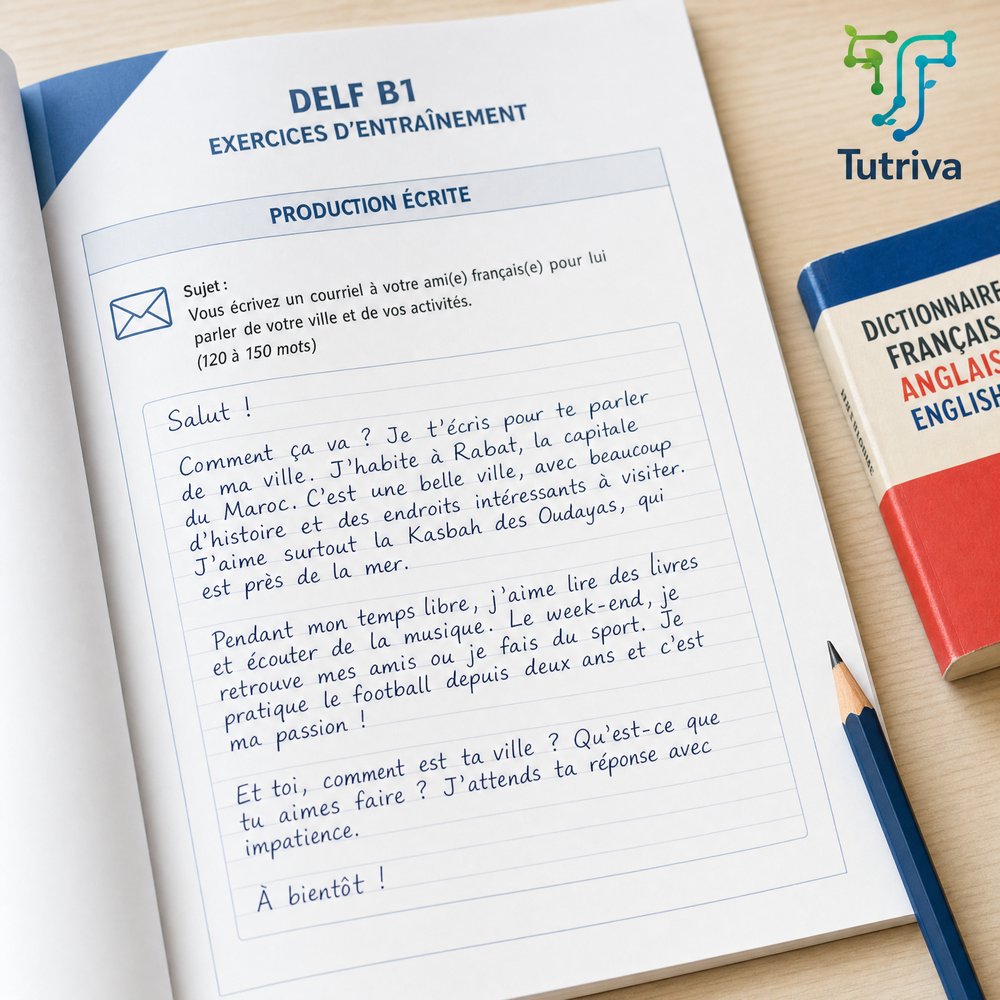
| Inline Image alt | A close-up of a student’s DELF practice booklet with a written production exercise filled in |
Every spring in Greater Vancouver, a quiet conversation runs through French Immersion families: how should we prepare for DELF, and is B2 really reachable by Grade 12? The DELF exam is one of the most useful credentials a BC French Immersion student can leave high school with, and the B1-to-B2 transition is where most of the work happens.
This guide is for parents and students in Vancouver, Burnaby, Richmond, Surrey, Coquitlam, North Vancouver, West Vancouver, and White Rock who are in BC French Immersion or Programme Cadre programs and want a clear picture of what DELF B1 and B2 actually involve, where students stall, and when a tutor helps.
What DELF actually is
The DELF (Diplôme d’études en langue française) is an official French-language proficiency diploma issued by France Éducation international, a public agency working with the French Ministry of Education. The diploma is recognized worldwide, never expires, and is a meaningful credential for university applications, work, and immigration purposes.
DELF is built on the Common European Framework of Reference for Languages (CEFR), with six levels: A1, A2, B1, B2, C1, C2. DELF covers A1 through B2; the higher-level DALF covers C1 and C2. A junior and a scolaire (“school”) version of DELF are also offered for school-aged students; they are equivalent diplomas with slightly more age-appropriate content.
In Greater Vancouver, DELF exams are administered through approved centres including Alliance Française Vancouver, plus various school-district arrangements for French Immersion students.
What B1 and B2 actually mean
The CEFR descriptions matter more than they sound on first reading:
- B1 (Independent User, threshold). A student at B1 can handle most situations likely to arise while travelling in a French-speaking area. They can produce simple connected text on familiar topics, describe experiences, give brief reasons and explanations, and understand the main points of clear standard speech.
- B2 (Independent User, upper intermediate). A student at B2 can understand the main ideas of complex text on both concrete and abstract topics, interact with native speakers fluently and spontaneously, write clear detailed text on a wide range of subjects, and explain a viewpoint giving advantages and disadvantages.
In practice, a strong BC French Immersion student is often around B1 by the end of Grade 9 or 10, and B2 is a realistic target by Grade 11 or 12 with consistent classroom work and focused exam preparation. Programme Cadre (francophone-stream) students, who have French as their primary language of instruction, often sit DELF earlier and at higher levels.
What the test looks like
Every DELF level has four sections, each scored out of 25 marks for a total of 100. A passing score is 50 out of 100, with a minimum of 5 out of 25 in each section.
The four sections:
- Compréhension de l’oral (Listening). Audio recordings followed by comprehension questions.
- Compréhension des écrits (Reading). Authentic French texts (articles, advertisements, interviews) followed by questions.
- Production écrite (Writing). A structured writing task. At B1, a personal expression of opinion or experience around 180 words (a letter, article, or forum post). At B2, a structured argumentative essay or formal letter around 250 words.
- Production orale (Speaking). At B1, an interview and a structured short discussion. At B2, the candidate chooses one of two short texts, has roughly 30 minutes to prepare, then presents a position based on the text and defends it in debate with the examiner.
The exam is offered in two formats: a paper-based traditional version and a progressively rolled-out computer-based version (DELF Numérique) in some certified centres internationally. Confirm the format directly with your test centre.
Why the B1 to B2 jump is hard
Three patterns show up over and over with Greater Vancouver French Immersion students preparing for DELF B2:
Pattern 1. Comfortable in class, lost in authentic media. A student who can write a confident essay in class can freeze when asked to discuss a radio interview about French politics or climate policy. B2 expects engagement with topics beyond school-controlled vocabulary. A Surrey or North Vancouver Grade 11 student who has done well in Immersion classes for years but rarely listens to French podcasts is a common version of this.
Pattern 2. Strong oral, weaker written argument. Many BC French Immersion students arrive at B2 prep with strong oral fluency and significant gaps in written argument structure. B2 production écrite is graded heavily on argument organization and connector use, not only on grammar.
Pattern 3. The “passive grammar” gap. Students recognize the subjunctive, the conditional, and complex tense structures when they read them, but do not deploy them confidently in their own writing. B2 expects active use of these structures, not only recognition.
These patterns are addressable, but the work is different from regular French class. DELF preparation has its own rhythm and its own vocabulary.
Where DELF fits in a BC student’s future
DELF B2 is meaningful for several BC student paths:
- Bilingual program admissions. Universities such as Simon Fraser University (with its French Cohort Program), the Université Sainte-Anne, the Université de Saint-Boniface, and the Université de Moncton offer French-language or bilingual programs where DELF B2 (or higher) can support application strength. UBC and McGill both accept French-language coursework in several programs and have departments where documented proficiency is valued.
- Federal government employment. A federal civil-service career often requires demonstrated French proficiency. DELF B2 (or its equivalent on the Public Service Commission second-language evaluation) is a useful starting point.
- Immigration and work in francophone regions. Provinces such as Quebec, New Brunswick, and Ontario reward demonstrated French proficiency in various skilled-immigration and employment pathways.
- International study and travel. A DELF diploma is recognized by universities and employers across the European Union, parts of Africa, and other Francophonie countries.
For students continuing in French at university or beyond, DELF B2 is the clearest external signal that the French Immersion years actually paid off.
When a tutor really helps
A tutor is worth bringing in when:
- The student is targeting DELF B2 in Grade 11 or 12 and has not yet practised the exam format under timed conditions.
- The student is strong in oral French but consistently underperforms on production écrite practice tasks.
- The student is moving from B1 to B2 and the gap with authentic media (news, podcasts, current French YouTube content) is widening rather than narrowing.
- The family wants a Francophone or near-native French tutor to bring authentic spoken French into the preparation, not classroom French.
A tutor is usually not worth it when:
- The student is already scoring solidly above 60 out of 100 on full DELF B2 practice tests and has time to keep practising independently.
- The real issue is unfamiliarity with the test format. One or two diagnostic sessions plus self-directed practice may be enough.
- The student is in a stressful Grade 12 application year and adding another weekly commitment will erode the rest of the schedule.
How to find a DELF tutor in Greater Vancouver
Ask about the level. A tutor strong at B1 is not automatically strong at B2. Ask whether they have specifically prepared students for DELF B2 and what their typical preparation arc looks like.
Ask about the four sections. “Which of the four DELF sections do your students typically need the most help on, and how do you structure that work?” A good tutor will answer with detail.
Ask about authentic materials. A tutor who builds preparation around real French podcasts, radio segments, and news articles tends to produce stronger B2 outcomes than one who relies only on textbooks.
Online works well for DELF preparation. The exam includes audio comprehension, which is well suited to shared digital materials. A Coquitlam or White Rock family balancing French Immersion homework, sports, and other activities often finds online sessions easier to keep consistent across a school year.
Tutriva and DELF support
Tutriva is a tutor–student platform serving Greater Vancouver: Vancouver, Burnaby, Richmond, Surrey, Coquitlam, North Vancouver, West Vancouver, and White Rock. Tutors set their own rates and keep what they earn; Tutriva does not take a commission on lessons. Students and parents browse tutors by subject and location, message directly, and book a free intro session before committing.
Many Tutriva tutors are Francophone or near-native French speakers, which matters at the B2 level where authentic spoken French becomes central. Families preparing for DELF can post a short request, for example “Grade 11 French Immersion student in West Vancouver, comfortable B1, targeting DELF B2 next May, looking for a weekly Francophone tutor with emphasis on production écrite and listening”, and get matched with tutors whose background fits. (For families also looking at reading habits that support DELF reading comprehension, see our BC parent guide to reading comprehension for Grades 4–9; for newcomer families still building academic English alongside French, our ESL tutor roadmap covers a parallel pathway.)
Frequently asked questions
At what grade should a BC French Immersion student sit DELF B2?
Strong students often sit DELF B1 in Grade 9 or 10 and DELF B2 in Grade 11 or 12. Programme Cadre students may sit higher levels earlier. Talk to the school’s French coordinator about timing options through the school or through Alliance Française Vancouver.
Does the DELF diploma expire?
No. Once earned, the diploma is valid for life. It does not need to be renewed.
Is DELF the same as a French Immersion certificate?
No. The BC Dogwood Diploma with French Immersion designation is a provincial recognition. DELF is an internationally recognized credential issued by France Éducation international. The two complement each other.
Is online DELF tutoring effective?
Yes. Listening practice, written feedback, and structured oral practice all translate well to online sessions, particularly with a Francophone tutor who may live outside Greater Vancouver.
Can a student who is not in French Immersion still sit DELF?
Yes. DELF is open to any student who registers. Non-Immersion students often sit lower levels (A1, A2, or B1) depending on background. B2 is harder to reach without French Immersion or significant home exposure.
The takeaway
DELF B2 is the moment when years of French Immersion classes turn into a credential the rest of the world recognizes. The B1-to-B2 gap is real and demands a different kind of preparation than regular French class. Students who start the work a year in advance, treat authentic French media as part of weekly practice, and bring in targeted help on their weakest of the four sections tend to feel ready to sit DELF B2 by the end of Grade 12 with a clear language credential ahead of them for university, work, or travel.
Looking for a DELF B1 or B2 tutor in Greater Vancouver? Browse French tutors by city on Tutriva, or post a one-minute request describing your student’s current level and your target exam date.